Review
 Private Internet Access Review

Score Breakdown:
Price from: $1.89/mo
Available on:


9.3
total score
Things To Like
Things Not To Like
PIA Plans (November 2026)
3 Years + 4 Months
$1.89 per month
- Unlimited devices, all features
- $75.60 for 40 months
- Renews at $75.60 every 3 years
1 Year
$3.99 per month
- Unlimited devices, all features
- $47.88 for the first year
- Renews at $47.88 a year
1 Month
$11.95 per month
- Unlimited devices, all features
- $11.95 for the first month
- Renews at $11.95 a month
PIA is cheap and was fast over WireGuard at every location I tested, but Netflix played in only two of the six countries I tried.
Private Internet Access (PIA) launched in 2010 under Andrew Lee’s company London Trust Media. Since 2019, it has belonged to Kape Technologies, which also owns ExpressVPN and CyberGhost, and it is run by PIA Private Internet Access, Inc. in Denver, Colorado, USA. One subscription covers as many devices as you own.
Updated 24 November 2026: my own speed, protocol, leak, Netflix and support tests with the Mac app, new screenshots, Black Friday prices, current server numbers, and new scores with the reasons for each.
Summary
In my tests from Romania, PIA kept 70–87% of my download speed over WireGuard, its default protocol, from Frankfurt all the way to Sydney. Uploads held up better than with most VPNs I’ve tested, about two thirds of my line in Europe and New York. One protocol let me down. OpenVPN over TCP, the fallback for networks that block everything else, crawled along at 9% of my line and dropped the connection.
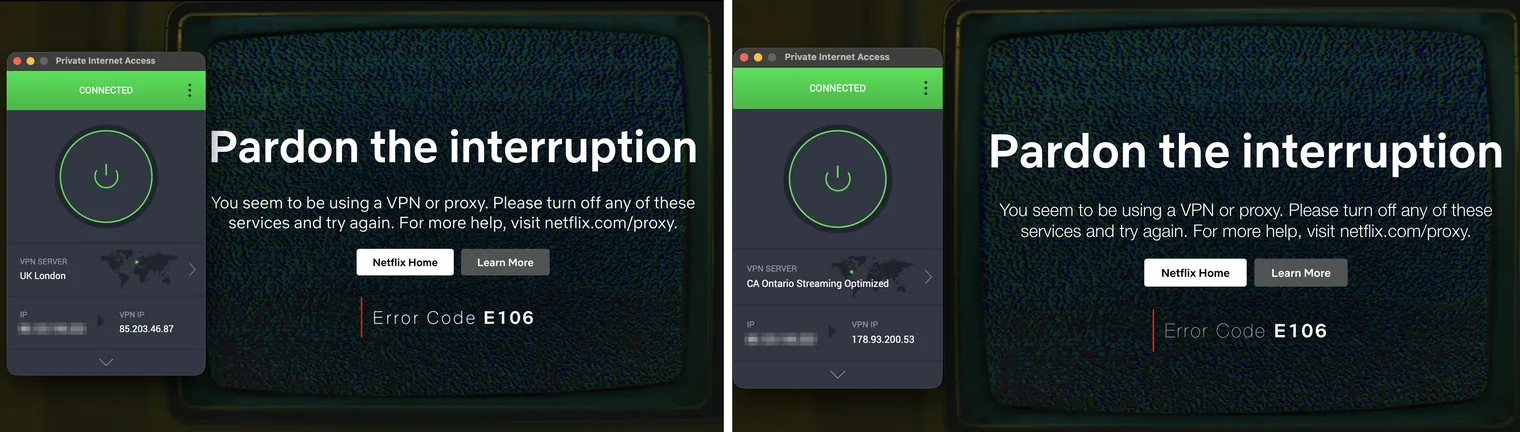
Netflix played on the first try in Germany and the US. In Canada, Australia, the UK and Japan, it showed its proxy error, and so did PIA’s streaming-optimized location for Canada.
PIA’s technical privacy record is hard to fault. Its no-logs policy has held up in two US court cases and three Deloitte audits, the servers run from RAM only, the apps are open source, and my leak test was clean. What costs it points is its owner, Kape, as with ExpressVPN. The Privacy section explains why.
The Black Friday plan costs $1.89 a month, or $75.60 for 3 years and 4 months, and it renews at $75.60 every 3 years. That’s the lowest long-term price among the VPNs I’ve re-tested. The monthly plan costs $11.95. Purchases on PIA’s website come with a 30-day money-back guarantee for new subscribers.
The Mac app looks dated, but it has more settings than most: split tunneling, port forwarding, multi-hop, automation rules and obfuscation for WireGuard. PIA also has a 24/7 live chat with real people, though you’d never guess it from the app.
If streaming is your main use, see our guide to the best VPNs for Netflix.
What’s new at PIA since our first review in 2022:
- Unlimited simultaneous devices (since March 2023; it was 10).
- Servers in 110 countries by PIA’s own server list (113 on its website), including all 50 US states (was 84 countries); 35 streaming-optimized locations.
- No-logs policy audited by Deloitte in 2022, 2024 and 2025; quarterly transparency reports.
- Version 3.8.0 (October 2026): WireGuard is now the default protocol, Windows got faster drivers, and macOS and Linux got obfuscation for WireGuard.
- New apps for Apple TV and on F-Droid.
- The 1-year plan costs more ($47.88 instead of $39.95), and the free Boxcryptor licence is no longer offered.
Key facts:
- Servers in 110 countries (212 locations), all 50 US states
- Unlimited simultaneous devices
- No-logs policy audited by Deloitte (2022, 2024, 2025) and tested in court
- RAM-only servers
- WireGuard (default) and OpenVPN; 100% open-source apps
- MACE ad and tracker blocker, kill switch, split tunneling
- Port forwarding, multi-hop and obfuscation
- 24/7 live chat with human agents (on PIA’s website)
- Dedicated IP and Antivirus as paid add-ons
- 30-day money-back guarantee for new subscribers
 Speed
9.5
I tested PIA’s Mac app on the morning of 24 November 2026, with the same setup I used for ExpressVPN, NordVPN, Surfshark and Mullvad: a 2021 MacBook Pro (M1 Max) on 5 GHz Wi-Fi, and a home line sold as 850 Mbps down and 500 Mbps up. Each result is the median of three Speedtest.net runs. My speed without the VPN is the median of six runs, three before the VPN tests and three after them.
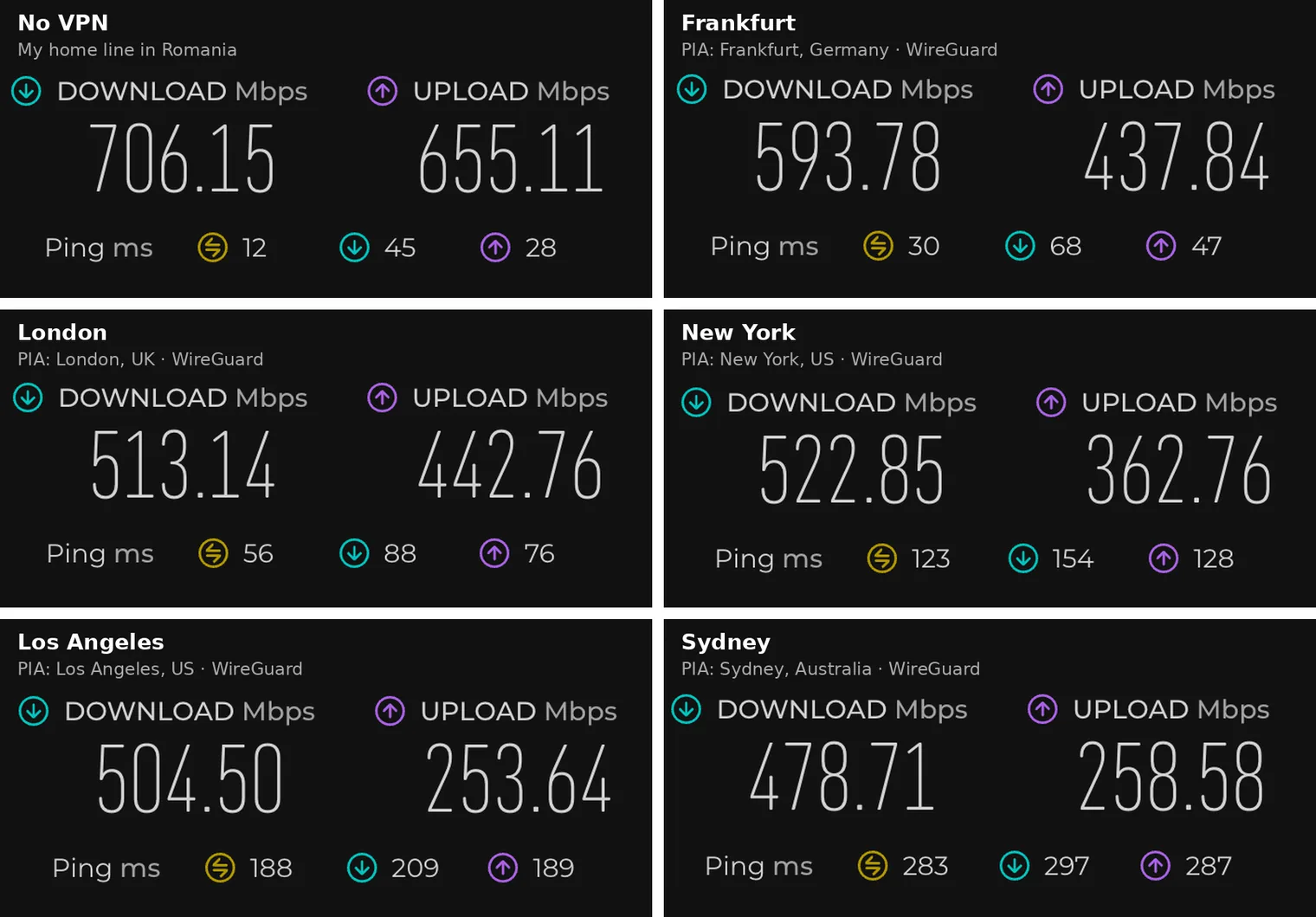
Frankfurt, the closest location, kept 87% of my download speed. The other four landed between 479 and 523 Mbps, about 70–77% of my line, and London was no faster than New York. One London run dipped to 284 Mbps, while the other two passed 510. For Sydney, Speedtest picked a test server in Melbourne, and the ping was 284 ms.
Uploads are where PIA stood out. It kept about two thirds of my upload speed in Frankfurt, London and New York. With ExpressVPN, NordVPN and Surfshark, uploads fell to about half of my line in Europe and lower in the US. To Los Angeles and Sydney, PIA dropped to 37–39%, which is still above the lowest I saw with those three (26–34%).
I tested the VPNs at different times of day, so I compare the share of my line each one kept rather than raw numbers. On nearby servers, ExpressVPN and NordVPN kept more of my download speed (93–105%), and Surfshark kept 87–90% everywhere. In Sydney, PIA’s 70% was close to ExpressVPN’s and NordVPN’s 73%, and its ping of 284 ms sat between theirs (273 and 291 ms). Browsing or streaming, you wouldn’t notice the difference.
Protocols
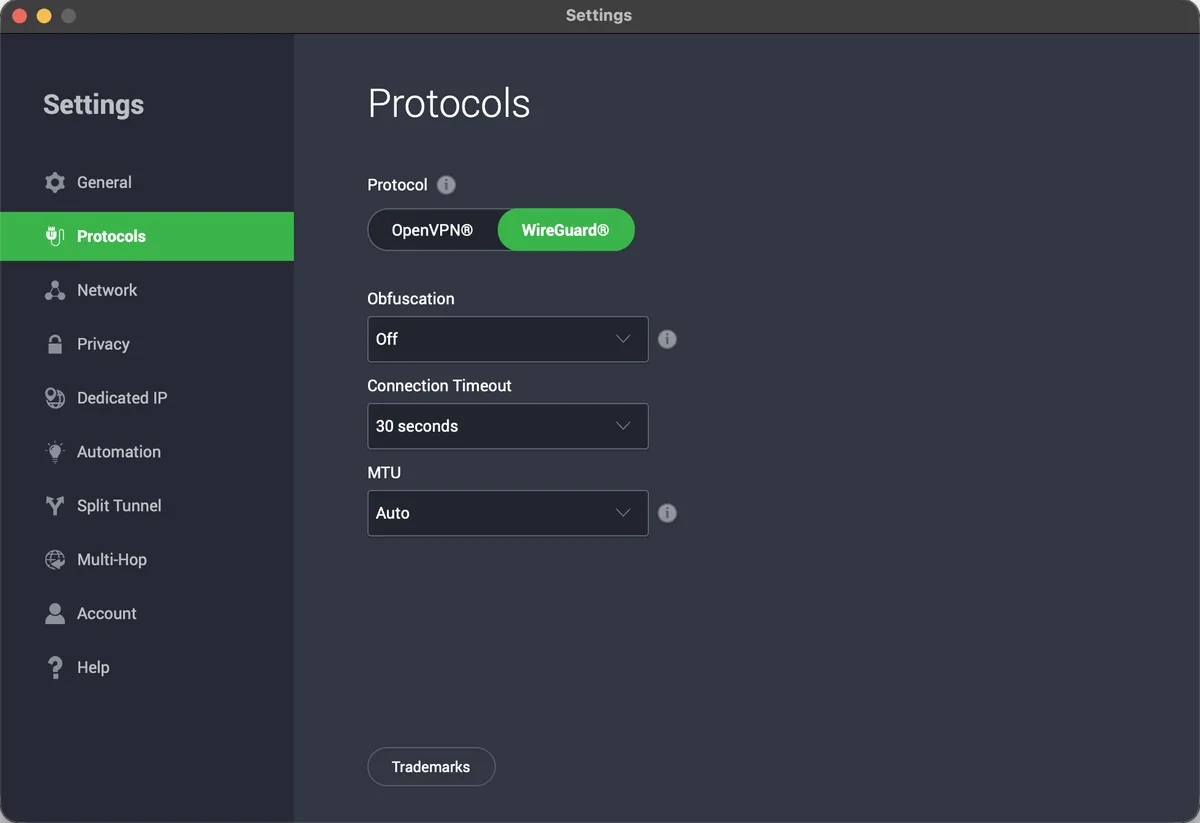
WireGuard has been the default protocol in PIA’s apps since version 3.8.0 (October 2026), and every location test above used it. To compare, I ran the same test in Frankfurt with OpenVPN over UDP and over TCP, and with WireGuard’s new obfuscation switched on.
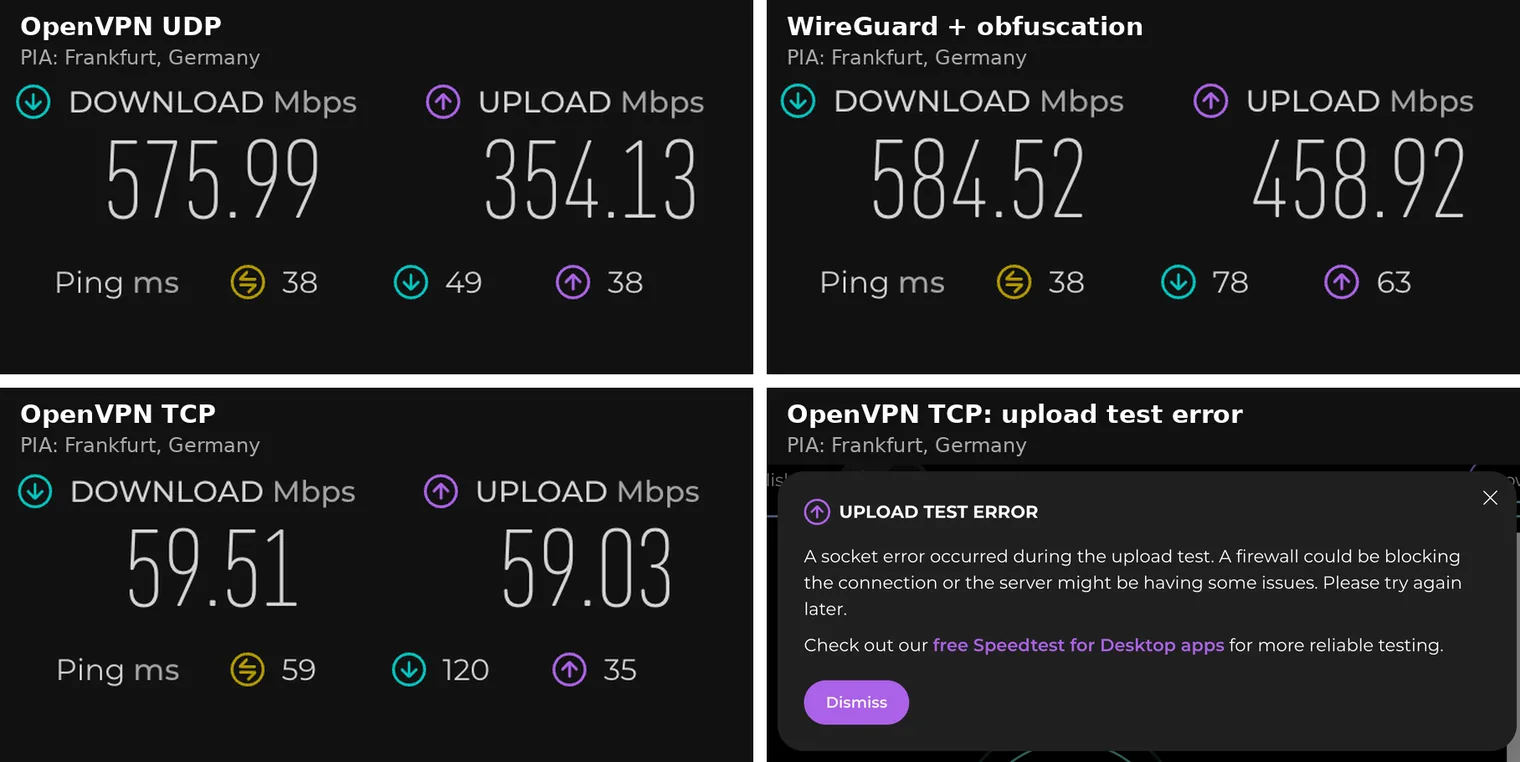
OpenVPN over UDP came close to WireGuard on downloads but gave up about a fifth of the upload speed. Obfuscation cost almost nothing: 86% of my download speed against 87% without it. If your network blocks VPNs, that’s the setting to try first. On a Mac, it’s under Settings, then Protocols, once WireGuard is selected.
OpenVPN over TCP was another story. It managed about 60 Mbps in both directions, 9% of my line, and one upload test failed with a socket error. Between two runs, the VPN address changed, which means the connection had dropped and come back. I left it connected for a while afterwards and saw more short drops. TCP is the protocol you fall back on when a hotel or office network blocks everything else, so it’s a bad place to fail.
Tips for better speeds
- Keep WireGuard unless your network blocks it. If it does, try WireGuard with obfuscation (macOS and Linux) before OpenVPN; in my test, it cost almost no speed.
- Connect to a nearby location. Distance to the server has the biggest effect on speed.
- With OpenVPN, use UDP if you can. You can also choose the port (UDP 8080, 853, 123 or 53; TCP 80, 443, 853 or 8443) and the encryption (AES-128-GCM or AES-256-GCM); 128-bit is usually a little faster.
- The MTU setting (large or small packets) can help on unreliable connections.
Why 9.5 out of 10
Over WireGuard, downloads kept 70–87% of my line at every location, no server was weak, and uploads held up better than with ExpressVPN, NordVPN or Surfshark. Half a point goes for OpenVPN over TCP, which crawled along at 9% of my line and dropped the connection. ExpressVPN’s TCP protocol failing my test counted against it too.
 Locations
9.0
On 24 November 2026, PIA’s public server list showed 212 locations in 110 countries and territories, including servers in all 50 US states. PIA’s website says 180 locations in 113 countries; it counts differently, so I went by the server list. When we first reviewed PIA in 2022, it had servers in 84 countries.
57 of the 110 countries have only virtual locations: the server stands in another country, but you get an IP address of the country you chose. PIA marks them in its apps, and in the Mac app, you can hide them with a setting under General (Show Geo-Located Regions, on by default). Virtual locations are common among big VPN providers, but they matter if you need a server that is physically in a certain country, and the extra distance shows up in your speed.
All servers run from RAM only, so nothing is stored on hard drives, and they are connected at 10 Gbps. Many are colocated: PIA owns the hardware in third-party data centers.
Streaming: Netflix
On the morning of 24 November 2026, I tried Netflix with PIA’s default settings on ordinary servers in Germany (Frankfurt), the US (New York), Canada (Ontario), Australia (Sydney), the UK (London) and Japan (Tokyo). It played on the first try in Germany and the US. In the other four countries, Netflix showed its proxy error (E106) straight away.
PIA has 35 streaming-optimized locations, which it says it monitors and tests against streaming services. So I tried the Canadian one too, CA Ontario Streaming Optimized. Same error.
Netflix blocks screenshots of what it plays, so my proof for Germany and the US is phone photos of my laptop screen. The error pages are screenshots.
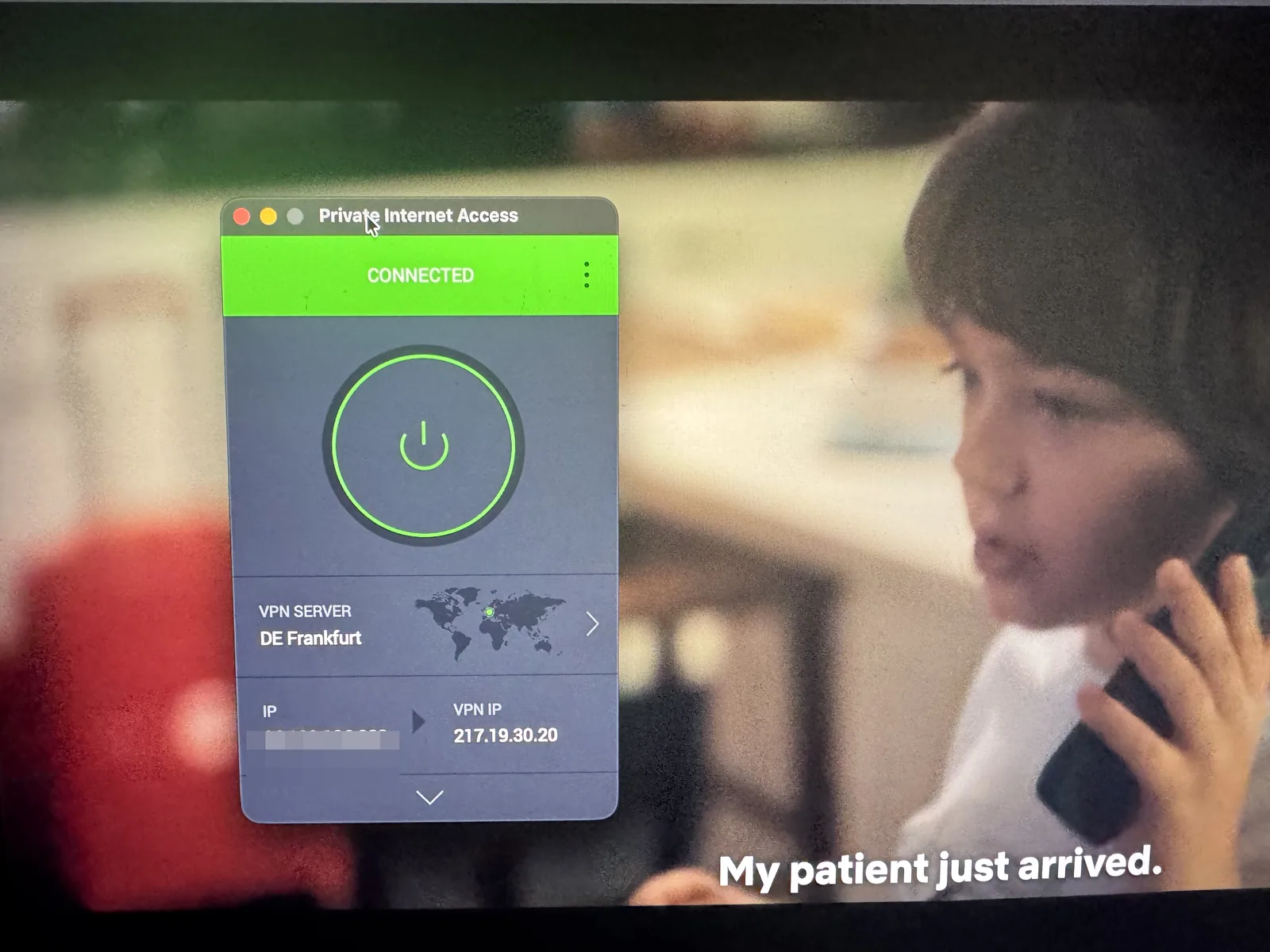
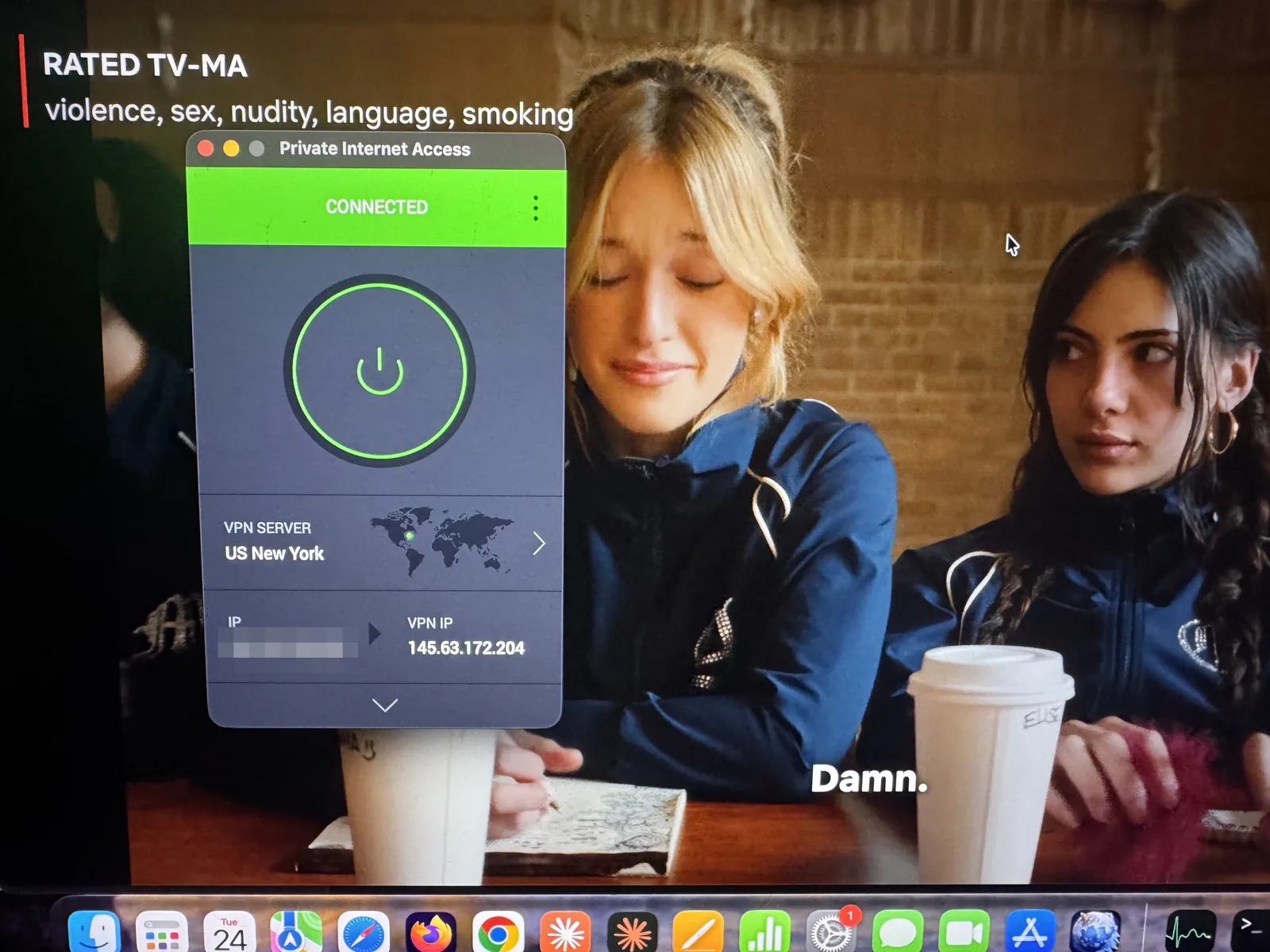
One morning of tests is a snapshot, and streaming services change their VPN blocking without warning. Still, I wouldn’t buy PIA for streaming. ExpressVPN, NordVPN and Surfshark played Netflix in every country I tried, on the first try, and ExpressVPN belongs to the same owner as PIA.
Torrenting and port forwarding
PIA allows P2P traffic on every server. Port forwarding, which helps with torrent seeding, game servers and remote access to devices at home, works at 156 of the 212 locations, all of them outside the US; US servers don’t support it. You switch it on in the app before connecting.
Dedicated IP
For an extra fee, PIA gives you an IP address that only you use. That helps with online banking, remote work and services that block shared VPN addresses, at the cost of the anonymity a shared address offers. PIA’s checkout lists 26 dedicated IP locations, in countries such as the US, the UK, Canada, Germany, Japan and Australia.
The address is activated with an anonymous token, so PIA says it cannot tell which dedicated IP belongs to which account. The location can’t be changed after you redeem the token. Prices are in the Pricing section.
Censorship
PIA left Russia in July 2016, after Russian authorities seized some of its servers and new laws required providers to keep user data. It still has no servers there. Locations such as India, China, Turkey and Hong Kong are virtual. On networks that block VPNs, try WireGuard with obfuscation first, then multi-hop (both in the Privacy section), but how well they work in heavily censored countries varies.
Why 9 out of 10
Servers in 110 countries by PIA’s own list, all 50 US states among them, with the virtual locations marked. Half a point goes because NordVPN and Proton VPN cover about 150 countries. The other half goes for streaming: Netflix played in only two of the six countries I tried, and PIA’s streaming-optimized location for Canada didn’t help. Without streaming, the score would be 9.5.
 Privacy
8.5
No-logs policy
PIA’s privacy policy (last revised 3 November 2025) states: “We DO NOT collect or store browsing history, connected content, user IPs, connection time stamps, bandwidth logs, DNS queries, or anything like that. We collect and retain zero user logs.”
To run the service, PIA keeps your email address and payment details and, if you live in the US, your state and ZIP code for tax purposes. The apps also send anonymized usage data, which you can switch off in the settings.
PIA’s claim has been tested in practice. In two US criminal cases, in 2016 and 2018, PIA was asked for user data and had no logs to hand over. Since then, Deloitte Audit Romania has examined PIA’s no-logs setup three times, in 2022, 2024 and 2025. The latest assessment (ISAE 3000 Revised, published in December 2025) covered PIA’s VPN server configurations, management systems, incident response and its token-based dedicated IP system.
PIA also publishes quarterly transparency reports. In July to September 2026, it received 9 legal requests and produced no logs. In the same quarter, its bug bounty program, which pays security researchers for reporting flaws, received 5 valid reports.
All servers run from RAM only (the support agent confirmed it in my chat test), and PIA’s apps are 100% open source, so anyone can inspect the code.
My leak test
Connected to Frankfurt over WireGuard on 24 November 2026, I ran ipleak.net and the extended test on dnsleaktest.com. Both showed only PIA’s addresses in Frankfurt: the IPv4 address, the WebRTC address and all 10 DNS servers that answered ipleak.net’s 121 queries. The IPv6 test couldn’t reach anything, so no IPv6 address leaked either. My real IP address and my internet provider didn’t show up anywhere.
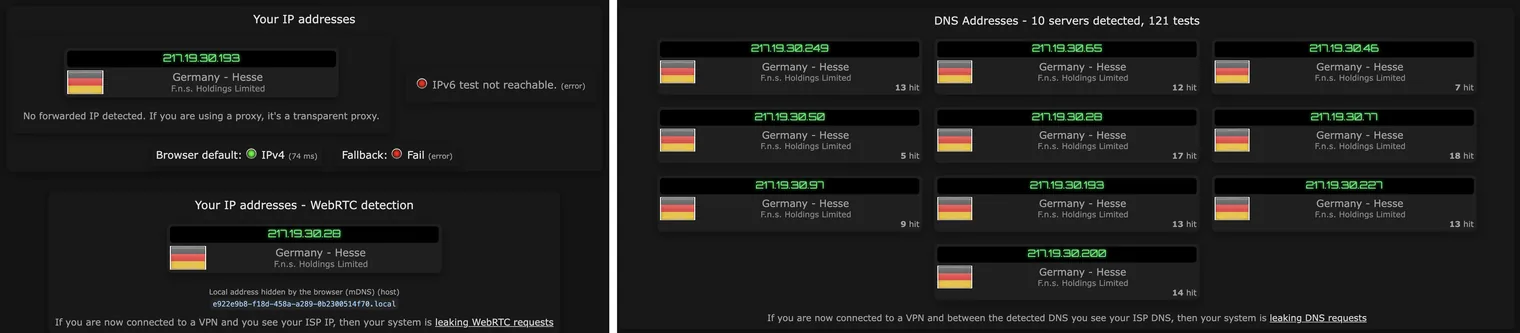
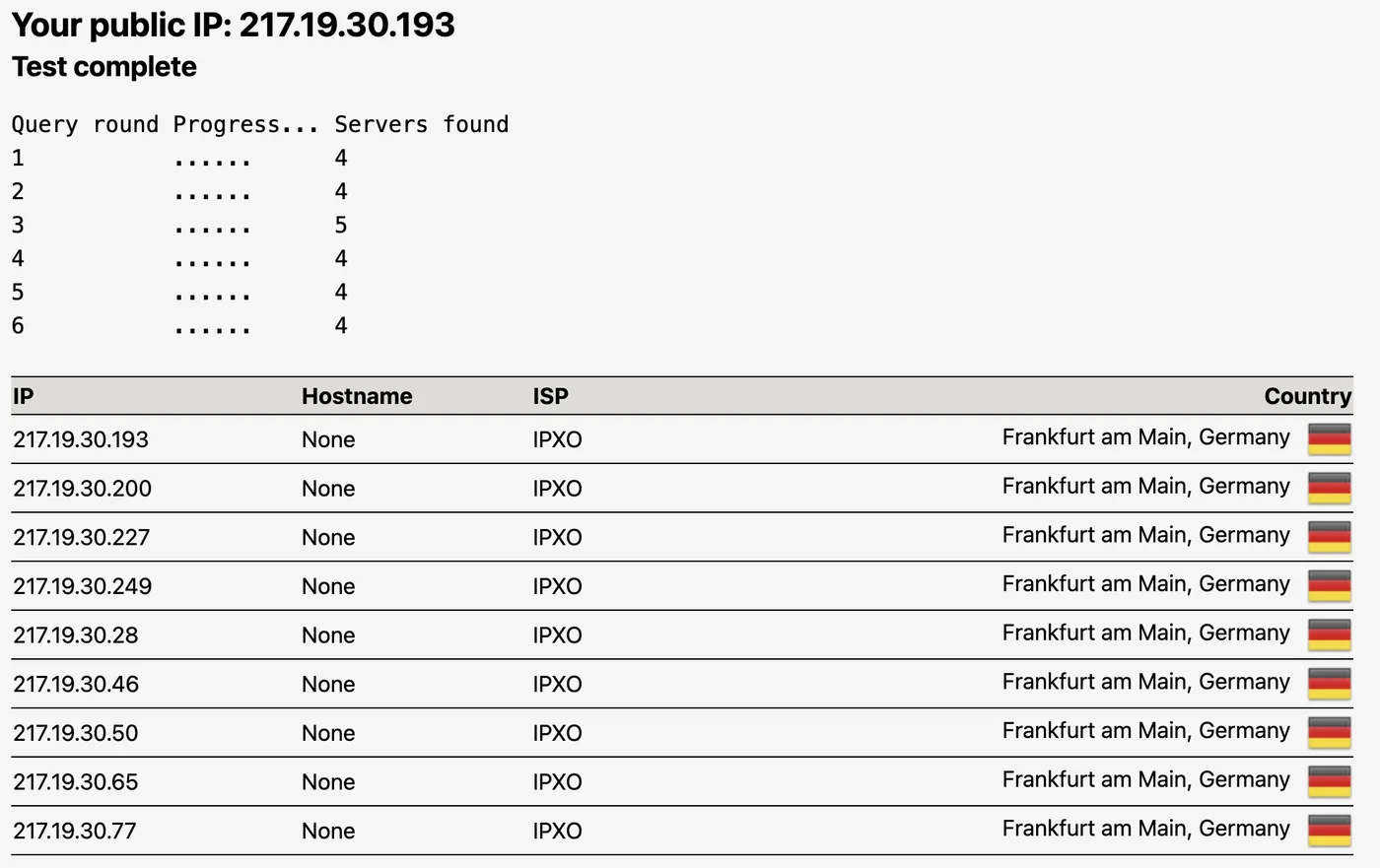
You can run the same check yourself: note your IP address on one of these sites without the VPN, then connect and run the test again. If you still see your own IP address or your provider’s DNS servers, contact PIA support.
Jurisdiction and ownership
PIA is based in the US, a member of the Five Eyes intelligence alliance, where authorities can demand data and issue gag orders. The US has no data retention law for VPN providers, though, and the two court cases show PIA had nothing to hand over. I don’t take points off for the country, just as I didn’t for Mullvad‘s Sweden.
Since November 2019, PIA has belonged to Kape Technologies, which also owns ExpressVPN and CyberGhost. Kape was previously called Crossrider, a company whose software platform was widely used by adware developers. Kape has been privately held since 2023 and is controlled by the Israeli businessman Teddy Sagi. PIA’s privacy policy says that neither PIA nor anyone at Kape logs or stores users’ browsing or connection data.
In September 2021, the same month Kape bought ExpressVPN, the U.S. Department of Justice announced that Daniel Gericke, ExpressVPN’s chief information officer, had signed a deferred prosecution agreement over his earlier work in “Project Raven”, a hacking operation for the United Arab Emirates. ExpressVPN kept him, and he left in July 2023, during layoffs at Kape. Gericke never worked for PIA. But the company that kept him in his job is the company that owns PIA and decides who runs it.
Protocols and encryption
PIA offers WireGuard (the default since October 2026, with ChaCha20 encryption) and OpenVPN (AES-128-GCM or AES-256-GCM, over UDP or TCP). On macOS and Linux, version 3.8.0 added obfuscation for WireGuard, based on AmneziaWG, which makes VPN traffic harder to detect and block. My speed results for each protocol are in the Speed section.
PIA doesn’t offer post-quantum encryption yet. It protects today’s traffic from being decrypted by quantum computers in the future, and ExpressVPN, NordVPN, Surfshark and Mullvad all have it. For now, I don’t take points off for it, but it’s the one gap in PIA’s technical setup.
Security and privacy features
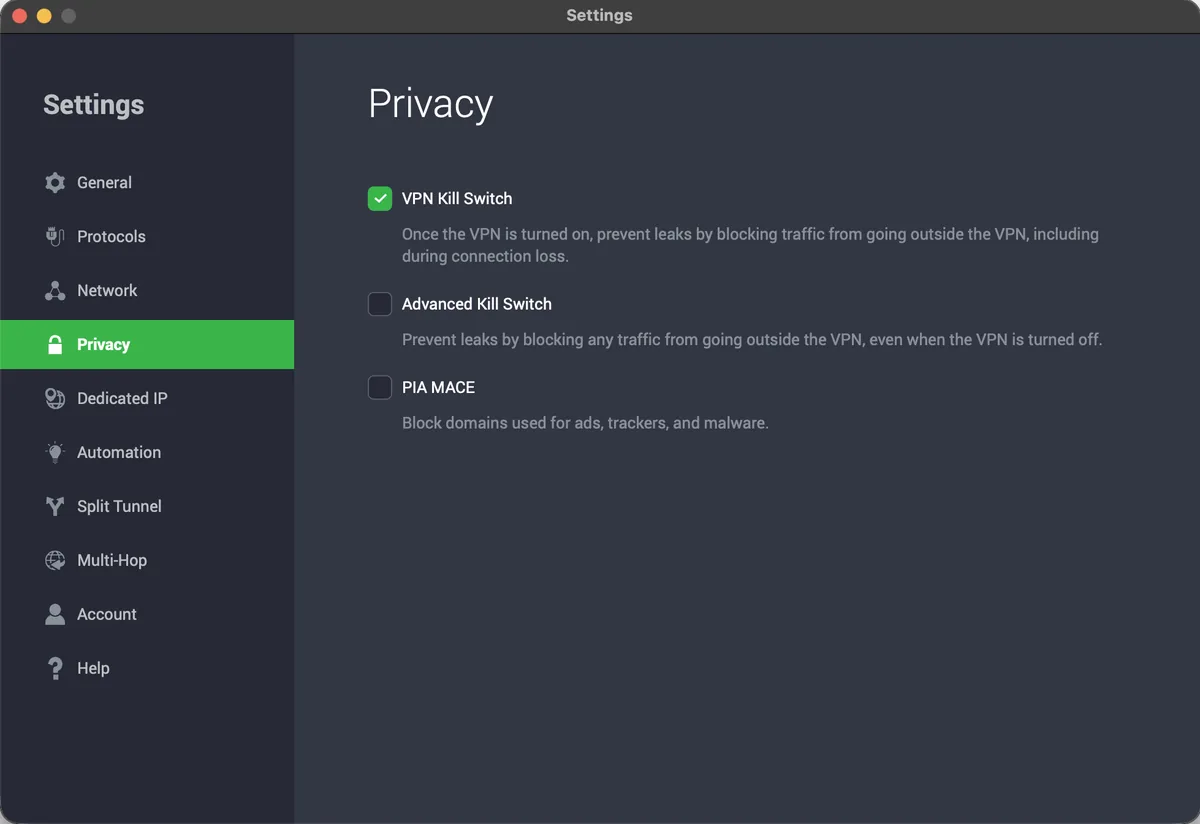
- Kill switch: blocks internet traffic if the VPN connection drops; it was on by default in my Mac app. The Advanced Kill Switch (off by default) blocks all traffic whenever the VPN isn’t connected, even if you disconnect it yourself. (Read more about what a VPN kill switch does.)
- Leak protection: by default, DNS requests go through the VPN tunnel to PIA’s own DNS servers. You can also choose Handshake DNS, your existing DNS or a custom server.
- MACE: blocks known ad, tracker and malware domains at DNS level in the desktop apps and on Android. It is off by default; on a Mac, it’s one checkbox under Settings, then Privacy. On iOS, PIA offers a Safari content blocker instead.
- Multi-hop: routes your traffic through a Shadowsocks or SOCKS5 proxy before the VPN server, so the network you’re on doesn’t see a VPN connection (desktop apps). It slows the connection down.
- Obfuscation: for WireGuard on macOS and Linux (see above).
- Automation: rules that connect or disconnect the VPN automatically on certain networks, for example unknown Wi-Fi.
- Antivirus (paid add-on, Windows only): scans files and websites and quarantines threats.
Why 8.5 out of 10
On the technology alone, PIA would get full marks: a no-logs policy that held up in two US court cases and three Deloitte audits, RAM-only servers, open-source apps and a clean leak test on my Mac. The 1.5 points I take off are for trust, as with ExpressVPN. PIA belongs to a company that began as Crossrider, and that company kept ExpressVPN’s Gericke in his job after the Project Raven news. He never worked at PIA, but the owner is the same, so the deduction is the same. The missing post-quantum encryption costs nothing for now.
 Ease of Use
9.5
PIA has apps for Windows 10 and 11, macOS (10.15 or later), Linux (a full graphical app for Ubuntu, Mint, Debian, Fedora and Arch), Android 7.0 or later (including Android TV, plus a version on F-Droid for devices without Google services), iOS and iPadOS 15 or later, Apple TV and Amazon Fire TV (Fire OS 6 or later, from the Amazon Appstore). Browser extensions for Chrome and Firefox protect only browser traffic. There is no router app: PIA supports routers only with a manual OpenVPN setup, not WireGuard. One subscription covers an unlimited number of devices at the same time.
The Mac app
The Mac app is the part of PIA I liked least. It looks old-fashioned next to ExpressVPN‘s or Surfshark‘s apps, and it’s small: by default, the main window is a narrow panel attached to the menu bar, and the settings window uses small type. PIA released no substantial app update between 2024 and October 2026, and the design looks like it has been left alone even longer. Next to ExpressVPN, which Kape also owns, PIA feels like the younger sibling who gets the hand-me-downs.
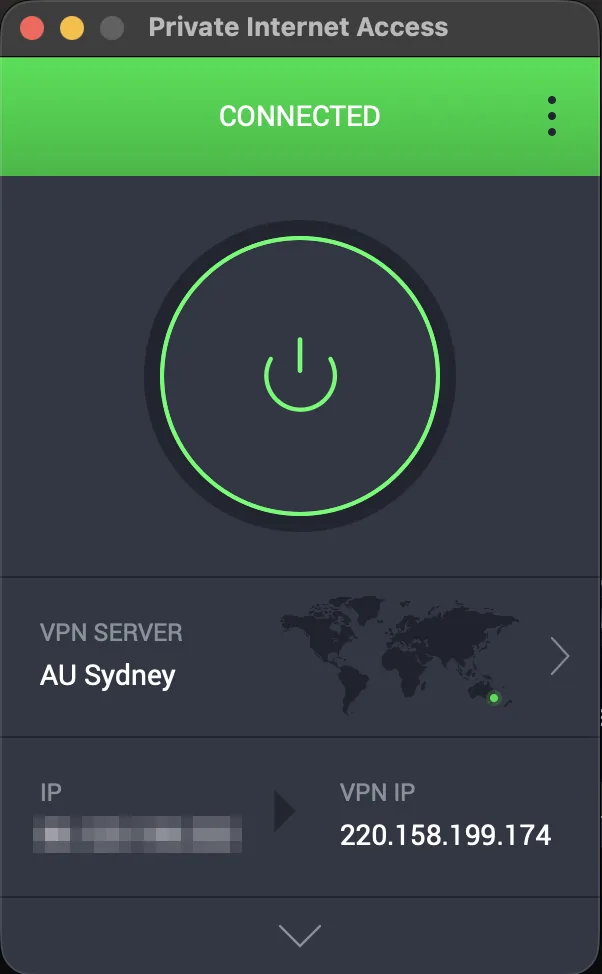
Under the plain surface, there is more to change than in most VPN apps. The settings sit behind the three-dot menu in the top-right corner: protocol, obfuscation and MTU, DNS, the kill switches and MACE, port forwarding, a dedicated IP, automation rules, split tunneling and multi-hop. Split tunneling on a Mac is rarer than it should be; NordVPN’s Mac app doesn’t have it. Everything I looked for was where I expected it.
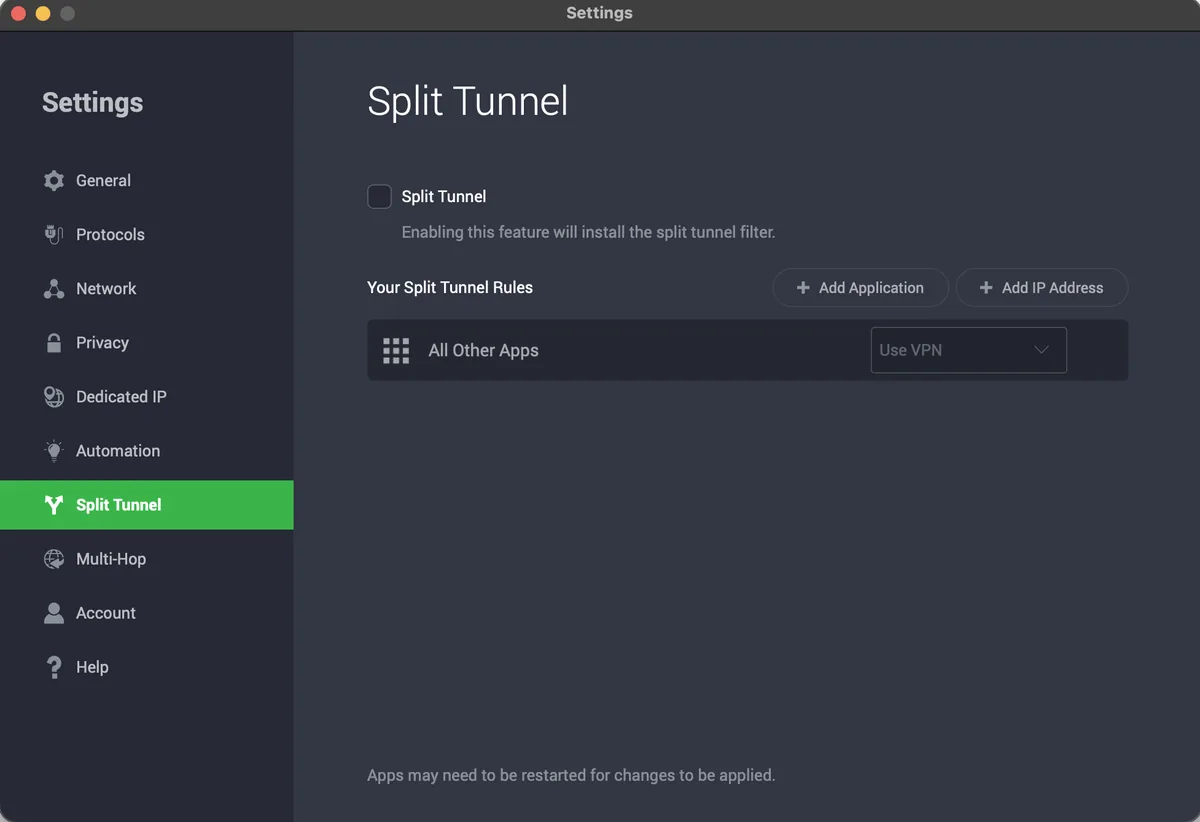
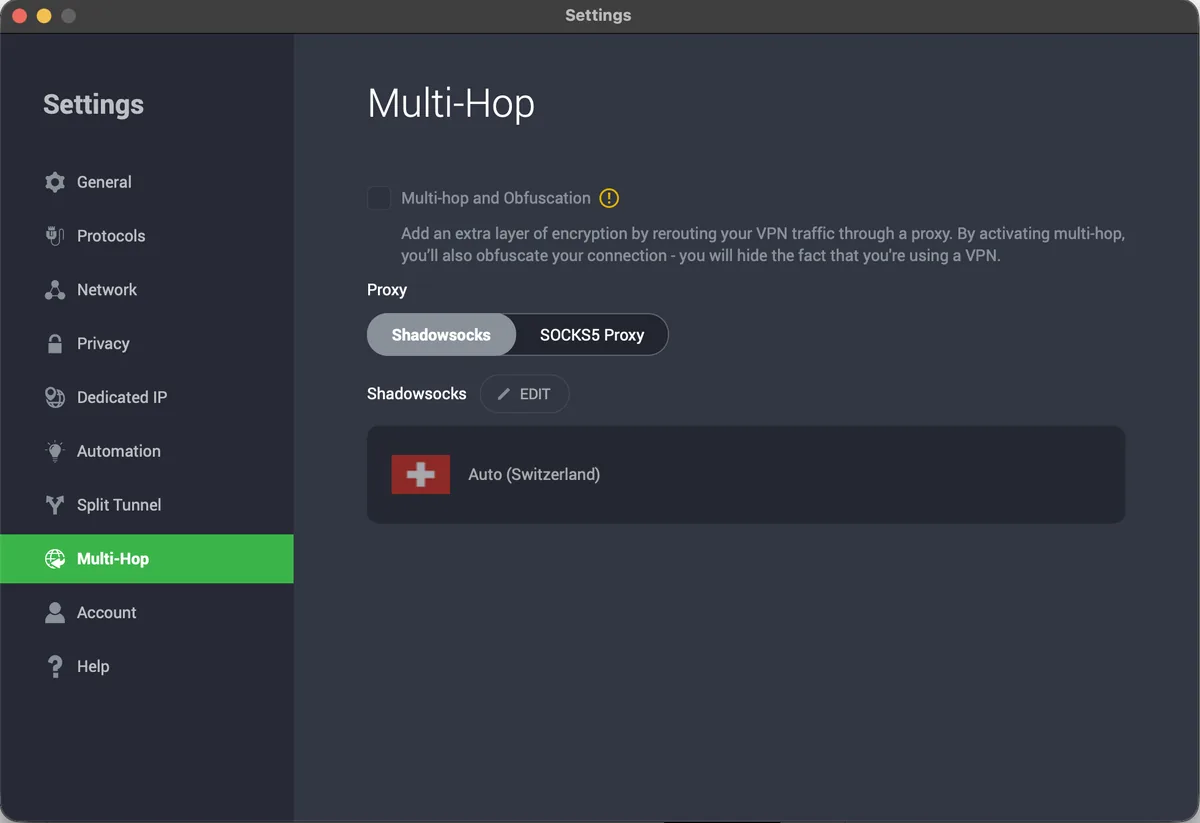
The Windows and Linux apps look and work the same way. Version 3.8.0 (October 2026) made WireGuard the default protocol, added faster drivers on Windows and fixed a bug that could make the Mac app hang during the split tunneling setup.
Mobile apps (Android and iOS)
The Android app has most desktop features, including split tunneling, MACE, automatic connection on public Wi-Fi and port forwarding requests. Given its feature set, we consider it a good VPN app for Android phones.
The iOS app is simpler because of Apple’s restrictions: it has a kill switch, DNS leak protection and the Safari content blocker, but no split tunneling and no MACE.
Browser extensions
The Chrome and Firefox extensions work as encrypted proxies. They only protect traffic inside the browser and add a few privacy settings, so for full protection, use the apps.
Why 9.5 out of 10
Apps for nearly every device, Apple TV, Android TV and Fire TV included, a graphical Linux app, and a Mac app where every setting I looked for was where I expected it. Half a point goes because there’s no router app, and on a router PIA supports only a manual OpenVPN setup; Mullvad, NordVPN and Surfshark lost the same half point. The dated, small look costs nothing, because looks don’t count in my scores.
Getting Started
Subscribing is simple:
- Choose a plan on PIA’s pricing page. The 3-year plan is the cheapest.
- Choose a payment method and pay; your account is created with your email address.
- Download the app for your device, sign in and connect.
- Optional: add a Dedicated IP or the Antivirus at checkout or later in your account.
 Support
9.0
PIA offers support around the clock by live chat and email (a ticket system); there is no phone support. Its help center has setup guides for every app and for routers, troubleshooting articles and billing FAQs.
My chat test
I nearly wrote that PIA has no live chat. In the Mac app, Help leads only to a ticket form on PIA’s website, and nothing in the app mentions a chat. The chat is there, though, on PIA’s website, behind a “Chat with us” button.
I opened it at 8:07 in the morning on 24 November 2026. PIA’s AI assistant answered first, and when I asked for a human agent, it handed me over right away, without asking what my problem was. An agent, Dianne, joined about a minute later.
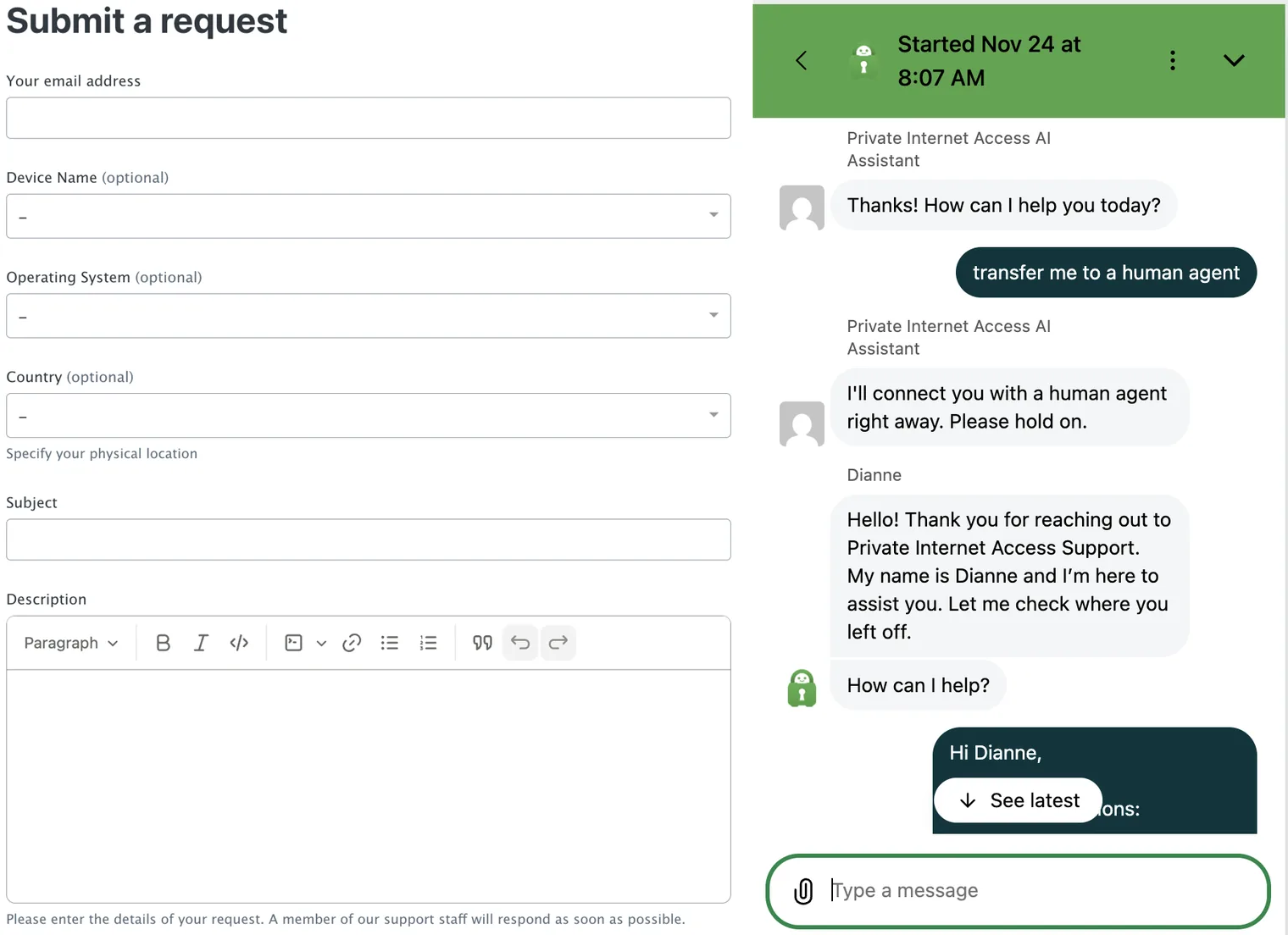
I asked her two questions. Are all PIA servers RAM-only? Yes, she said, which matches what PIA publishes. Does PIA work in Russia? She first asked whether I was there, and when I said I was only curious, she replied that PIA can’t guarantee a smooth connection in Russia because of “complexities and limitations outside of our control”.
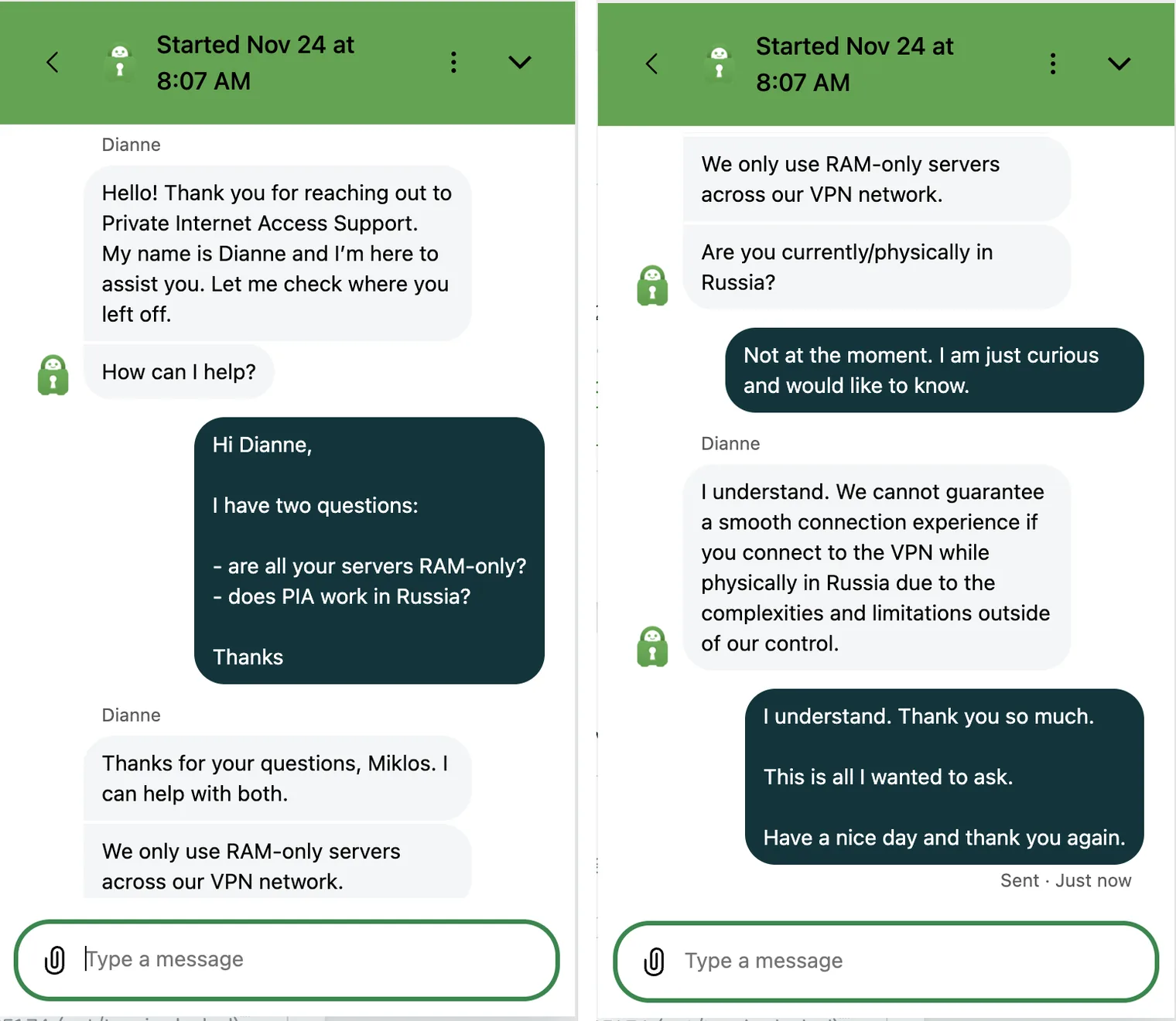
I took that as a no, which is probably what it was. A plain yes or no would have been better. PIA has had no servers in Russia since 2016, so it’s not a hard question.
Why 9 out of 10
24/7 live chat with real people, and a person answered within about a minute of my first request. Half a point goes because the app never mentions the chat: its Help leads only to a ticket form, so if you only use the app, you’d think there is none, as I did. The other half goes for the Russia answer, which circled the question instead of answering it. NordVPN lost half a point for the same.
 Pricing
10.0
PIA sells one plan with all VPN features in three lengths: 1 month, 1 year and 3 years (plus extra months). Every plan includes unlimited devices, all servers, MACE, port forwarding and split tunneling; Dedicated IP and Antivirus cost extra.
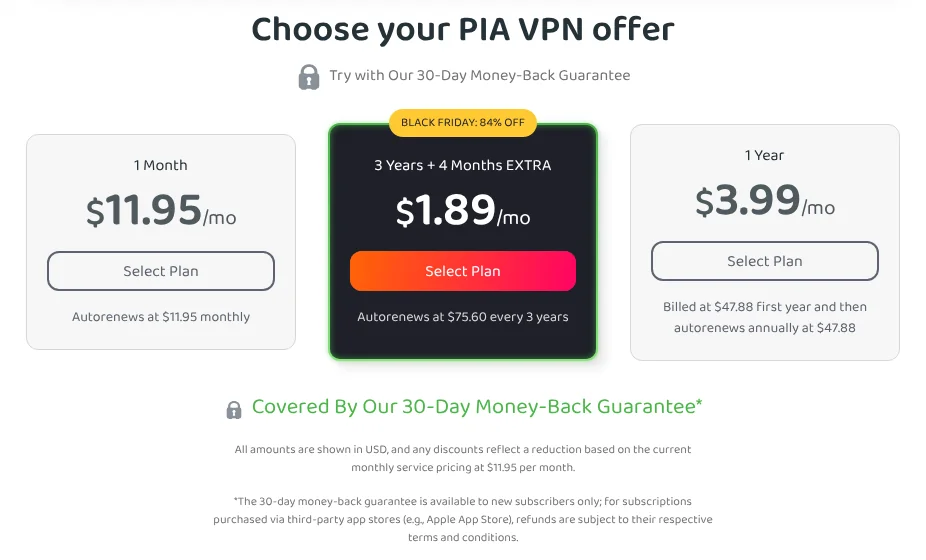
Prices (as of 24 November 2026)
| Plan length | Price per month | First payment | Renewal price |
|---|---|---|---|
| 1 month | $11.95 | $11.95 | $11.95 a month |
| 1 year | $3.99 | $47.88 | $47.88 a year |
| 3 years + 4 months | $1.89 | $75.60 for 40 months | $75.60 every 3 years |
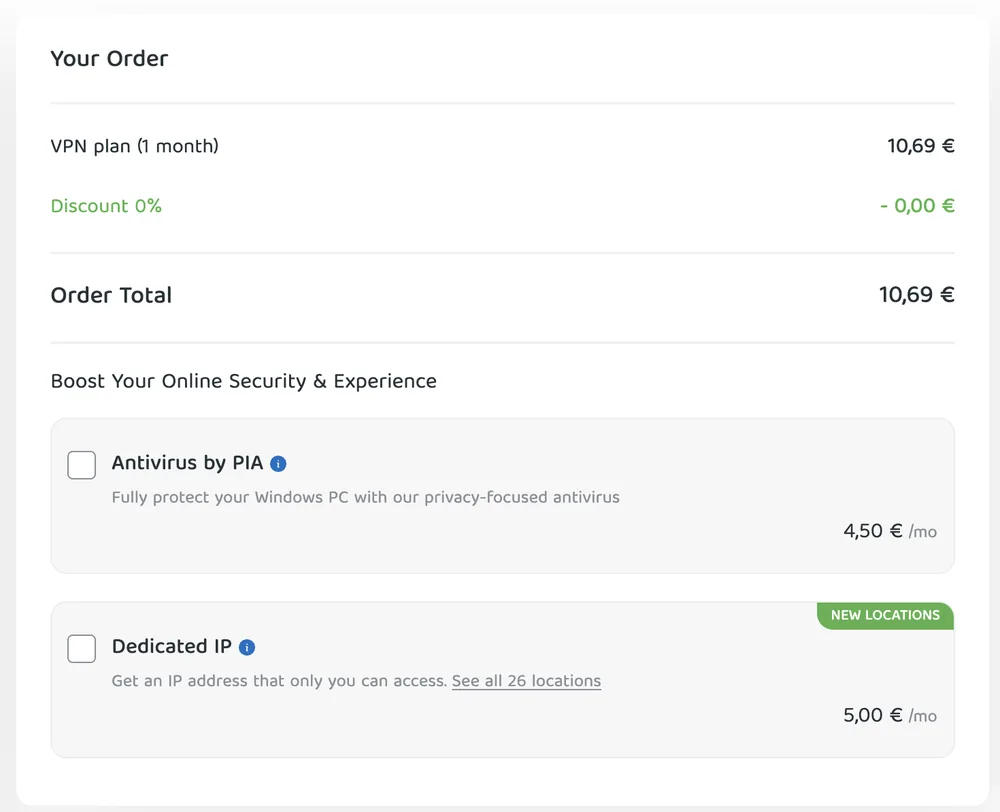
Prices are in US dollars, without sales tax or VAT; my own monthly order from Romania came to €10.69 with VAT. The 3-year price is PIA’s Black Friday offer, and it didn’t change across three page loads on 24 November. In late October, the same plan cost $79 for 39 months and renewed at $79. Unlike most rivals, PIA renews at the price of the first term, but its terms allow price changes with advance notice.
Add-ons
| Add-on | 1 month | 1 year | 3 years |
|---|---|---|---|
| Dedicated IP | $5.00 | $51 ($4.25/mo) | $90 ($2.50/mo) |
| Antivirus (Windows) | $4.50 | $24 ($2.00/mo) | $36 ($1.00/mo) |
At checkout, the add-ons are offered for the same length as the VPN plan. The 1-year and 3-year orders also include PIA Cleaner at no extra cost.
Good to know:
- Money-back guarantee: 30 days, for new subscribers who haven’t had a refund in the previous 3 months, on purchases made directly with PIA, not through the App Store, Google Play, gift cards or deal sites. PIA’s terms of service also mention refunds after a renewal, but its pricing page limits the guarantee to new subscribers.
- Free trial: the iOS app’s App Store listing advertises a 7-day free trial. Subscriptions bought in the app stores (1 month or 1 year only) are billed and refunded by Apple or Google, at their own prices.
- Refer a friend: you and the friend each get 30 days for free.
Which plan makes sense?
- 3 years + 4 months is the best value: $75.60 for 40 months, and it renews at the same price.
- 1 year if you don’t want to commit for 3 years. It costs about twice as much per month.
- 1 month only for short-term needs such as a trip. At $11.95, it is still cheaper than the monthly plans of ExpressVPN, NordVPN and Surfshark.
Payment methods: credit and debit cards, PayPal, Apple Pay, Google Pay and Amazon Pay at checkout; according to PIA’s help center, also one-time payments with cryptocurrencies, US gift cards (through PayGarden) and iDEAL.
Click here to see the current PIA plans.
Why 10 out of 10
$75.60 for the first 40 months, and the same every 3 years after that, comes to $1.89 a month, the lowest long-term price of the VPNs I’ve re-tested. Over three years, Surfshark works out at about $3.75 a month and ExpressVPN at about $4.59. Add unlimited devices and a 30-day money-back guarantee, and I found nothing to take half a point off for.
Final Thoughts
PIA is cheap, it was fast over WireGuard everywhere I tested it, uploads included, and its no-logs policy has held up in court and in three audits. The Mac app has more settings than most, even if it looks like it’s from another decade.
It loses points in four places. Netflix played in only two of the six countries I tried. OpenVPN over TCP barely held a connection. The app hides the live chat, and the agent wouldn’t give me a straight answer on Russia. And it belongs to Kape, which costs it the same 1.5 points for trust as ExpressVPN.
Overall, that’s 9.3 out of 10, the average of the six scores above.
A good choice if you want a cheap VPN for every device in the house, with plenty of settings, port forwarding for torrents and servers in every US state.
Look elsewhere if streaming is your main reason for a VPN, or if you need one that holds up on networks where only TCP gets through.