Surveillance Pricing: How Companies Use Your Data to Set Your Price (and How to Avoid It)

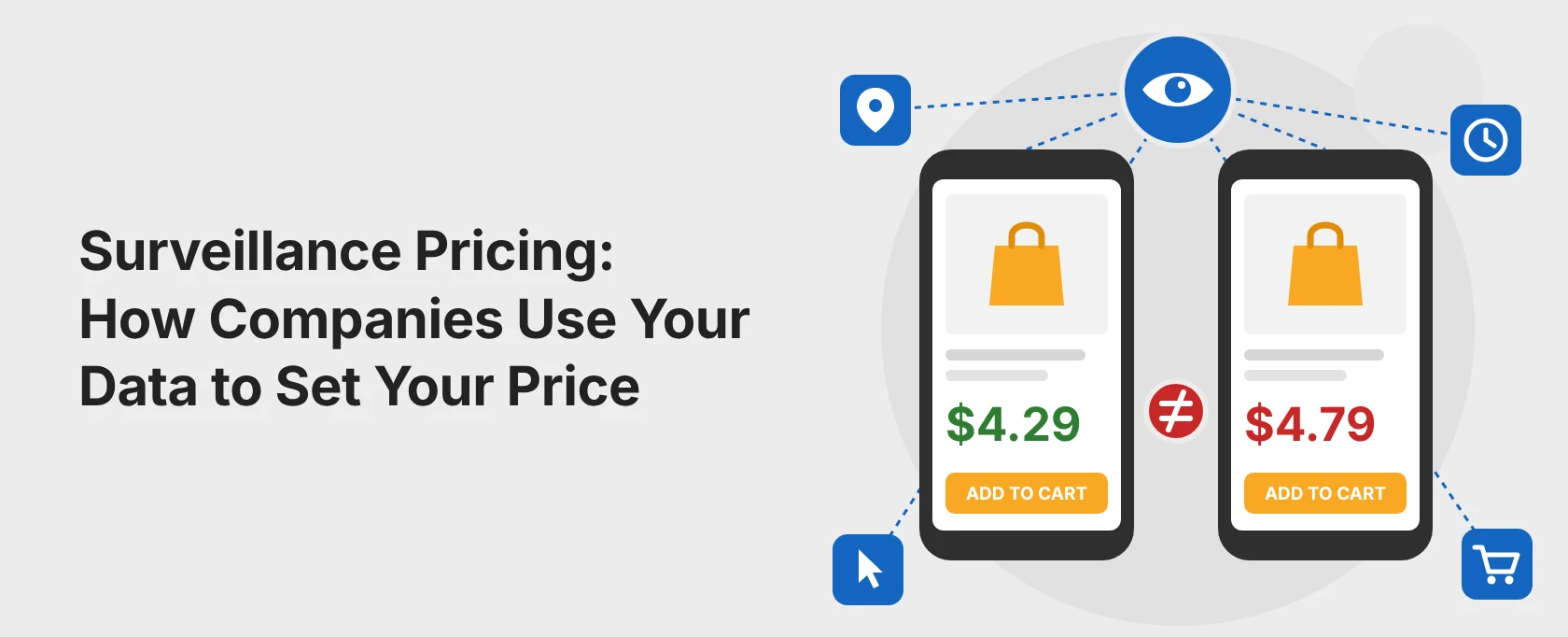
Two people open the same shopping app, look at the same product from the same store at the same moment, and see different prices. This isn’t a glitch. The price may have been set using data about each of them.
This practice is called surveillance pricing. It has moved from academic papers into lawmaking: several US states have banned it for groceries or retail, the EU requires stores to disclose it, and in October 2026 the US Federal Trade Commission ordered nine major companies to explain how they set prices. This guide explains how surveillance pricing works, how to test whether it’s happening to you, and what you can do about it.
- What is surveillance pricing
- How it differs from dynamic pricing
- What data can affect the price you see
- How to check whether a price is personalized
- How to avoid paying a price set for you
- Whether surveillance pricing is legal
What Is Surveillance Pricing?
Surveillance pricing, also called personalized pricing, is when a business uses personal data to decide what price a specific customer sees. The inputs can include where you are, what device you use, what you searched for and bought before, and what a system predicts you are willing to pay.
Charging what the market will bear is nothing new. What’s new is the amount of data available. Online stores, apps and loyalty programs now collect enough about each customer that a price can be set per person instead of per market.
On October 28, 2026, the FTC ordered Delta, United, JetBlue, Uber, Lyft, DoorDash, Instacart, Target and Walmart to document whether their prices vary from person to person and what inputs and tools they use. “Consumers deserve to know whether companies use their web surfing habits or other personal data” to set prices, FTC Chairman Andrew Ferguson said. The companies have 45 days to respond.
Dynamic Pricing, Personalized Pricing, or a Price Test?
Not every price change is surveillance pricing. Four practices are often mixed up:
- Dynamic pricing: the price changes with demand, supply or time, but everyone sees the same price at that moment. Examples: ride-hailing surge fares, airfares rising as seats sell.
- Geographic (zone) pricing: the price depends on the store or delivery area, and everyone in that area sees the same price. Example: a chain charging more in one city than in another.
- Price testing (A/B tests): customers are randomly assigned different prices, so prices differ, but not because of who you are. Example: Instacart’s price tests (see below).
- Surveillance (personalized) pricing: the price depends on data about you, so two people can see different prices at the same moment. Example: a higher price because your profile suggests you’ll pay it.
The difference matters because dynamic and zone pricing are legal almost everywhere, while the new laws target prices based on personal data.
In practice, the lines blur. Your location counts as personal data when it comes from your phone’s GPS. A “random” price test still means two neighbors pay different prices for the same item. And personalization often appears as a discount instead of a markup: everyone sees the same list price, but only some customers get the coupon. The result is the same: some people pay more.
What Data Can Affect the Price You See
In January 2025, the FTC published initial findings from its study of pricing intermediaries, the firms that sell pricing software to retailers. The six companies in the findings (Mastercard, Accenture, PROS, Bloomreach, Revionics and McKinsey & Co.) worked with at least 250 clients, including grocery stores and apparel retailers.
According to the FTC, their tools can use:
- precise location
- browsing history, search and purchase history
- demographics
- mouse movements on a webpage
- products left unpurchased in an online shopping cart
- the time of purchase and the sales channel (app, website or store)
Other signals can play a role too: the device and operating system you use, whether you’re logged in or a loyalty member, and data a company buys from data brokers.
One example from the FTC: a shopper profiled as a new parent could be shown higher-priced baby thermometers first in search results.
The FTC’s examples were hypothetical. The report described what these tools can do, not how often retailers use them. That is what the October 2026 orders are meant to find out.
Real Cases of Personalized Pricing
Instacart (2025). Consumer Reports, Groundwork Collaborative and More Perfect Union ran an experiment with Instacart shoppers. They found that nearly three in four grocery items were shown at more than one price. At one Safeway in Washington, D.C., a dozen Lucerne eggs appeared at five prices, from $3.99 to $4.79. Instacart said the tests were assigned at random and were not surveillance pricing. It ended the program on December 22, 2025. Instacart is one of the nine companies in the FTC’s October 2026 orders.
Delta Air Lines (2025). Delta said AI from its partner Fetcherr helped price about 3% of its domestic fares, with a goal of 20% by the end of 2025. After US senators raised concerns about personalized fares, Delta said the system uses anonymized booking data and market trends, and that it doesn’t set individual fares based on personal data. The FTC’s 2026 orders ask Delta, United and JetBlue whether fares vary with factors like loyalty program participation or analysis of personal data.
Wish (EU, 2022). The Dutch consumer authority (ACM) found that the shopping platform Wish personalized prices based on factors like location and purchase behavior without telling customers. Wish stopped personalizing prices in the EU on May 25, 2022.
Orbitz (2012). The Wall Street Journal reported that Orbitz showed Mac users pricier hotels higher in search results, because Mac users spent up to 30% more per night. Orbitz said it didn’t show the same room to different users at different prices. This was steering, not a personalized price, but it showed how much a device can say about a shopper.
Staples (2012). The Wall Street Journal found that Staples’ website gave discounts to customers within 20 miles of a rival store such as OfficeMax or Office Depot. As a result, shoppers in areas with fewer stores, often less wealthy ones, paid more.
Princeton Review (2015). ProPublica found that the price of an online SAT tutoring package depended on the ZIP code entered, ranging from $6,600 to $8,400. Asian Americans were nearly twice as likely to be quoted a higher price. The company said its prices were based solely on large geographic market areas.
The lesson from these cases: even a “neutral” input such as location can lead to unfair outcomes.
How to Check Whether You're Getting a Personalized Price
You can run a simple side-by-side test:
- Pick one product and one store.
- Check the price at the same minute from two setups: your usual one (logged in, app, home Wi-Fi) and a clean one (logged out, in a private window or another browser, on another device).
- Change one thing at a time: logged in vs. logged out, app vs. website, phone vs. computer, Wi-Fi vs. mobile data.
- Go all the way to the final checkout price. Fees, delivery charges and discounts often appear only at the end.
- Take screenshots with the time visible.
Interpret the results carefully. Dynamic prices can change within minutes, so repeat the test a few times. A difference doesn’t prove that personal data was used; it may be a random test or a different store or delivery zone. A difference that appears again and again, and follows your account, device or location, is a stronger signal.
Look for disclosures, too. Since November 10, 2025, businesses in New York must show the label “THIS PRICE WAS SET BY AN ALGORITHM USING YOUR PERSONAL DATA” next to such prices. In the EU, online stores must tell you when a price was personalized by automated decision-making.
How to Avoid Paying a Price Set for You
No single tool stops surveillance pricing. The aim is to limit the data stores can use and to compare before you buy.
Compare logged out. Your account links every search and purchase to you. Check prices logged out in a private window before you buy. A private window clears cookies when you close it, but it doesn’t hide your IP address or your browser fingerprint.
Compare the app with the website. Apps can collect more than websites: precise location, device identifiers, and how you use the app. Don’t give shopping apps precise location access unless you need it. On iPhone, choose “Ask App Not to Track” when asked. On Android, you can delete your advertising ID in the Ads section of the privacy settings.
Block trackers. Trackers on shopping sites feed the profiles that data brokers sell. A privacy-focused browser or a reputable tracker blocker cuts down this flow. Keep extensions to a minimum, since extensions have privacy risks of their own.
Send an opt-out signal. Global Privacy Control (GPC) is a browser setting that tells websites not to sell or share your data. Brave and DuckDuckGo send it by default, and Firefox has it as a setting. In California, Colorado and several other US states, businesses must treat GPC as an opt-out. You can also use the “Do Not Sell or Share My Personal Information” links on store websites. Californians can use the state’s free DROP platform to send one deletion request to every registered data broker. Since August 1, 2026, brokers must process these requests at least every 45 days. More on this in our guide to how the sale of personal data works.
Check the price from another location with a VPN. A VPN replaces your IP address with one from the server you pick, so a store sees a different location. It doesn’t remove cookies, accounts or fingerprints, so you can still be tracked if you stay logged in. Don’t expect large savings. In a 2025 test, Tom’s Guide searched three flight routes through VPN servers in 10 countries. The biggest saving was $9, and on the London–New York route most VPN locations showed higher prices than the UK baseline. A VPN is most useful as a way to check whether a price depends on your location. Watch out for currency, taxes, and store terms that tie prices to your billing country.
Think twice about loyalty programs. Loyalty discounts are real, but you pay with data. That data can also shape which offers you get and which ones you don’t. Most of the new state laws exempt loyalty programs, so they remain one of the main channels for personalized prices. Join programs where the savings are clear, and read what they collect.
Track price history. Price trackers such as Keepa and CamelCamelCamel (for Amazon) or Google Flights’ price tracking show whether a price is high or low compared to its history. Set an alert and buy when the price drops for everyone.
Don’t rely on the “abandoned cart” trick. Leaving items in your cart sometimes triggers a discount email. But the FTC lists unpurchased cart items among the data pricing tools can use, so this can work against you as well as for you.
Is Surveillance Pricing Legal?
It depends on where you live. In most places it’s legal, but more and more of it is regulated.
United States. No federal law bans surveillance pricing. The FTC says Congress hasn’t given it the power to prohibit personalized pricing in all circumstances, but it can act against unfair or deceptive practices. On August 19, 2026, it proposed a policy statement: where consumers reasonably expect prices not to depend on their personal data, businesses should clearly disclose that prices are personalized, on what basis, and what data is used. The comment period closed on September 25, 2026, and no final statement has been issued.
States and cities are moving faster:
- New York, Algorithmic Pricing Disclosure Act (in force since November 10, 2025): prices set by an algorithm using personal data must carry a label saying so.
- New York, One Fair Price Act: a broad ban passed by the legislature in June 2026, awaiting the governor’s decision.
- Maryland, Protection From Predatory Pricing Act (in force since October 1, 2026): food retailers and food delivery services can’t charge specific shoppers higher prices based on personal data.
- Connecticut, Public Act 26-130 (from July 1, 2027): bans surveillance pricing by retailers and food delivery services.
- New Jersey, Fair Price Protection Act (from August 1, 2027): bans it for groceries and other necessities, and consumers can sue.
- Seattle, Fair Pricing and Transparency Ordinance (from September 1, 2027): bans algorithm-based price discrimination.
Colorado’s governor vetoed a ban in June 2026. California has no specific law, but its attorney general began investigating surveillance pricing under the state’s privacy law (CCPA) in January 2026. Most laws exempt loyalty programs, equal discounts for groups such as seniors or veterans, and price differences based on real costs.
European Union. Personalized pricing isn’t banned as such. Since May 28, 2022, the Consumer Rights Directive, as amended by the Omnibus Directive, has required traders to tell you when a price was personalized on the basis of automated decision-making. The GDPR also applies: the data behind a personalized price must be collected and used lawfully, and you can ask a company what data it holds about you. The European Commission is expected to propose a Digital Fairness Act in mid-November 2026. Personalized and dynamic pricing are part of the debate, including calls to ban dynamic pricing for event tickets.
Latest developments (updated October 31, 2026)
- October 28, 2026: the FTC orders nine airlines, ride-hailing, delivery and retail companies to explain personalized pricing and pay.
- October 5, 2026: Seattle’s mayor signs the city’s ban (in force from September 2027).
- October 1, 2026: Maryland’s ban for food retailers takes effect.
- Pending: New York’s One Fair Price Act (governor) and the EU’s Digital Fairness Act proposal (expected mid-November 2026).
What to Do If You Think You Were Overcharged
- Keep evidence: screenshots of both prices with the time, and a note of the setup (account, device, app or website, location).
- Ask the company why the prices differed. In the EU and the UK, you can also send a GDPR access request to see what data the company holds about you.
- Report it. In the US, report to the FTC at ReportFraud.ftc.gov and to your state attorney general, who enforces the state laws above. In the EU, contact your national consumer protection authority or data protection authority.
- Know your rights. From August 1, 2027, New Jersey consumers will be able to sue over surveillance pricing of groceries and other necessities.
Summary
Surveillance pricing uses data about you to decide what you pay. Most documented cases so far are price tests, location effects and steering, not a unique price for every shopper. Still, the tools exist, regulators are investigating, and the rules are changing quickly.
You can’t switch it off, but you can make it harder: compare prices logged out and across devices, limit the data apps and trackers collect, send opt-out signals, check prices from another location, and track price history before you buy.
Frequently Asked Questions
Some people found answers to these questions helpful
Is surveillance pricing legal?
In most of the US it is, but New York requires a disclosure label, Maryland bans it for groceries, and Connecticut, New Jersey and Seattle have bans taking effect in 2027. In the EU it isn't banned, but stores must tell you when a price was personalized by automated decision-making.
Does incognito mode stop personalized pricing?
Only partly. A private window logs you out and drops cookies when closed, but stores can still see your IP address, device and browser fingerprint. Use it to compare prices, not as full protection.
Can a VPN get me lower prices?
Sometimes, but the differences are usually small. In a 2025 test of flight searches from 10 countries, the biggest saving was $9. A VPN is most useful for checking whether a price depends on your location.
Do airlines use personal data to set fares?
Airfares are mostly dynamic: they change with demand and time for everyone. Delta said in 2025 that its AI pricing doesn't use personal data. In October 2026, the FTC asked Delta, United and JetBlue whether fares vary with loyalty status or personal data. Their answers aren't public yet.
Is surge pricing the same as surveillance pricing?
No. Surge pricing raises prices for everyone in an area when demand is high. It would count as surveillance pricing only if the price were tailored to you personally. The FTC's October 2026 orders ask Uber and Lyft whether their prices vary from person to person.
Are loyalty programs a form of surveillance pricing?
They use your data to personalize offers, so they work in a similar way, but they're voluntary and most new laws exempt them. Join the programs where the savings are clear, and read what data they collect.