Research
Government Requests for User Data in 2026: Who Asks, Who Hands It Over
Published

Governments asked Google, Apple, Meta and Microsoft for user data 1,509,759 times in 2025. In four cases out of five, they got some.
That is 21% more than in 2024 and six times the 2015 figure. The total has grown every single year of the past ten.
This page puts the transparency reports of 18 companies side by side: who asks, how often the answer is yes, what each service can hand over, and what changed in the law in 2026. The core numbers are for calendar 2025, the last full year that every large company has reported. Where a company has already published the first half of 2026, we show that too.
- 1,509,759 requests for user data reached Google, Apple, Meta and Microsoft in 2025: 21% more than in 2024 and 6.2 times the 2015 figure.
- 80% of them ended with some data handed over. Microsoft said no most often and produced data in 65% of cases.
- India sent 31% of all requests (465,050), 50% more than a year earlier. Germany asks the most per person: 186 requests per 100,000 people.
- 128,922 were emergency requests, sent without a court order: one in twelve, three quarters of them to Meta.
- Secret US FISA orders for content covered at least 388,500 Google accounts in 2025, more than one and a half times the 241,752 accounts named in all ordinary US requests to Google.
- AI chatbots are the fastest-growing target: OpenAI received 794 requests in the first half of 2026, against 455 in all of 2025.
2025 in numbers: 1.5 million requests to four companies
Meta received the most requests in 2025: 790,493, for Facebook, Instagram, WhatsApp and its other apps. Google followed with 591,929, naming 1.41 million accounts. Apple (69,295) and Microsoft (58,042) are far behind.
Apple’s figure needs one note. It counts requests about Apple accounts, emergencies and push notifications, the ones that point at a person. Apple also received 58,773 device requests and 20,336 financial-identifier requests in 2025, which it says typically come from police helping owners of lost or stolen devices and from suspected card fraud. We leave those out, so the comparison stays fair.
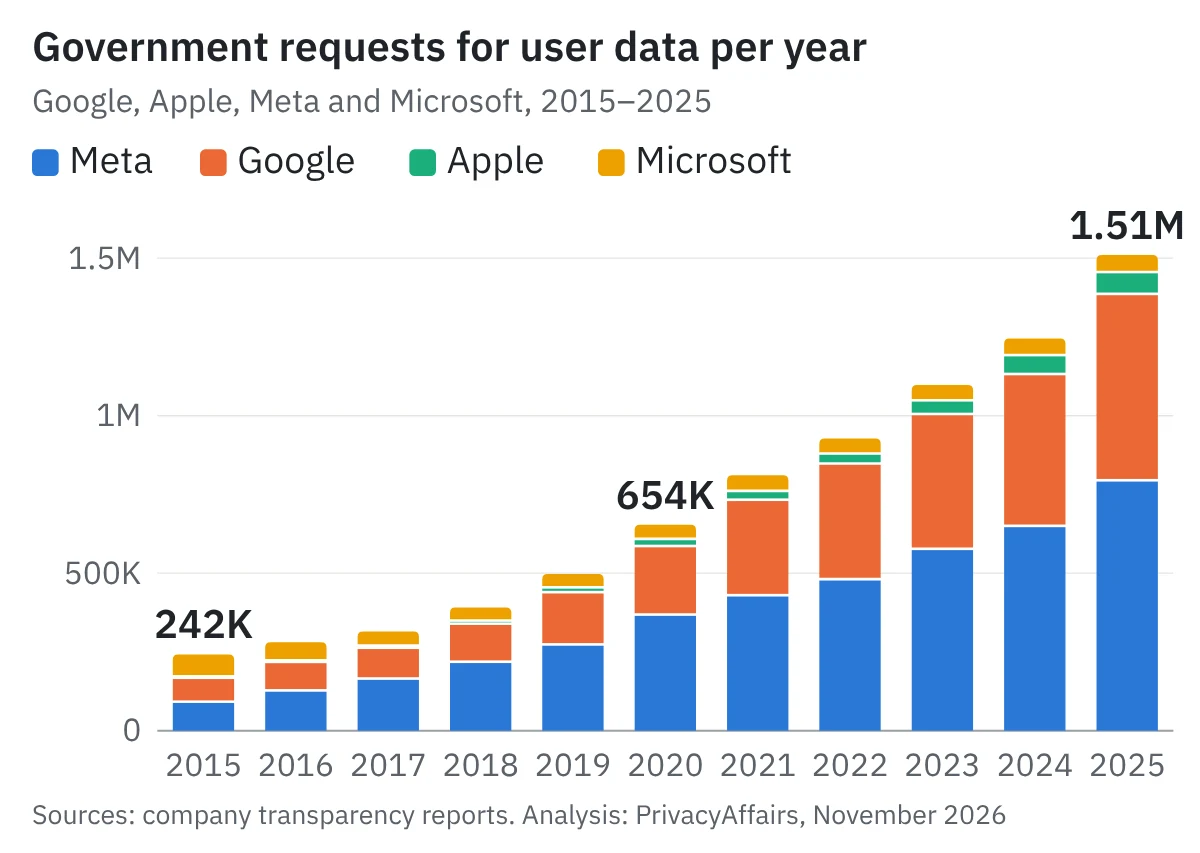
Part of the growth follows more users and more services, so the raw count is no surveillance index. Still, the direction has not changed once in ten years, and from 2024 to 2025 Meta (+22%) and Google (+23%) grew faster than in most years before.
The rest of the industry gets far fewer requests, but the same kind. Amazon received 66,831 for its shop, Alexa, Ring and other consumer services, plus 3,489 for AWS. TikTok received 47,077, Snap almost 50,000 from the US alone.
Facebook, Instagram, WhatsApp
without AWS
US requests only
ChatGPT
Claude
The first reports for 2026 point the same way, with one exception. Microsoft received 30,341 requests in the first half of 2026, Snap 27,555 from the US (8% more than a year earlier) and Reddit 1,306 (11% more). Amazon’s count fell by 10%, to 28,601. And OpenAI, which received 455 requests in all of 2025, received 794 in six months (chapter 6).
Which governments ask the most
India sent 465,050 requests to the four big companies in 2025, 31% of the world total and 50% more than in 2024. Most went to Meta: India alone accounts for 38% of all the requests Meta received worldwide.
The United States comes second with 327,834, then Brazil (157,288) and Germany (155,237). Together, these four countries sent almost three requests out of four.
Per person, the ranking changes. Germany sent 186 requests per 100,000 people, ahead of Austria (116), the United Kingdom (102), Poland (102) and the United States (96). India, the largest sender, made 32 per 100,000.
Where the request comes from also decides how often it works. US authorities got some data in 88% of cases, Indian authorities in 76%. The companies are American, and a US subpoena or warrant fits their legal process without translation. A request from abroad often has to show that it meets the same standards, or travel through a treaty between governments.
How often companies say yes
Google produced some data in 83.4% of requests in 2025, Apple in 83.0% and Meta in 78.2%. Microsoft is the most reluctant of the four with 65.0%. It rejected 12,089 law enforcement requests in 2025 for not meeting legal requirements, about one in five.
“Some data” can mean very little. Most disclosures are a name, an email address, a sign-up date or IP logs. Microsoft handed over content, meaning emails, documents or photos, in 2,768 of its 56,005 law enforcement requests, under 5%.
Smaller platforms vary more, and foreign governments fare worse with them:
- LinkedIn produced data for about half of its 3,274 requests in 2025. France sent more requests than the US in the second half of the year, but got data in only 29% of cases, against 80% for US requests.
- X has not published a global report since the one for July–December 2024. In that half-year it handed over data in 51% of cases: 78.5% for US requests and 31.3% for all other countries.
- Discord produced data for 82% of US requests and 44% of international ones between March 2025 and March 2026.
- Reddit handed over data in 69–70% of cases, Snap in 82–84% of US requests.
Emergency requests and gag orders
An emergency request is a request without a court order. The police say a life is in danger, and the company decides alone whether to answer. The four big companies received 128,922 of them in 2025, about one request in twelve. Three quarters went to Meta (98,656, or 12.5% of everything Meta received). Apple received 6,348, Google 21,881 and Microsoft 2,037.
The fast lane has a weak point. In November 2024 the FBI warned that criminals were using hacked police and government email accounts to send fake emergency requests to US companies and collect people’s personal data.
Most companies promise to tell you when a government asks for your data, unless the law forbids it. In the US, the law forbids it often:
- 78.1% of the US requests Meta received in the second half of 2025 came with a non-disclosure order.
- 33% of Microsoft’s US legal demands in the first half of 2026 carried a secrecy order: 2,185 orders, 1,524 of them from federal authorities.
Google also promises notice, and in April 2026 the Electronic Frontier Foundation asked the attorneys general of California and New York to investigate after Google gave ICE a PhD student’s name, address and IP address under an administrative subpoena without warning him first. Google says it notifies users unless the law or exceptional circumstances prevent it.
The secret part: FISA orders and National Security Letters
US national security requests stay out of all the counts above. Companies may report them only in ranges, usually of 500. The exact number, it seems, is also a national security matter.
The ranges are still large. In 2025, orders under the Foreign Intelligence Surveillance Act (FISA) for content covered:
- Google: 388,500–389,498 accounts (plus 137,000–137,998 accounts in non-content orders)
- Meta: 193,500–193,999 accounts in the first half of 2025 alone; the second half is still under the six-month reporting delay
- Apple: 153,000–153,998 accounts (plus 124,000–124,998 non-content)
- Microsoft: 69,000–69,998 accounts
To compare: all ordinary US requests to Google in 2025, from every police department, court and agency in the country, named 241,752 accounts. The secret orders covered more than one and a half times as many in content orders alone. Section 702 of FISA targets people outside the US, but some of the nearly 350,000 targets are in contact with Americans, whose messages are collected too. National Security Letters, which the FBI can issue without a judge, added 1,500–1,999 affected accounts per half-year at Google.
Section 702 expired on 12 June 2026, when Congress failed to renew it. Collection did not stop: the FISA Court had approved the yearly certifications on 17 March 2026, and they allow surveillance to continue until 17 March 2027, as the Brennan Center explains.
AI chatbots and privacy services
Chatbots are the newest place where governments look for evidence, and the fastest-growing one. OpenAI received 455 requests in 2025 and 794 in the first half of 2026 alone: 620 for account data, 146 for content and 28 emergency requests. It produced data in 539 cases. Content here means what you typed and what ChatGPT answered, plus uploaded files. Its US national security count also rose, to 250–499 requests for the half-year.
Anthropic, the maker of Claude, reported no requests at all for the first half of 2025 and 22 for the second, with data produced in 9. We found no other major chatbot company that publishes such numbers yet.
Services built so that they can’t read your data still get orders. They just have less to give:
- Proton received 9,301 legal orders for Proton Mail in 2025. It contested 988 and complied with 8,313, which typically means account details and, if ordered, logging one account’s IP addresses from then on. Proton VPN received 59 orders and denied all 59, because it keeps no activity logs. It is hard to hand over logs that were never written.
- Tuta received 447 requests in 2025 and rejected 75% of them.
- Signal publishes the subpoenas themselves. The two it published in 2026, both from a grand jury in Washington, D.C., got the same answer as always: the date an account was created and the date it last connected.
- Telegram has handed over IP addresses and phone numbers of suspects on court orders since its privacy policy change in September 2024, but shows its numbers only country by country inside its app. A public dataset that collects them counted 39,863 fulfilled requests from India alone in 2025.
What changed in 2025 and 2026
The two years brought new tools for governments and a few new limits. In the EU, authorities can now order a provider in another member state directly. In the US, the Supreme Court decided that getting location data from Google with a geofence warrant is a search, and a UK tribunal refused to let the government keep its order against Apple secret.
What each service can hand over
What a company can give to the police depends less on its promises than on what it can read. If your messages are end-to-end encrypted, only the devices in the conversation hold the keys, and a warrant to the company gets account data at most.
So what can you do? Most of it is about choosing where your data lives:
- Messages: use a service that encrypts by default (Signal, WhatsApp, iMessage, personal chats in Messenger). Instagram DMs lost that option on 8 May 2026, and TikTok says it won’t add it.
- Cloud backups: a standard iCloud backup holds copies of your iMessages that Apple can read. Advanced Data Protection closes that gap, except for new users in the UK, where Apple withdrew it in February 2025.
- Location: Google moved Location History (Timeline) onto phones in 2025 and says it can no longer answer geofence warrants from its own servers.
- Disk encryption keys: if Windows saved your BitLocker recovery key in your Microsoft account, Microsoft can hand it over. In January 2026 it was reported to have given such keys to the FBI.
- Chatbots: what you type into ChatGPT or Claude is content they hold. Delete chats you don’t need and use temporary chats for sensitive questions.
- A VPN keeps your real IP address out of the logs that services store and hand over. It does nothing for what is already in your account.
The honest fix is not a better transparency report. It is data the company itself cannot read.
How we built this, and its limits
Sources. Every figure comes from the companies’ own transparency reports, downloaded on 23 November 2026: Google‘s bulk CSV files, Apple‘s data archive, Meta‘s CSV files (to mid-2025) and the per-country figures on its report site for the second half of 2025 (they add up exactly to Meta’s published total of 415,977), and Microsoft‘s spreadsheets for every half-year from 2015 to mid-2026. For the other companies we used their reports as published; where we added two half-years, the sum is ours.
What counts as a request. Every request for user data, including emergency requests. Not counted: preservation requests (they freeze data until a formal request arrives; they don’t disclose anything) and requests to delete or restrict accounts. For Apple we count account, emergency and push-token requests, not device or financial-identifier requests. For Microsoft we add its emergency table to its law enforcement table and leave out civil requests; its files for 2015 and 2016 don’t separate emergencies.
Handed over. The share of requests where the company produced at least some data, by its own count.
Per person. Requests per 100,000 people use World Bank population estimates for 2025 (for Taiwan, the Interior Ministry’s end-of-2025 figure). Countries with fewer than one million people are left out of the per-person ranking, where a handful of requests would swing the result.
Limits. Companies count differently: one request can name many accounts, one person can have several accounts, and each company decides what makes one request. So compare directions and shares between companies more than raw totals. Telegram’s figures come from a crowdsourced collection of its in-app reports, not from Telegram directly. X stopped publishing global reports after the second half of 2024, Discord’s latest report covers March 2025 to March 2026, and Cloudflare publishes no total.
Updates. We update this page twice a year, after the companies publish their reports for each half-year.
Dataset. Download the country table (CSV): 2025 requests to Google, Apple, Meta and Microsoft for 162 countries, with population and requests per 100,000 people. Download the company table (CSV): requests, accounts, data handed over and emergency requests per company and half-year, 2015 to 2026. How to cite: PrivacyAffairs, “Government Requests for User Data in 2026: Who Asks, Who Hands It Over”, privacyaffairs.com, November 2026.
Frequently Asked Questions
Some people found answers to these questions helpful
How many government requests for user data were there in 2025?
Google, Apple, Meta and Microsoft received 1,509,759 requests in 2025, 21% more than in 2024, and produced some data in about 80% of them. Other companies add tens of thousands more, among them Amazon (66,831), TikTok (47,077) and Snap (almost 50,000 from the US alone).
Which country makes the most requests for user data?
India, with 465,050 requests to the four big companies in 2025, 31% of the total. The United States came second with 327,834. Per person, Germany asks the most: 186 requests per 100,000 people.
Do tech companies have to give my data to the government?
They have to obey valid legal orders in the countries where they operate, and they check every request first. In 2025 the big four produced some data in 80% of cases; Microsoft rejected about one law enforcement request in five. Emergency requests are voluntary: the company decides.
Can the police read my WhatsApp or Signal messages?
Not by asking the company. Both encrypt messages end to end, so WhatsApp can hand over account and connection data, and Signal only the date an account was created and last connected. Messages can still be found on your phone itself or in an unencrypted cloud backup.
What is an emergency data request?
A request without a court order, sent when police say a life is in danger. The company decides whether to answer. The four big companies received 128,922 in 2025, and the FBI has warned that criminals send fake ones from hacked police email accounts.
Will I be told if the government asks for my data?
Usually, unless a court or the law forbids it, and in the US that happens often. 78.1% of Meta's US requests in late 2025 came with a non-disclosure order, and 33% of Microsoft's US demands in early 2026 carried a secrecy order.
Does a VPN protect me from government data requests?
Only partly. A VPN keeps your real IP address out of the logs that websites and apps keep, but it does nothing for data stored in your accounts. VPN providers get orders too: Proton VPN received 59 in 2025 and could answer none, because it keeps no activity logs.