Internet Shutdowns in 2026: Every Government Cut-Off So Far (Tracker)
Published

In 20 countries, governments cut the internet or blocked major apps at some point in 2026 so far. Iran alone spent more than 100 days almost completely offline.
This page lists every government-ordered shutdown and platform block we could document between 1 January and 20 November 2026: where and when it happened, what was cut, the reason given or reported, and whether a VPN could have helped. Each entry rests on public evidence from network monitors such as Cloudflare Radar and IODA, digital rights groups such as Access Now and SFLC.in, official notices and news reports.
The yearly count of the #KeepItOn coalition arrives around March. Until then, this is the running tally for 2026, and we update it every month.
- 20 countries cut the internet or blocked major platforms in 2026 so far: 66 separate episodes started between 1 January and 20 November, and 8 older ones were still in force.
- Iran was offline for more than 100 days: about three weeks during the January protests and 88 days from the start of the war on 28 February. Access since then is slowed and tiered.
- Exam cheating is still a reason to switch off a country: Iraq did it at least 34 times, Sudan 10 times. Syria held its exams without a shutdown for the first time in at least a decade.
- Telegram was blocked by four governments (Russia, India, Iraq and Jordan), Iraq twice.
- A VPN would not have helped in 18 of the 66 episodes: the whole internet was off. In another 7, VPNs themselves were the target.
2026 edition, data to 20 November 2026. Next update: December 2026.
2026 so far: who cut the internet, and when
Three countries kept a shutdown running for most of the year. Myanmar’s military has held about 125 townships offline since before 2026, Russia cut mobile data somewhere almost every day, and Iran went from total blackouts to a slowed, tiered internet. India still had the most separate episodes, although its 33 shutdown orders are the fewest in a decade.
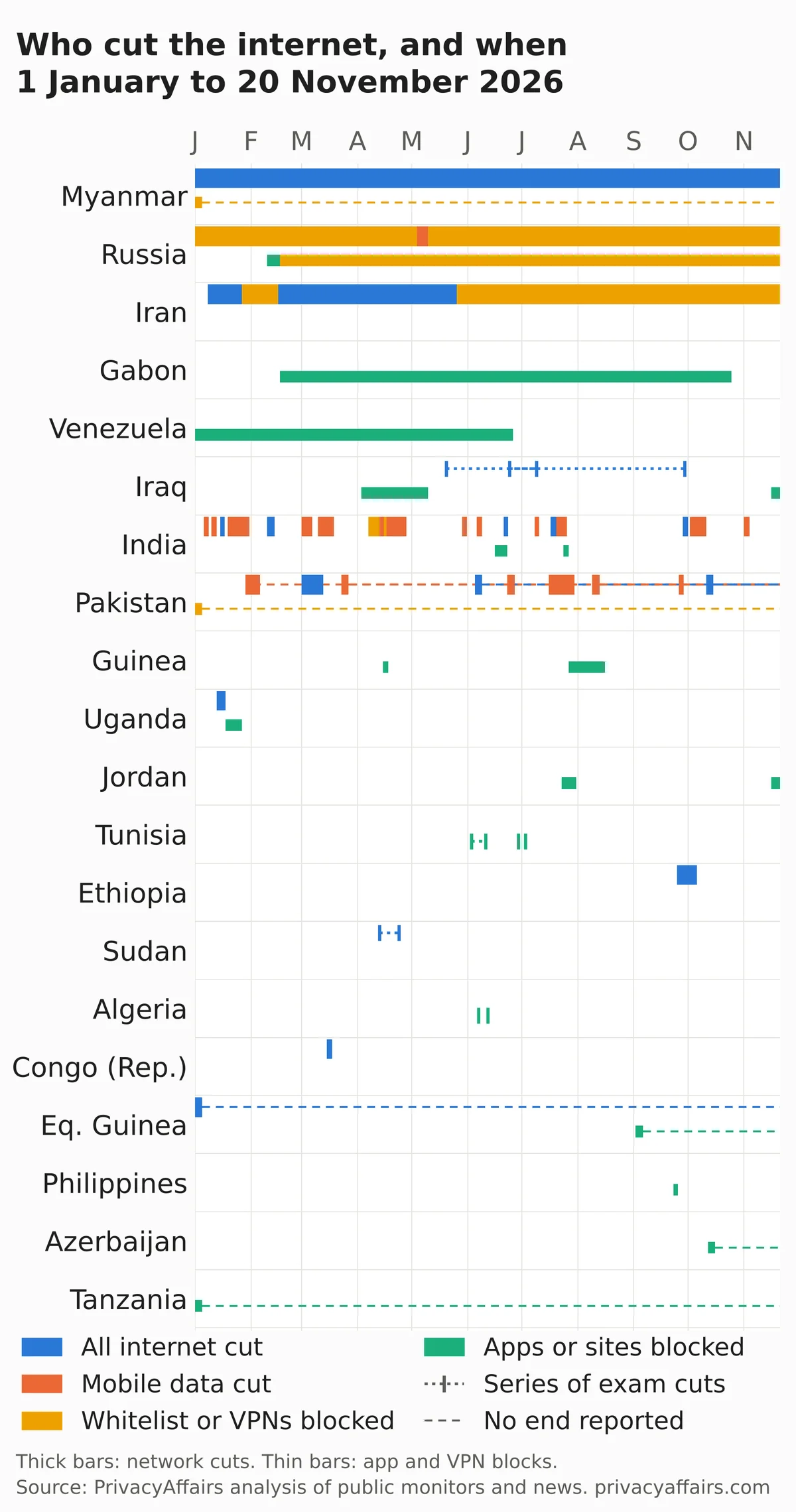
Every shutdown we recorded, by region
One row is one episode. Dates are in UTC. The last column says whether a VPN would have got you back online; chapter 7 explains the four cases. Our dataset has a source link for every row.
Middle East and North Africa
Sub-Saharan Africa
Asia
Europe, Central Asia and the Americas
Why governments cut the internet in 2026
Protests and unrest were behind 26 of the 66 episodes that started this year, more than any other reason. Delhi switched off mobile data seven times, every time against the same youth movement. Azad Kashmir in Pakistan lost broadband for 99 days after a protest march in June, and mobile data for even longer. Azerbaijan blocked TikTok, Instagram and X in October, while protests against a school hijab ban were growing.
Elections come next on the list of usual suspects. Uganda’s communications regulator ordered the internet off on 13 January, two days before the presidential vote; it came back after about 101 hours, but social media stayed blocked until 26 January. The Republic of the Congo went dark for about 60 hours during its own presidential election in March, without any official explanation.
War and “security” account for the longest cuts. Iran’s wartime blackout lasted 88 days. Tigray in Ethiopia lost all connectivity for about 10 days when fighting resumed in late September, and who ordered it is disputed. Russia cuts mobile data under the pretext of drone attacks, and Pakistan did the same in Balochistan and Khyber Pakhtunkhwa during military operations, and across all four provinces during Muharram.
Then there are the exams. Iraq switched the whole country off at least 34 times this year so that pupils could not share answers, according to Access Now, and Sudan did it 10 times in April. Syria, a regular on this list, held its 2026 exams without a shutdown for the first time in at least a decade, and Algeria limited its blocks to the area around exam centres. So it can be done: the exams took place, and the internet stayed on.
The last group is about content. Telegram was blocked by four governments this year: Russia, India (for a week before a re-run medical entrance exam), Jordan and Iraq, which blocked it in April and again from 16 November. Gabon suspended social networks for eight months, from 17 February to 24 October, while its media regulator demanded better moderation from the platforms.
A government that switches off the internet to calm a protest rarely gets calm. It does get a population that cannot pay a bill, reach a doctor online or tell anyone what happened.
Iran: the longest nationwide shutdown on record
Iran cut the global internet on the evening of 8 January as protests spread, and traffic stayed near zero until about 21 January, Cloudflare measured. What followed was not a reopening. From late January, only approved services worked and most platforms and many VPNs failed.
On 28 February, the day US and Israeli airstrikes began, the country went dark again. Only the National Information Network, Iran’s domestic intranet, kept working. On 5 April NetBlocks called it the longest nation-scale shutdown on record in any country. On 14 April the government unveiled “Internet Pro”, unfiltered access for state bodies and authorised businesses, while everyone else stayed on the intranet, as IODA documented.
Access returned from 26 May, after 88 days, and it returned selectively. Traffic settled at about 59% of its pre-shutdown level. In October the government spokeswoman, Fatemeh Mohajerani, said state bodies slow the internet on purpose, and using Starlink is punishable by six months to two years in prison, Al Jazeera reported. It is not often that a censor confirms the obvious in a press conference.
Russia: thousands of local cuts, and an internet with a guest list
Russia does not switch the country off. It switches off mobile data, region by region, sometimes street by street, and it has done so almost daily since May 2025. The official reason is the threat of Ukrainian drones. The monitoring project Na Svyazi, using data from Monitor Runeta, counted 20,218 partial regional cuts in the year to 5 May 2026. Nizhny Novgorod and Rostov had the most, just ahead of Moscow, Saratov and Sverdlovsk.
Moscow got its first long cut on 5 March. Mobile internet in large parts of the city stayed down until about 24 March, and St Petersburg followed within days, Human Rights Watch reported. In February a new law obliged operators to suspend service at the request of the FSB.
During most cuts, a whitelist of approved services keeps working: government portals, banks, big Russian shops and taxi apps. In July, 69.5% of mobile sessions in central Russia and nearly 90% in the regions bordering Ukraine could reach only whitelisted services, according to Vigo data reported by Kommersant. In whitelist mode the mobile internet works, as long as you only want what the state has already approved.
The platforms went too. Russia’s regulator blocked WhatsApp in February, and by 10 April 95% of OONI’s tests showed Telegram blocked, Meduza reported. VPNs are under pressure from two sides: common protocols are blocked, and since mid-April more than 20 big Russian services refuse users who connect through a VPN at all.
In our tables, the rotating mobile cuts are one episode, because counting them one by one is not possible from public sources. If we counted every local cut, Russia alone would outnumber the rest of the world.
Why the trackers count differently
Ask four trackers how many shutdowns there were this year and you get four different numbers. None of them is wrong; they count different things.
Access Now’s count is the highest because it records every order and every platform block, with input from local partners. The Internet Society’s Pulse tracker adds a shutdown only when it has specific technical data, so its list is shorter. Cloudflare sees drops in its own traffic, which works best for national blackouts and less well for a single district. National monitors such as SFLC.in in India and Na Svyazi in Russia go deepest in one country.
So when a headline says “a record year”, check who counted and what. A record by one method can be an average year by another.
Can a VPN get you around a shutdown?
Sometimes. It depends on what was cut, and in 2026 the answer was “no” more often than VPN marketing would suggest.
What helps, in order of how often it works:
- Install before you need it. App stores and VPN websites are usually blocked together with the platforms. A VPN with obfuscation has better odds where VPNs are hunted, and a second one is a sensible backup.
- Tor Browser with bridges. The Snowflake and obfs4 bridges disguise the connection; our Tor guide shows how to set them up.
- Avoid the free apps that flood the stores during a shutdown. Some log or sell what passes through them, as we explain in the dark side of free VPNs.
- For mobile-only cuts, switch networks. Wi-Fi at home, work or a café usually keeps working.
- For a full cut, think offline. Offline maps downloaded in advance, and messaging apps such as Briar that work over Bluetooth and Wi-Fi without the internet, cover short distances. Calls and SMS sometimes survive a data shutdown.
Check the local law first. In some countries, using a VPN, a Tor bridge or a satellite terminal can bring a fine or a prison sentence, and that risk is yours, not the app’s.
How we built this list, and its limits
What counts. We follow the #KeepItOn coalition’s definition: an intentional disruption of the internet or of electronic communications that makes them inaccessible or unusable for a population or in a place. That covers full shutdowns, mobile data cuts, whitelist regimes and blocks of major social, messaging and video platforms ordered by a government or another authority.
What does not. Power cuts, cable breaks, storms, cyberattacks, single websites and AI apps (Indonesia, Malaysia and the Philippines blocked the Grok chatbot in January), and long-standing censorship such as China’s. A block that began before 2026 is included when it was still in force this year; there are 8 such rows.
Sources. Our research on 21 November 2026 went through Cloudflare’s quarterly disruption reports, IODA, OONI, Access Now statements, SFLC.in, Na Svyazi, government notices and news reports, country by country. Every row has at least one source link in the dataset, and we checked the facts behind the key findings by hand against their sources. The Internet Society’s Pulse tracker helped us find events, but every row also rests on a source other than Pulse, and we do not republish Pulse or Cloudflare data.
Episodes. A run of near-identical cuts for the same reason in the same place counts as one episode, with the number of cuts in the dataset. India’s 33 orders became 23 episodes, Iraq’s exam cuts one.
Limits. Local cuts that nobody reports are invisible to us, as they are to everyone. For 12 episodes no end date has been reported, and the dataset marks them as such. Some reasons are the official ones, which are not always the real ones.
Updates and corrections. We update the page every month and add new episodes as monitors confirm them. Found an error or a missing shutdown? Write to us with a source.
Dataset. Download the CSV (74 rows, one per episode, with dates, places, what was cut, reason, status, VPN class, source links and our confidence level). How to cite: PrivacyAffairs, “Internet Shutdowns in 2026: Every Government Cut-Off So Far”, updated 21 November 2026, https://www.privacyaffairs.com/internet-shutdowns/.
Frequently Asked Questions
Some people found answers to these questions helpful
How many internet shutdowns have there been in 2026?
We counted 66 episodes that started between 1 January and 20 November 2026, in 17 countries, plus 8 older shutdowns or blocks that were still in force; 20 countries in all. Trackers that count each order separately get higher numbers. Access Now's full-year figure for 2026 is expected around March 2027.
Which country had the longest internet shutdown in 2026?
Iran. Its wartime blackout lasted 88 days, from 28 February to 26 May, and NetBlocks called it the longest nation-scale shutdown on record. Together with about three weeks in January, Iran was almost fully offline for more than 100 days this year.
Why do governments shut down the internet during exams?
To stop leaked exam papers and answers from spreading on messaging apps. In 2026 Iraq did it at least 34 times and Sudan 10 times; Syria stopped, and Algeria and Jordan limited their blocks to the area around exam centres.
Can a VPN bypass an internet shutdown?
Only if some internet is left. A VPN usually gets around blocked apps and websites, but it cannot help when all connectivity is cut, and in Russia, Iran, Pakistan and Myanmar VPNs themselves are blocked. For mobile-only cuts, Wi-Fi is the simpler fix.
What is a whitelist shutdown?
A cut where the internet keeps working only for services the state has approved, such as government portals and banks. Russia uses it during most mobile cuts, and Iran used a similar approved-list regime between its two blackouts.
How often is this tracker updated?
Every month. Each update adds newly confirmed episodes, closes the ones that ended and moves the date at the top of the page.