News
Ad Tracker RedTrack Breached: Attacker Reached Logs Holding API Keys, Ad Tokens and Certificate Keys
Published

An attacker spent the night of 22 November inside the network that runs RedTrack, an ad-tracking platform, and copied data from several of its systems.
RedTrack, run by RedTrack Technologies Ltd in Cyprus, told its customers in an email on 24 November. The part with the widest reach is the log store the attacker got into. According to RedTrack, it held API keys, session tokens, advertising-network tokens, private keys of certificates that customers had uploaded, and hashed personal data of people who bought something or signed up after clicking an ad.
I received the notice because I signed up for a RedTrack trial more than a year ago. I haven’t used it since. We checked the email’s headers. It came from RedTrack’s own mail domain and passed the standard authentication checks. When we published, RedTrack’s website and blog had no statement about the incident, and we found no news coverage of it. We’ve asked RedTrack for comment. Everything below is RedTrack’s own account unless we say otherwise, and its investigation is still running.
What RedTrack Says Happened
RedTrack is a cloud platform that media buyers, affiliates and online shops use to track the clicks and conversions from their ads, and to report those conversions back to ad networks such as Meta, Google and TikTok.
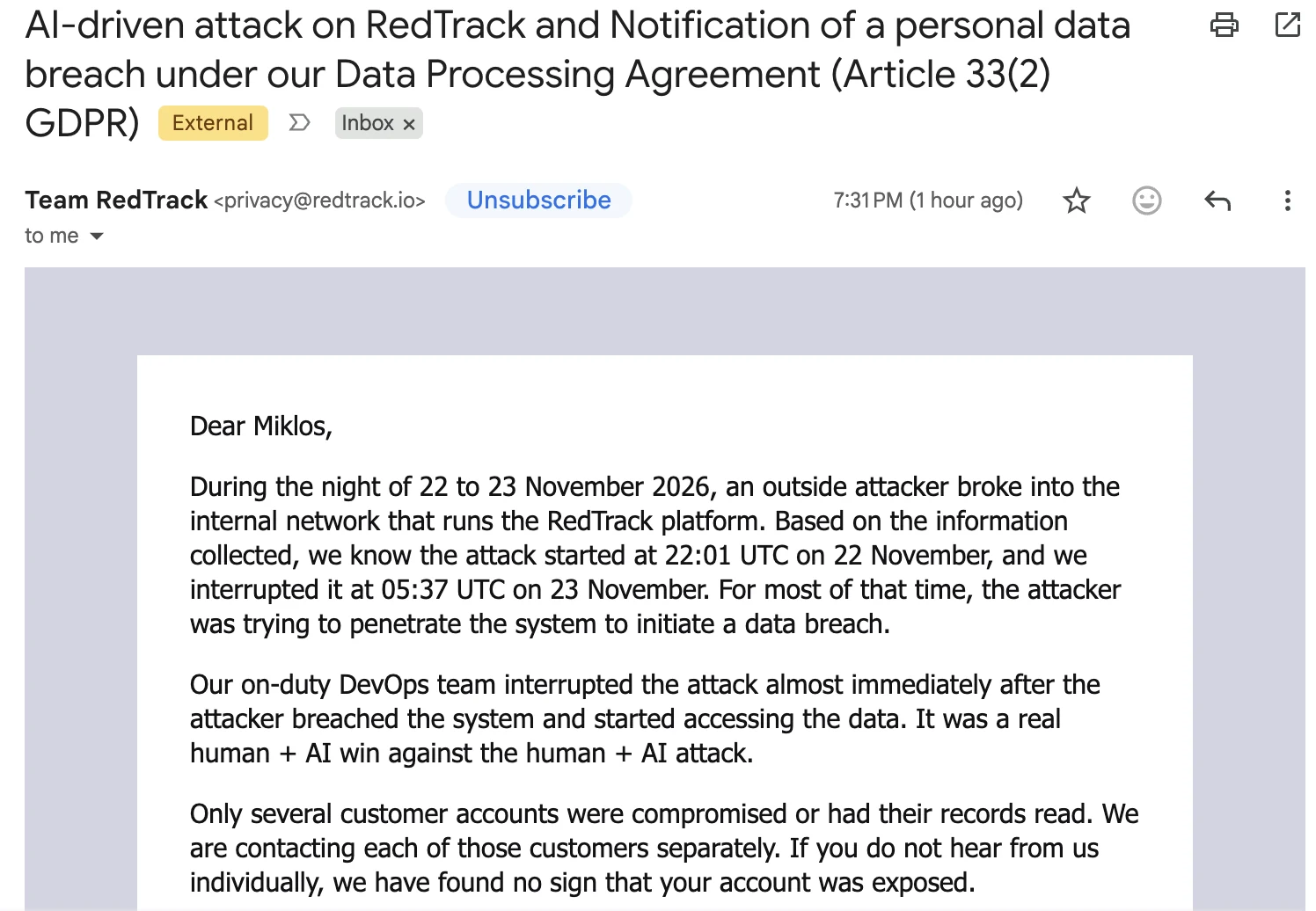
RedTrack’s notice of 24 November, as it reached my inbox.
The attack began at 22:01 UTC on 22 November. For most of the night, RedTrack says, the attacker was trying to get further into the system. Between 04:24 and 05:07 UTC, the attacker received a short extract of the live conversion and postback events passing through one of RedTrack’s servers. At 05:37 UTC, RedTrack blocked the attack and removed the access.
Several customer accounts were entered or had their records read. RedTrack says it’s contacting those customers one by one; if a customer doesn’t hear from it, RedTrack has found no sign that their account was entered. It also has evidence of misuse in 3 advertising accounts, through access tokens recorded in its logs, and of phishing or fraud tied to 7 accounts.
The subject line calls it an “AI-driven attack”, and the email describes the outcome as a win of humans plus AI over an attack by humans plus AI. It does not say what the AI did, on either side.
RedTrack says it has informed the Cypriot data protection authority and the police.
The Logs Held the Keys
According to RedTrack, the logs it reviewed show no sign of access to its databases, which hold the clicks, conversions and reports. The log store is another matter. RedTrack lists what it contained:
- API keys and session tokens
- advertising-network tokens
- private keys of certificates supplied by customers
- the text of emails the platform sent
- conversion records with end buyers’ hashed personal data
RedTrack says its evidence points to targeted searches rather than a mass copy, but that it can’t tell exactly what the attacker looked at.
Keeping secrets out of logs is basic security advice. OWASP’s logging guidance lists session identifiers, access tokens and encryption keys among the data that should not be recorded there. A log is supposed to record what happened to the keys. This one kept copies of them.
RedTrack says it replaced the API keys of all users, publishers and advertisers, so the old keys no longer work. It renewed the advertising-network credentials it holds for Meta, Google, TikTok, Bing, Snapchat and Pinterest, and it fixed or switched off the product features that had been misused. It does not say which features those were.
How far back the log store goes is not in the notice. RedTrack’s GDPR page gives a 12-month rolling retention for log-level campaign-tracking data; whether the log store followed it is one of our questions.
Hashed Is Not Anonymous
The people with the least say in this are the end buyers, who clicked an ad run by a RedTrack customer and then bought something or signed up. They have no account with RedTrack, and the notice doesn’t go to them.
RedTrack’s notice names in particular the buyers of customers who use the Facebook conversions integration. Meta’s Conversions API requires email addresses, phone numbers and names to be hashed with SHA-256 before they are sent.
Hashing turns the same input into the same output every time. So anyone with a list of email addresses or phone numbers can hash them and look for matches. The US Federal Trade Commission warned in 2024 that hashes are not anonymous and can still be used to identify people.
The 43 minutes of live conversion events add to this. RedTrack doesn’t say what those events contained.
For this data, RedTrack is a processor working for its customers. Each customer is the controller, so it is up to them to decide whether to report the breach to their regulator and whether to tell the buyers. For customers’ own account data, such as their team’s logins, RedTrack’s GDPR page says it is the controller itself.
Replacing a Certificate Doesn't Revoke It
Many RedTrack customers run their tracking links on their own subdomain, pointed at RedTrack and protected by a certificate. RedTrack issues free certificates for these domains, and some customers upload their own.
RedTrack says the attacker had access to the private keys of these certificates and that it treats them as exposed. Its notice warns that until a certificate is replaced, someone who can intercept traffic to the domain could read it or imitate it. An old certificate stays valid until it is revoked or expires, even after a new one is installed.
RedTrack tells customers who supplied their own certificate to have it revoked, because a replacement doesn’t cancel the old certificate. That is good advice. For the certificates it issued itself, RedTrack only says it is reissuing them and that customers have nothing to do. Whether it also revokes the old ones, the notice does not say.
A Phishing Risk That RedTrack's Email Setup Doesn't Reduce
RedTrack expects phishing and fraud aimed at its customers’ teams, partners and end buyers, using email addresses and knowledge of their campaigns. It already has evidence of this for 7 accounts. With the text of the platform’s emails in the log store, convincing fakes would be easier to make.
On 24 November we looked up redtrack.io’s DMARC policy, the setting that tells receiving mail servers what to do with mail that fakes a domain’s address. It is “p=none”, which asks them to take no action. So a fake email from a redtrack.io address is not rejected on that basis. Spam filters may still catch it, but nothing guarantees they will.
The real notice contains no login link. Treat any email about this incident that asks you to click and sign in as suspect, and go to RedTrack by typing its address.
What to Do If You Use RedTrack
RedTrack’s notice asks customers to do the following:
- API keys: update the key in every script and integration that uses it. RedTrack advises the new keys under Tools > Integration > API keys and says the legacy keys will be removed.
- Ad-network connections: delete the credentials stored in RedTrack, create new ones and reconnect. Check recent activity and ad spend in those ad accounts.
- Password: change your RedTrack password, and ask your team members to do the same.
- Your own certificate: if you uploaded one for a tracking domain, ask your certificate authority to revoke it, then create a new private key and certificate and install them.
- Conversion API integrations: renew their secret keys.
- Your GDPR duties: as controller, you have 72 hours from becoming aware of a breach to notify your supervisory authority, unless the breach is unlikely to put people at risk. If the risk to them is high, you must also tell the people concerned. RedTrack says it will help with the information you need.
Two more steps of our own. Be wary of any email or message about this incident that contains links. And if you no longer use RedTrack, as I don’t, you can ask it to delete your account under Article 17 of the GDPR.
What the Notice Leaves Open
RedTrack says its on-duty team stopped the attack “almost immediately” after the attacker reached the data. By its own timeline, the attacker was inside for seven and a half hours, copied data from several systems and received live conversion events for 43 minutes, a stream that ended half an hour before the cut-off. The notice never gives a time for when RedTrack first spotted the intrusion. One sentence even reads as if it became aware of the attack at 05:37 UTC, when it blocked it.
“Several” is not a number, and RedTrack can’t say how much of the log store was read. It doesn’t say how the attacker got in.
The notice also says the new API keys it recommends have been available since 16 November, six days before the attack. It may be a typo or an earlier change; we’ve asked. And it says RedTrack doesn’t hold full payment card numbers, which leaves open what partial card data it does hold.
The notice reached me on 24 November at 17:31 UTC, about 36 hours after the cut-off. It mentions an earlier email or in-app message on 23 November about the ad-network credentials; I did not receive that one. It was sent through Klaviyo, an email marketing service, with an unsubscribe link and an open-tracking pixel. So the breach notice, like any newsletter, reports back when it is opened.
We’ve sent RedTrack these questions and will update this article when it replies.
How we report
We check claims against primary sources, ask the companies involved for comment and never publish personal data from a leak.
Our reporting has been cited by the FBI and CISA, Tom’s Hardware, PC Gamer, TechRepublic and the Financial Post.
Spotted an error or have a tip? Email [email protected] — we reply within one working day.
Who cites us