 PureVPN Review

Score Breakdown:
Price from: $2.15/mo
Available on:


8.3
total score
Things To Like
Things Not To Like
PureVPN Plans (November 2026)
Standard, 2 Years + 3 Months
$2.15 per month
- VPN for 10 devices, tracker blocker
- $58.20 for 27 months
- Renews at $47.95 a year
Max, 2 Years + 3 Months
$3.55 per month
- Adds password manager, data removal, dark web monitoring, eSIM
- $95.85 for 27 months
- Renews at $84.95 a year
Standard, 1 Month
$12.95 per month
- VPN for 10 devices, tracker blocker
- 31-day money-back guarantee
- Renews at $12.95 a month
PureVPN has been selling VPN subscriptions since 2007. It’s run by GZ Systems Limited, which moved from Hong Kong to the British Virgin Islands in 2021, and belongs to PureSquare, a group led by PureVPN co-founder Uzair Gadit. The pitch hasn’t changed much over the years: apps for nearly every device, low prices on long plans and add-ons such as port forwarding and dedicated servers.
Updated 3 November 2026: plans and prices, servers, apps, features, privacy policy, audits and security incidents, rechecked on PureVPN’s website, help center and policies, in court records and in press reports. Test results quoted in this review come from the sources named; the app screenshots are from 2021.
Is PureVPN safe?
For everyday use, yes. It encrypts your traffic on public Wi-Fi and gets you an IP address in another country. If you need a VPN to protect you from a determined adversary, we’d pick one with a cleaner record.
The record is the problem. In 2017, an FBI affidavit in a US cyberstalking case said PureVPN had linked the suspect’s account to his home and work IP addresses, at a time when it advertised that it kept no logs. PureVPN rewrote its policy afterwards and had it assessed four times between 2019 and 2023. Then the assessments stopped. PureVPN still calls itself an “always-on audit” VPN, but it hasn’t announced a new one since April 2023, and you get the last report only by asking for it by email.
What you do get is a lot for little money. The Standard plan costs $2.15 a month for the first 27 months, renews at $47.95 a year and covers 10 devices, with a 31-day money-back guarantee. If you host a game server, reach a camera at home or need a fixed IP address, PureVPN sells port forwarding, dedicated IPs in 7 countries and whole dedicated servers as add-ons.
Summary
PureVPN now comes in three tiers. Standard is the VPN with a tracker and ad blocker, Plus adds a password manager, and Max adds data removal, dark web monitoring and an eSIM with 3 GB of mobile data. Each is sold for 1 month, 1 year, 2 years or 5 years. The network has more than 6,000 servers in 80+ locations across 65+ countries, and about half of those locations are virtual.
What’s new since our previous review (May 2023):
- Three tiers instead of one plan, and a 5-year plan. Standard on the 2-year plan costs $2.15 a month for the first term (we listed $2.91 in 2023).
- A smaller network. PureVPN claimed 140 countries in 2023 and lists 65+ today, after removing 64 virtual locations; 41 of the remaining locations are still virtual.
- One more no-logs assessment (February to April 2023). It is the most recent one.
- WireGuard is a standard protocol now (it was in beta in 2023), and OpenVPN connections in 6 countries can use encryption keys generated by a quantum computer.
- An Apple TV app and a tracker and ad blocker.
- Two flaws in the Linux apps, made public in September 2025: an IPv6 leak and a reset of firewall rules.
Key facts:
- Company: GZ Systems Limited, British Virgin Islands (Hong Kong until 2021)
- Price: from $2.15 a month (Standard, 2 years + 3 months), renews at $47.95 a year; $12.95 for a single month
- Devices: 10 at the same time
- Network: 6,000+ servers, 80+ locations, 65+ countries
- Protocols: WireGuard, OpenVPN, IKEv2
- Refund: 31 days, but not for crypto or app-store payments
 Speed
8.5
PureVPN says its servers have 20 Gbps ports and that bandwidth is unlimited. How fast it runs for you depends mostly on the protocol and on how far your traffic travels. WireGuard is normally the quickest choice. OpenVPN over TCP is slower but gets through restrictive networks more often.
Virtual locations add distance you can’t see. You get, say, a Turkish IP address, but the server sits in another country, so your data takes the longer route.
Independent results point in different directions. AllAboutCookies measured an average download loss of about 20% from the US in August 2026: 412 Mbps on a Dallas server from a 428 Mbps line, 279 Mbps to Brisbane, with uploads 27–45% lower. CyberInsider, in a review dated February 2026, got 59 Mbps from a 500 Mbps line on a US server and 18 Mbps in London. Neither says which protocol it used. If speed is what you’re buying it for, use the 31-day refund window to try your own connection on WireGuard.
 Locations
8.5
PureVPN’s server page lists 6,000+ servers in 80+ locations across 65+ countries. In 2023 it claimed 140 countries.
The difference is mostly a clean-up of virtual locations. According to a help center article (updated February 2026), PureVPN dropped 64 of its 88 virtual locations because users complained that the IP address didn’t match the country they had picked and that connections were unstable. It kept 24 and turned 17 physical locations into virtual ones. That leaves 41 virtual locations, among them China, India, Turkey, the UAE, Ireland and Sweden.
A virtual location gives you an IP address from one country while the server stands in another. Most streaming and shopping sites only look at the IP address, so it rarely matters there. It does matter if you want your traffic to stay out of a country, or you need it to really pass through one. Check the list before you buy.
Torrenting is allowed, and the apps label the servers meant for it (P2P).

The Windows app’s locations screen in 2021, with P2P labels on servers that allow torrenting (older version).
PureVPN’s Netflix page promises “the complete US Netflix catalog” from abroad, and it has guides for Disney+, ITVX and Peacock. Testers report mixed results. AllAboutCookies got the US, Canadian and UK Netflix libraries in August 2026, but not the Australian one; CyberInsider had frequent buffering on US servers. Streaming services block VPN addresses in waves, so any VPN’s streaming record is a snapshot. For Netflix, see our best VPNs for Netflix.
Add-ons
The add-ons are where PureVPN differs most from the big names. Prices are in the Pricing section.
- Port forwarding: opens ports on the VPN connection, so a game server, a torrent client or a camera at home can accept incoming connections. You set the rules in the member area.
- Dedicated IP: an IP address only you use, in the USA, the UK, Singapore, Canada, Germany, Malta or Australia. It means fewer CAPTCHAs and you can be whitelisted by your bank or office network, at the cost of being easier to recognize. The privacy policy says the address stays on record for 25 days after your subscription ends. It can be combined with port forwarding.
- Dedicated server: a whole server for you or your team.
- Residential Network: IP addresses of home internet connections in the US and the UK, with a monthly data allowance. They look less like a VPN to websites. PureVPN’s help center says residential VPNs “rely on users agreeing to share their IP address and some of their traffic”; it doesn’t say where its own residential addresses come from.
- Multi-login: up to 10 more devices on top of the 10 included.
 Privacy
7.0
GZ Systems Limited, PureVPN’s operator, is registered in the British Virgin Islands (terms of service). The company was based in Hong Kong for 14 years and moved in 2021. How much a jurisdiction protects you depends less on the map than on what the company stores, though, and that’s where PureVPN’s history matters.
The 2017 FBI case
In October 2017, the FBI arrested a Massachusetts man for a long cyberstalking campaign against his former roommate. According to the FBI affidavit quoted by TorrentFreak, “PureVPN was able to determine that their service was accessed by the same customer from two originating IP addresses”: his home connection and the company he worked for. PureVPN’s privacy policy said at the time that its servers recorded “the time at which you connect” and nothing that could tie activity to a user. He was later sentenced to 17 and a half years in prison.
Few people will feel sorry for a convicted stalker. The point is that PureVPN marketed itself as a no-logs VPN while it could still match an account to the IP addresses it connected from.
No-logs policy and assessments
The policy has been rewritten since. PureVPN’s no-logs claim was checked by Altius IT in 2019, by KPMG in 2020 and 2021 (the 2021 check was a “snap assessment” without notice), and in a fourth assessment carried out on servers in several countries between 16 and 22 February 2023, with follow-up checks until April 2023. That last report, by an auditor PureVPN now calls a “well known audit firm”, found the policy kept but made “two observations regarding our legacy protocols”.
Two things weaken this. No assessment has been announced since April 2023, although the no-log assessment page describes PureVPN as an “always-on audit VPN” that can be checked at any time. And the reports aren’t published: you request the latest one by email.
What PureVPN keeps
The privacy policy (last updated 22 October 2026) lists:
- Account: name, email address, password and payment method.
- For customer support: the day you connected (not the time) and the name of your internet provider (not your IP address).
- Usage: the total amount of data you use, and app analytics and crash reports.
- Add-ons: a dedicated IP stays in the records for 25 days after the subscription ends. With the tracker and ad blocker switched on, PureVPN “will be able to view the domains” during the connection.
It says it keeps no browsing activity, no connection timestamps and no originating IP addresses.
PureVPN’s servers run on hard disks with full-disk encryption, not RAM only. Its blog argues that encryption gives the same protection once a server is switched off. That’s a fair point about seized hardware, but a RAM-only server can’t keep anything after a reboot even if someone wanted it to.
Requests from authorities
According to its transparency report for 2024, PureVPN received 60,385 complaints and requests that year. Most were copyright notices (59,126). Six were subpoenas asking for “basic details such as names or addresses”, and 24 were emergency disclosure requests; PureVPN says it disclosed nothing. The warrant canary in its Trust Center, meanwhile, says “We have not received any subpoenas”. We’d go by the transparency report, which is the more detailed of the two.
Encryption and protocols
The apps use WireGuard, OpenVPN (UDP and TCP) and IKEv2; PureVPN’s protocol page lists L2TP for older devices only. OpenVPN uses AES-256 encryption. PureVPN advertises a kill switch and protection against IPv6, DNS and WebRTC leaks.
The “quantum-resistant” encryption deserves a note. On OpenVPN, in 6 countries (the US, the UK, Australia, Germany, Canada and the Netherlands), PureVPN uses encryption keys generated by a quantum computer from Quantinuum. Better randomness is welcome, but it doesn’t make the key exchange resistant to quantum attacks, which is what “post-quantum” encryption usually means.
Leaks and security problems
In September 2025, two flaws in the Linux apps (graphical app 2.10.0, command-line app 2.0.1) were made public as CVE-2025-59691 and CVE-2025-59692. With IPv6 on, traffic could leak outside the tunnel, and the app wiped the computer’s own firewall rules. PureVPN’s security advisory confirmed both and promised a fix by mid-October 2025. Its Linux release notes (updated June 2026) still list 2.10.0 as the latest graphical app, so we couldn’t confirm the fix. On Linux, switch off IPv6 until you’ve checked.
Other tests disagree. AllAboutCookies found no DNS or WebRTC leaks on Windows in August 2026; CyberInsider reported DNS leaks in the Windows app on some servers and modes in February 2026.
 Ease of Use
8.5
PureVPN has apps for Windows, macOS, Linux (with a graphical app and a command-line version), Android, iOS, Android TV, Fire TV and Apple TV, and a DD-WRT applet for routers. One subscription covers 10 devices at once.
The browser extensions for Chrome, Firefox, Edge and Brave are proxies: they change the IP address websites see in that browser, but they don’t encrypt the rest of your device’s traffic.
Features differ by platform. Split tunneling, which lets you choose the apps that use the VPN, works on Windows, Android, Android TV and Fire TV, but not on macOS or iOS.

Windows app settings in 2021: auto-connect and the kill switch, called IKS (older version).

The Android app in 2021: menu, locations and the split tunneling setting (older version).
According to AllAboutCookies, about a third of the desktop dashboard is given over to selling add-ons, and the locations tab is “a bit laggy”. The password manager, data removal and dark web monitoring come with the Plus and Max tiers and run in the same app.
 Support
8.0
PureVPN offers live chat around the clock, email tickets and a help center with setup guides for each device, troubleshooting articles and billing answers. The apps have a help section that links to the same articles and to the chat.

In-app help in the 2021 Windows app: FAQs, support tickets and live chat (older version).
The help center is spread over three addresses (support.purevpn.com, purevpn2.helpjuice.com and intercom.help), so a search on one may miss an article on another. Refunds are requested by email.
 Pricing
9.0
PureVPN sells three tiers. All include the VPN for 10 devices and the tracker and ad blocker; Plus adds the PureKeep password manager; Max adds data removal, dark web monitoring and an eSIM with 3 GB of data for 30 days. The tiers come as 1-month, 1-year, 2-year and 5-year plans.
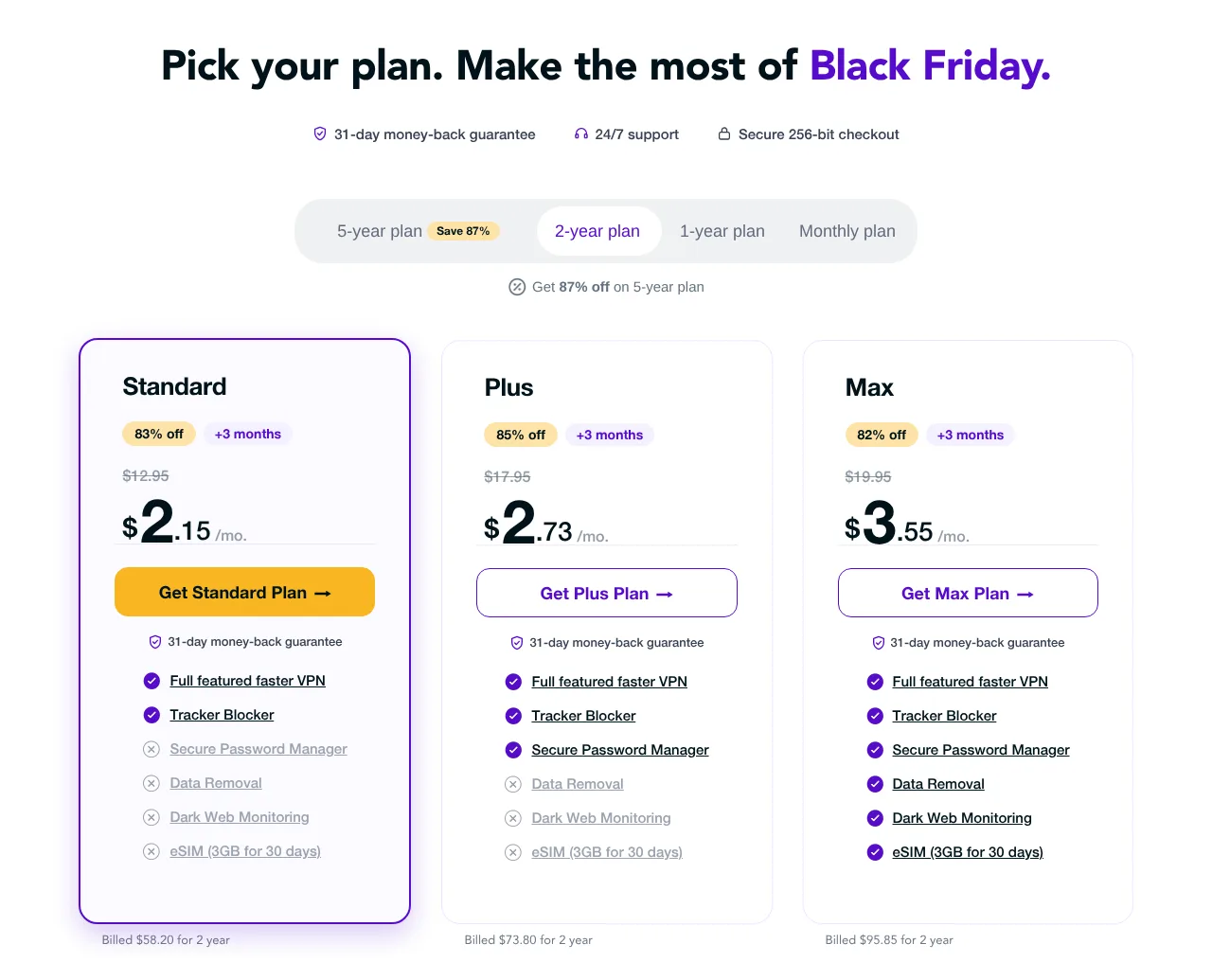
Prices (as of 3 November 2026)
PureVPN was running a Black Friday sale when we checked its order page, so these first-term prices may change:
Ignore the small print at the bottom of the order page, which says the plan “renews at $2.15/mo after 27 months”. The plan itself says $47.95 a year, and so does PureVPN’s Renewal Prices page. PureVPN says it emails you before a price change.
Our link opens a PureVPN offer page with the same 2-year and monthly prices, 4 extra months on the 1-year plan (16 months for the 1-year price) and no 5-year plan.
Add-ons
The add-on prices change with the plan length; the 1-year and 5-year plans sit in between.
Which plan makes sense?
- Just the VPN: Standard on the 2-year plan. $58.20 for 27 months, then $47.95 a year.
- Five years in one go: only if you’re sure. $1.69 a month is the lowest price, but $101.55 is a lot to pay up front for a VPN whose last audit is from 2023.
- Password manager: Plus costs 58 cents a month more on the 2-year plan. Worth it only if you don’t already use one.
- Max: data removal and dark web monitoring are services you can also buy separately; compare before you pay $3.55 a month.
- Monthly: $12.95 is expensive; the 1-year Standard plan costs $40.80 in total.
Good to know:
- Money-back guarantee: 31 days from your first purchase. Its refund policy excludes renewals, special accounts and payments through CoinPayments (crypto), Google Play and the App Store.
- Trial: the website’s 7-day trial costs $0.99 (Standard) or $1.99 (Max) and becomes a 1-year plan at $40.80 or $89.95 unless you cancel. Trial renewals are not refunded.
- Payment methods: credit and debit cards, PayPal, Google Pay and cryptocurrency through CoinPayments.
Conclusion
PureVPN is cheap, works on almost anything with a screen and sells add-ons such as port forwarding and dedicated servers. For streaming, public Wi-Fi and getting a home-country IP address abroad, that’s a good deal.
For privacy we’re more careful. A VPN that handed the FBI enough to identify a user in 2017 needs a steady stream of audits to win back trust, and PureVPN’s stopped in 2023. Add the virtual locations, the hard-disk servers and the open question over the Linux fix. If privacy is the main reason you want a VPN, compare it with our list of the best VPNs first.