 IPVanish Review

Score Breakdown:
Price from: $2.19/mo
Available on:


8.9
total score
Things To Like
Things Not To Like
IPVanish Plans (November 2026)
Essential, 2 Years
$2.19 per month
- VPN for unlimited devices
- $52.56 for the first 2 years
- Then $99.99 a year
Complete, 2 Years
$2.79 per month
- VPN + antivirus + phone support
- $66.96 for the first 2 years
- Then $109.99 a year
Essential, 1 Year
$3.89 per month
- VPN for unlimited devices
- $46.68 for the first year
- Then $99.99 a year
IPVanish is a fast US VPN for as many devices as you own. Its privacy record is the part to read before you buy.
The service started in 2012 under Highwinds, a network company in Florida, went to StackPath in 2017 and has been, since 2019, part of the New York company now called Ziff Davis. Ziff Davis also publishes PCMag, CNET, ZDNET, Mashable and Lifehacker, and IPVanish quotes some of its sister sites on its own pricing page. Their reviews may well be fair. It is still a family recommendation.
Updated 6 November 2026: plans and prices, network, apps, features, privacy policy, audits and security record, rechecked on IPVanish’s website, help center, Trust Center and blog, and in independent sources. The speed and support notes from our earlier review (last updated January 2023) were not re-tested. Other test results come from the sources named.
Is IPVanish safe?
For everyday privacy, yes. Its policy says it doesn’t log your browsing, IP address, connection times or DNS requests. Auditors checked that three times, Leviathan in 2022 and Schellman in 2025 and 2026. IPVanish’s quarterly transparency reports, published since late 2024, list no data handed over.
The history is why the audits matter more here than elsewhere. In 2016, when Highwinds owned IPVanish, it told US Homeland Security investigators that it didn’t log usage, then handed over a user’s name, email, real IP address and connection times anyway (TorrentFreak, from court documents). StackPath, which bought the company in 2017, said in 2018 that it had found no logs and no logging systems.
Two smaller points. The audit reports are not public; customers can read them in their account. And in March 2026 researchers found a flaw in the Mac app that let other software on the Mac take full control of the computer. IPVanish fixed it in three days, but it was the second flaw of this kind in the same part of the app.
Summary
IPVanish sells three plans: Essential (the VPN), Complete (adds antivirus and phone support) and Advanced (adds cloud storage and a secure browser), each for a month, a year or two years. The network has 3,650+ servers in 150+ locations, according to IPVanish, and the apps use WireGuard, OpenVPN or IKEv2.
What’s new since our previous review (January 2023):
- A much bigger network: 3,650+ servers and 56,000+ IP addresses, up from about 1,000 servers and 40,000 IPs.
- Unlimited devices instead of 10.
- Three plans, Essential, Complete and Advanced; Complete and IPVanish Antivirus arrived in October 2026.
- Two more no-logs audits (2025 and 2026), quarterly transparency reports since late 2024, and RAM-only servers being rolled out (all servers by 2027, IPVanish says).
- Double Hop (November 2024), a dedicated IP add-on (October 2026) and WireGuard in the Apple TV app (July 2026).
- A Mac security flaw in March 2026, fixed within three days.
Key facts:
- Company: IPVanish, a Ziff Davis company (New York, USA)
- Price: from $2.19 a month ($52.56 for the first 2 years), then $99.99 a year; $14.99 for a single month
- Devices: unlimited
- Network: 3,650+ servers in 150+ locations, about 110 countries
- Protocols: WireGuard, OpenVPN, IKEv2
- No-logs audits: 2022, 2025, 2026 (reports for customers only)
- Refund: 30 days, on yearly and 2-year plans bought on the website
 Speed
9.0
IPVanish uses WireGuard by default. After a two-year rebuild of its network (50 Gbps server ports, two data centers in each major city), it says the average throughput per server rose by 41%. That is IPVanish’s own figure.
Independent tests found it fast. Tom’s Guide measured 738 Mbps with WireGuard to a nearby server in Dublin and 449 Mbps to the US, on a 10 Gbps line (March 2026). OpenVPN reached only 196–209 Mbps in the same test, and TechRadar saw the same gap in 2024: 230 Mbps with OpenVPN, up to 770 Mbps after switching protocol. So keep WireGuard unless a network blocks it. On Windows, the High-Speed Mode (OpenVPN DCO) makes OpenVPN faster, but it doesn’t work together with Scramble.
From our earlier review (last updated January 2023; not re-tested):
Its fastest servers are located in key countries such as the UK, Canada, and the US, where download speeds can reach up to 200 Mbps.
This is more than enough to stream HD and 4K movies effortlessly. Smaller countries are a bit problematic, where speeds usually reach only around 20–30 Mbps.
Now, mind that these are also more than enough to stream HD and 4K clips, but some other VPN networks offer much better speeds in these countries.
IPVanish connects in around 10 seconds, which is normal. I have not experienced any connection drops while using this VPN.
IPVanish is an industry leader when it comes to upload speeds. A big strength of IPVanish is upload speeds reaching up to 200 and 300 Mbps.
 Locations
9.5
IPVanish’s server page claims 3,650+ servers in 150+ locations and 56,000+ IP addresses, with at least 10 IP addresses per server for users to share. The country count depends on which IPVanish page you read: 113 in a blog post of October 2025, “55 countries” in one of September 2026. We counted 112 countries and territories in the server list. The regional totals on the same page add up to about 2,400 servers, not 3,650. So treat the headline numbers as approximate.
Some locations are virtual: the IP address belongs to one country, while the server stands in another. IPVanish says its apps label which locations are physical and which are virtual, so check the label if the exact country matters to you.
Streaming
The old version of this review said that so many IP addresses make blocks by Netflix almost impossible. That was too optimistic. IPVanish’s own help article on Netflix says Netflix blocks VPN servers and suggests split tunneling, so Netflix runs outside the VPN. Others’ tests went better: Tom’s Guide got into Netflix in the US, UK, Australia, Canada and Japan, plus BBC iPlayer, ITV, Channel 4 and Disney+ (after switching servers a few times) in March 2026. TechRadar passed 8 of 12 tests in 2024 and failed Netflix Canada. More in our guides to IPVanish and Netflix and the best VPNs for Netflix.
Torrenting and dedicated IPs
IPVanish allows P2P on all servers and offers a SOCKS5 proxy for torrent clients. Its terms let it close the accounts of people who infringe copyright. Its transparency report counts the notices (30,881 in the first quarter of 2026) and lists none answered with user data.
A dedicated IP costs extra: $48 a year with a yearly plan or $84 for two years with a 2-year plan (prices at checkout). It is available in New York, London, Paris, Frankfurt and Tokyo.
Where it doesn’t work
As a US company, IPVanish may not do business with Iran, North Korea, Cuba, Syria, Sudan, South Sudan, Crimea or the Donetsk and Luhansk regions. Its country list says its website is blocked in Qatar, Saudi Arabia, the UAE, Egypt, China, Kazakhstan, Myanmar and Cameroon.
 Privacy
7.5
IPVanish is a US company, owned by Ziff Davis, with its legal address in New York. US law can force it to hand over what it has, so what matters is what it stores. Ziff Davis is running a review of its businesses and sold one division in 2026; nothing has been announced for IPVanish.
What the privacy policy allows
The privacy policy (February 2025) says IPVanish doesn’t log your browsing, and its no-logs page adds IP addresses, connection times, DNS requests and traffic. What it does collect:
- Account and payment data (email, name, billing address, card details and an IP address), to process payments and prevent fraud.
- App analytics through Google’s Firebase: device and system, country, crash reports, session lengths, server use, protocol and what you tap in the app.
- Anonymous, aggregated performance data, which it says contains no IP addresses, timestamps or DNS requests.
Connection logs for troubleshooting stay on your device unless you send them. Session lengths and server use in an analytics tool are not a connection log, but they are not nothing either. On iPhone and Android you can sign up without an email address.
The 2016 case
In 2016, investigators of US Homeland Security asked Highwinds, then IPVanish’s owner, about an IPVanish IP address in a child-exploitation case. The company first answered that it didn’t log usage. After a second request, it gave them the user’s name, email address, real IP address and the times he connected to and disconnected from the chat network under investigation (TorrentFreak, 2018, from court documents). StackPath, which had bought Highwinds in 2017, said in 2018 that no logs existed and that IPVanish doesn’t log. IPVanish’s current pages speak of its “history” without naming the case.
Audits and transparency
- No-logs audits by Leviathan Security (2022) and Schellman (February 2025 and September 2026). The third no-logs audit included interviews, a review of server configurations and test traffic. The reports are not public: customers can download them in their account, journalists can ask by email.
- IPVanish says it audits its apps and source code every year too, but has published no such report.
- Quarterly transparency reports since late 2024 on its Trust Center. July to September 2026: 7 requests from governments, police and civil parties, 6,436 copyright notices, no data provided.
- Servers: a mix of encrypted hard drives and RAM-only machines. In April 2026, 870+ servers in 26 cities ran only in RAM; IPVanish plans to switch the whole network by 2027, and the apps can filter for RAM-only servers.
- IPVanish has held the VPN Trust Seal of the VPN Trust Initiative, an industry group, since 2023 (renewed in 2026).
Security record
- March 2026: SecureLayer7 published a flaw in the Mac app’s helper tool that let any program on the Mac run code with full system rights. Only users who had switched to OpenVPN were exposed; IPVanish fixed it in version 4.10.3 three days later. The flaw had no CVE number in the US vulnerability database by November 2026.
- The same helper had the same kind of flaw in 2018 (CVE-2018-10192). Both needed malicious software already on the Mac, so the risk was local. Still, the same helper failed the same way twice.
- TunnelVision (2024): IPVanish said all its apps were safe except Apple TV, which had no kill switch then.
- IPVanish supports only IPv4, and its apps block IPv6 so it can’t leak past the tunnel. In a 2020 test of the Windows app, AV-Comparatives found no leaks and a working kill switch.
- No breach of IPVanish’s servers or customer data has been reported.
 Ease of Use
9.0
IPVanish has apps for Windows 10 and 11 (also on ARM), macOS 13 and later, iPhone and iPad, Android, Fire TV, Android TV, Apple TV, Chromebooks (through the Android app) and Apple Vision Pro. Linux and routers are set up by hand with OpenVPN or WireGuard files; there is no Linux app (supported systems).
Connections are unmetered: you can protect every device you own with one account.
The only browser extension is Secure Browser, an isolated browser that runs in the cloud. It comes with the Advanced plan (30 hours a month) and is not a VPN extension.
The features worth knowing:
- Kill switch: on Windows, Mac, iPhone and Android, plus a separate Kill Switch app for Fire TV and Android TV.
- Split tunneling: apps and websites on Windows and Android, apps on Fire TV, websites only on Mac and iPhone.
- Scramble: hides OpenVPN traffic on networks that block VPNs (Windows, Mac, Android, Fire TV, Apple TV).
- Double Hop: sends your traffic through two servers (Windows, Mac, Chromebook, Android, iPhone).
- Threat Protection: blocks ads and malicious sites through DNS while you are connected, on every plan.
 Support
9.5
IPVanish answers around the clock by live chat, email and social media. Phone support runs Monday to Friday, 9 am to 5 pm Central Time, with numbers in the US, the UK, Mexico, Spain, Australia and Brazil. The help center lists it for everyone; the pricing page shows it only for the Complete and Advanced plans.
The help center has setup guides for each device. If the app won’t connect, our fixes for IPVanish connection problems cover the usual causes.
From our earlier review (last updated January 2023; not re-tested):
IPVanish has 24/7 live chat customer support. I was quite impressed with the live chat support person who I got in contact with.
I asked her a pretty complicated and technical question as a test, and she could immediately give the correct answer.
 Pricing
9.0
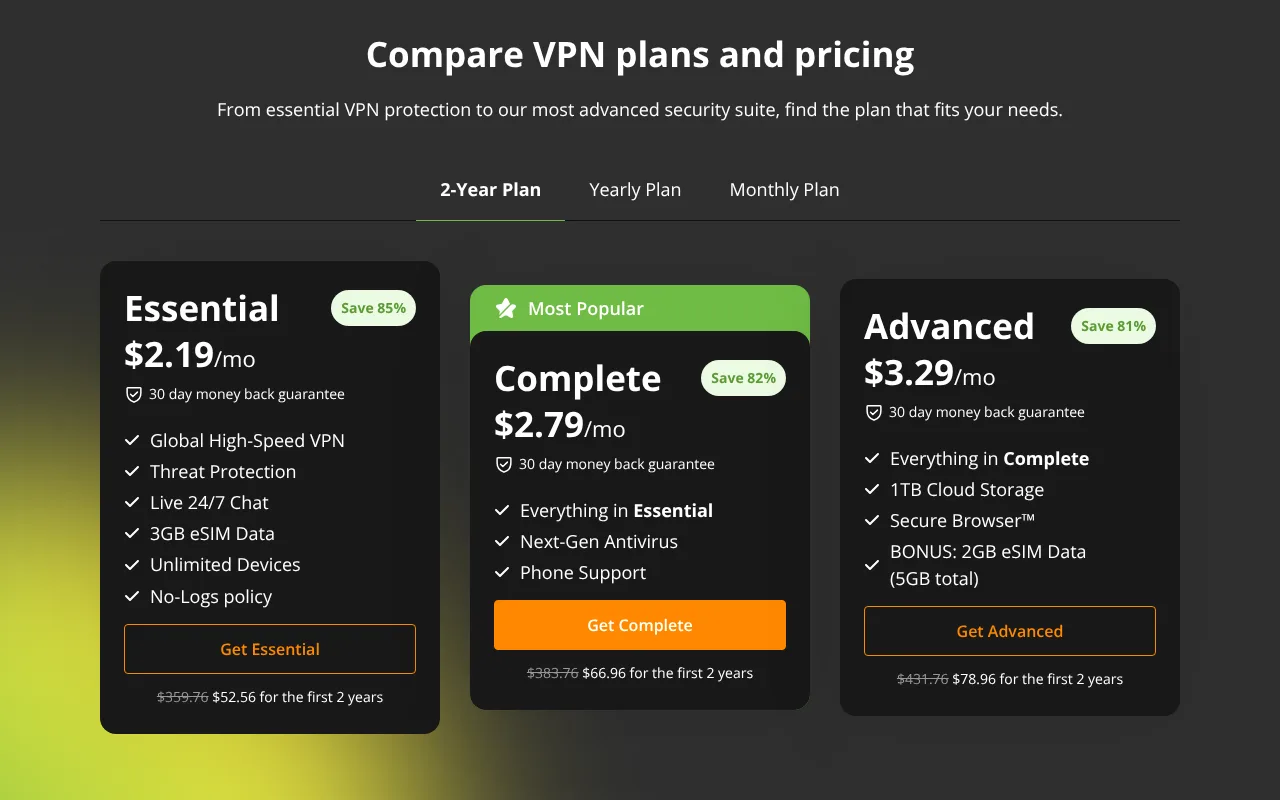
IPVanish sells three plans, Essential, Complete and Advanced, for 1 month, 1 year or 2 years. The VPN is the same in all of them; the bigger plans add antivirus, phone support, cloud storage and a secure browser.
Prices (as of 6 November 2026)
The first term is cheap; the renewal is not. Essential costs $52.56 for the first two years, then $99.99 every year, so the third year alone costs almost twice the first two together. The “Save 85%” badge compares the 2-year price with paying $14.99 every month. IPVanish’s renewal-price page lists Complete’s yearly renewals at the first-term prices ($57.48 and $66.96), which contradicts its own pricing FAQ ($109.99); we went with the FAQ. Renewal reminders arrive by email before the renewal date.
What each plan includes
Which plan makes sense?
- Most people: Essential for 2 years, $52.56. Put the renewal date in your calendar and decide then whether $99.99 a year is still worth it.
- You want antivirus on Windows or Mac anyway: Complete for 2 years, $66.96. IPVanish Antivirus uses the VIPRE engine.
- Advanced: only if you need 1 TB of backup and don’t already pay for cloud storage elsewhere.
- Just trying it: the 7-day free trial in the iPhone or Android app (with a yearly plan) or a yearly plan on the website, which you can cancel within 30 days. A single month costs $14.99 and can’t be refunded.
Good to know:
- Money-back guarantee: 30 days for first-time customers on yearly or 2-year plans bought on the website. Monthly plans, renewals and purchases through Apple, Google or Amazon don’t qualify (refund rules).
- Payment methods: Visa, Mastercard, American Express, Discover, UnionPay, Diners Club, PayPal, Google Pay, Apple Pay and Amazon Pay. No cryptocurrency.
- Cancelling: all plans renew automatically until you cancel; 2-year plans renew for one year at a time (pricing page).
Conclusion
IPVanish is a fast, easy VPN for a household with many devices, and since 2022 it has done a lot for its credibility: three audits, transparency reports, a RAM-only rollout. If you mainly stream and torrent, the test results above speak for it.
If privacy from authorities is the reason you want a VPN, the 2016 case, the US jurisdiction and audit reports you can only read after paying are three reasons to look at a provider outside the US first. Compare it in NordVPN vs IPVanish or in our list of the best VPNs.