Review
 Mullvad VPN Review

Score Breakdown:
Price from: €5/mo
Available on:


8.3
total score
Things To Like
Things Not To Like
Mullvad VPN Prices (November 2026)
1 Month
€5 per month
- 5 devices, all features
- No subscription, no auto-renewal
- 14-day refund (not cash or crypto)
1 Year
€5 per month
- €60 up front, same monthly price
- Pay by card, PayPal, bank or cash
- 5 devices, all features
Paid in Crypto
€4.50 per month
- 10% off with Bitcoin or Monero
- Any length
- No refunds on crypto
Mullvad is a VPN you can buy without telling anyone who you are. It costs €5 a month, for one month or for ten years.
Signing up gives you an account number and nothing else: no email, no name, no password. You can even mail cash to Sweden. The Swedish police found out in 2023 what that means in practice, when they came to Mullvad’s office for customer data and left with none.
In my tests it kept 85–88% of my download speed to Frankfurt and London. It skips what most VPN ads are about. There is no streaming promise, no live chat and no discount for paying years ahead.
Facts checked on 23 November 2026 on Mullvad’s website, terms, policies, blog and published audits, and in independent reporting. The speed, leak and kill switch results are my own tests from 23 November 2026; the Turkey section is my own use of Mullvad in September 2026. Mullvad has no affiliate program, so we earn nothing from this review.
Is Mullvad private?
More than almost any VPN you can buy, and not only on its own word.
Mullvad’s no-logging policy says it keeps no record of your traffic, DNS requests, connection times, IP addresses or bandwidth. Its servers run from memory only, so a server that loses power forgets everything. Independent firms have audited its apps, servers and systems eleven times since 2022, and the 2023 police visit tested the claim the hard way.
The weak spots are small and mostly not Mullvad’s doing. Android lets some traffic slip past every VPN, and no one has audited the servers since June 2024. Details under Privacy below.
Does Mullvad work in Turkey and other countries that block sites?
It did for me. I spent 30 days in Turkey from 13 September 2026. On the hotel Wi-Fi I couldn’t reach my crypto wallets, the sites I trade on or Discord, which I use every day and which Turkey has blocked since October 2024. The Wi-Fi password was the hotel’s name, which tells you how private that network was.
With Mullvad on, everything opened, on my phone and on my laptop. I connected to Romania and Germany with the default settings, and it connected every time.
My mobile data needed no VPN at all. I was roaming on my Romanian SIM, and roaming data usually travels back through your home operator before it reaches the internet, so the Turkish blocks never saw it. A Turkish SIM card gets filtered like the hotel Wi-Fi.
One trip is one data point. Turkey blocks VPN brands by name rather than by protocol: a 2023 order from the telecoms regulator BTK listed 16 services, and Mullvad wasn’t on it. İFÖD, a Turkish free-expression group, found Mullvad blocked on one provider, Vodafone, in its 2023 tests.
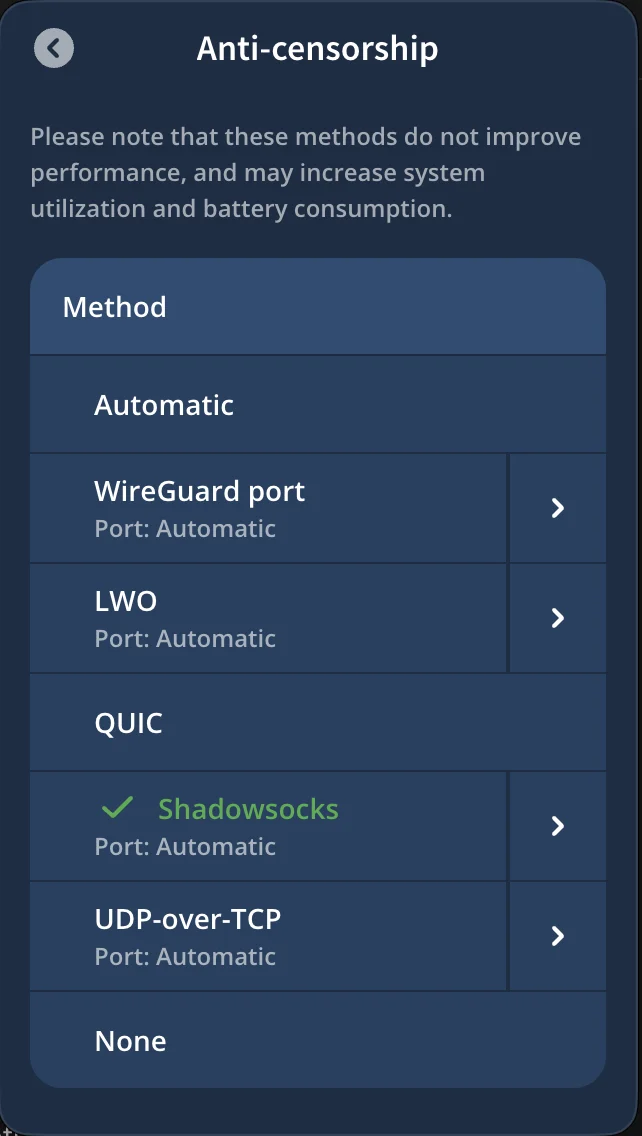
If the default connection fails, Mullvad’s anti-censorship settings disguise the traffic with Shadowsocks, QUIC, UDP-over-TCP or LWO, its lighter WireGuard obfuscation. For Russia Mullvad suggests European servers with one of those, and for China US servers. Mullvad also says it can’t get past Russia’s mobile whitelists, and Apple has removed its iPhone app from the Russian App Store. For Russia, Amnezia VPN is the better tool.
Install and test it before you leave. A VPN’s own website is often among the first things a censor blocks.
Summary
Mullvad is the most private VPN I know of that is still easy to use every day. You don’t hand it your identity, it has shown more than once that it doesn’t keep what it says it doesn’t, and its price never changes. In my tests it was fast to nearby servers and fine across the world, apart from one slow server in New York.
What you give up is streaming, live chat, more than five devices and the cheap long plans of the big brands. If you can live without those, it is the VPN I’d pick when privacy comes first.
 Pricing
8.0
Mullvad has one price: €5 a month, VAT included. You can pay for a month, a year or, as the pricing page offers, a decade, and the monthly price stays the same. There are no sales either, “not for Christmas or any other holiday”, Mullvad says.
How you can pay (as of 23 November 2026)
- Card, PayPal or bank transfer, plus Swish, iDEAL | Wero, Bancontact, EPS and Przelewy24: €5 a month
- Bitcoin, Bitcoin Cash or Monero: 10% off, so €4.50 a month
- Cash by post to Mullvad in Sweden, in euros, dollars, pounds, Swedish or Norwegian kronor and four more currencies
- Vouchers from resellers, Amazon among them in several countries
There is no subscription to forget. Mullvad stopped taking new recurring card and PayPal payments in 2022, so your time runs out and you top up when you want.
Refunds: 14 days, but none for cash or crypto payments, according to the terms. Purchases from the App Store or a reseller are refunded by them.
Devices: up to five at a time.
Is €5 cheap? Month to month, yes. A single month of NordVPN or ExpressVPN costs $14.99. On long plans, no. Over three years Mullvad works out at about $5.54 a month, while Surfshark, ExpressVPN and Proton VPN come to $3.75–4.66 if you pay two years up front, renewal included and tax not yet added (our VPN True Cost Calculator, prices checked 12 November 2026).
So the €5 doesn’t buy the lowest price. It buys no lock-in, no renewal surprise and the option to pay without your name on the bill.
Why 8 out of 10
Mullvad charges everyone the same €5 a month, with no renewal jump and no subscription to forget. Over three years, though, that comes to about $5.54 a month, more than most big brands’ two-year plans cost even after renewal, and that costs a point. Half a point goes for the limit of five devices, where most rivals allow ten. The other half is for refunds, which last 14 days instead of the usual 30 and don’t exist at all for cash or crypto payments.
 Speed
9.0
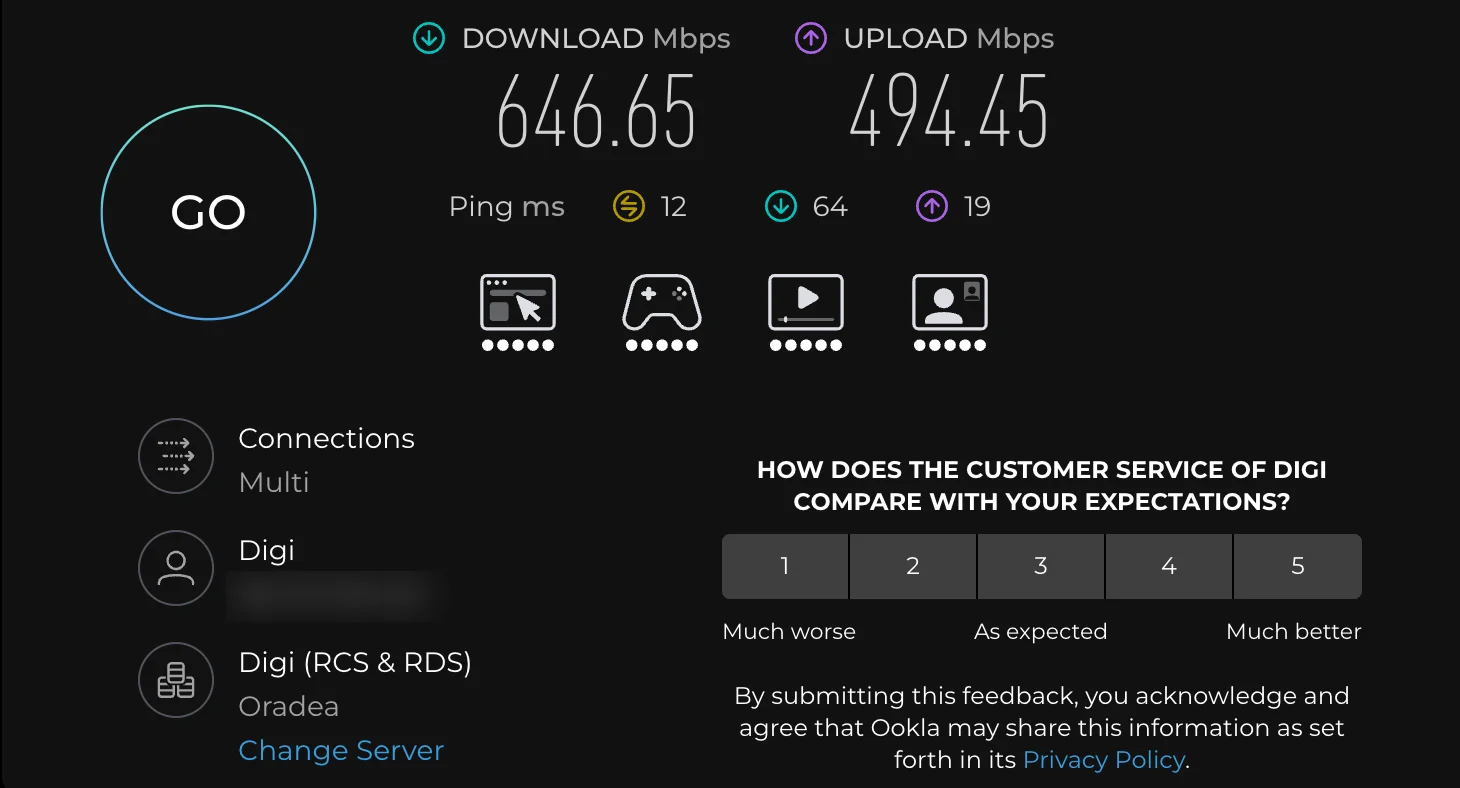
I tested Mullvad’s Mac app (version 2026.5) on 23 November 2026, between 13:30 and 14:15 Romanian time, on a 2021 MacBook Pro (M1 Max, macOS 27.0.1) over 5 GHz Wi-Fi, on a home line sold as 850 Mbps down and 500 Mbps up. Each result is the median of three Speedtest.net runs. My speed without the VPN is the median of six runs, three before the VPN tests and three after.
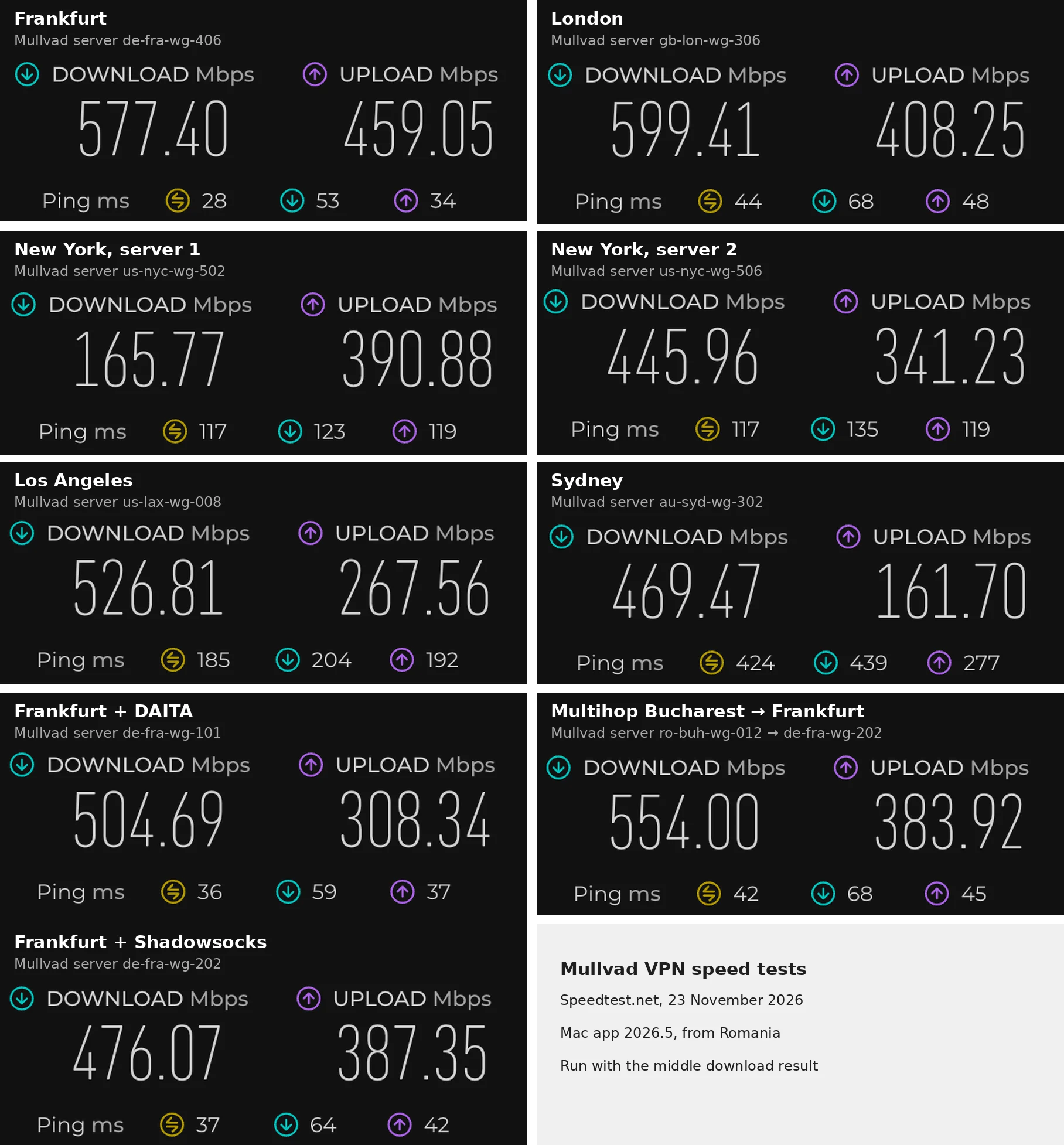
Nearby servers barely slowed me down. Frankfurt and London kept 85–88% of my download speed and added 16–33 ms of ping, which you won’t notice in a browser or on a video call.
Distance costs more. Los Angeles kept 77% and Sydney 69%, both still over 450 Mbps, but Sydney’s 423 ms ping is something you’d feel in games and calls.
New York shows why one server is never the whole story. The first one I got, us-nyc-wg-502, gave me 166 Mbps, less than a quarter of my line, while Los Angeles, further away, managed three times that. Half an hour later a second New York server, us-nyc-wg-506, gave me 446 Mbps, or 65%. If a location feels slow, pick another server in the same city; the app lists them one by one.
Mullvad’s extra protections cost less speed than I expected. With DAITA, which pads your traffic with dummy packets against traffic analysis, Frankfurt dropped from 85% to 74%. Multihop through Bucharest to Frankfurt kept 81%, and Shadowsocks obfuscation 70%.
Uploads varied more than downloads from one test server to the next, so read them as a rough guide. All of this is one Mac on one afternoon; evenings and other servers can look different.
Below are the screenshots: my line without the VPN (my IP address blurred), then, for each server, the run with the middle download result.
Why 9 out of 10
Nearby servers kept most of my speed, distant ones stayed above 450 Mbps, and uploads held up better than ExpressVPN’s in my tests on the same day. Half a point goes for the New York server that gave me less than a quarter of my line. The other half is for Sydney, where the ping was 423 ms, 150 ms more than ExpressVPN’s on the same line.
 Locations
7.5
Mullvad lists 572 servers in 50 countries and 91 cities, fewer countries than the big brands advertise. It says it uses no virtual locations: each server is one it owns or a whole machine it rents, and the server list marks which is which.
The list includes Turkey (Istanbul) and Romania (Bucharest), but not Russia or China.
Streaming
Mullvad doesn’t promise to unblock anything. Its help pages say Netflix often blocks VPNs and suggest split tunnelling, so the Netflix app skips the VPN altogether.
I tried anyway. On 23 November 2026 I connected to ten random US servers and opened Netflix in the browser on my Mac, and every one got Netflix’s proxy error. Some server may still get through, but you’d have to dig deep to find it, if it exists at all. Most people give up after ten tries. I did. Engadget got Netflix working in 13 of 15 regions in February 2026, which shows how quickly this changes.
If streaming is the point, pick a VPN that works at it. ExpressVPN got into US Netflix on the first try in my test the same day.
Torrenting
Mullvad’s terms don’t mention P2P. It removed port forwarding in 2023, which matters if you seed: fewer peers can connect to you.
Why 7.5 out of 10
Every location is a real server in the country it names, which not every VPN can say. But 50 countries is far fewer than the 110 to 150 the biggest brands list, and that costs 1.5 points. One more point goes for streaming, which I count here because getting into a country’s content is what many people want a location for. None of the ten US servers I tried got into Netflix. If you don’t stream, read this as 8.5.
 Ease of Use
9.0
Mullvad has apps for Windows (including ARM), macOS, Linux, Android and iOS, and setup guides for routers. Its Android app also runs on Android TV and Fire TV, though on Fire TV you install it by hand, because it isn’t in Amazon’s app store. There is no Apple TV app. The Mac app is a single screen: a map, where you’re connected and one big button.
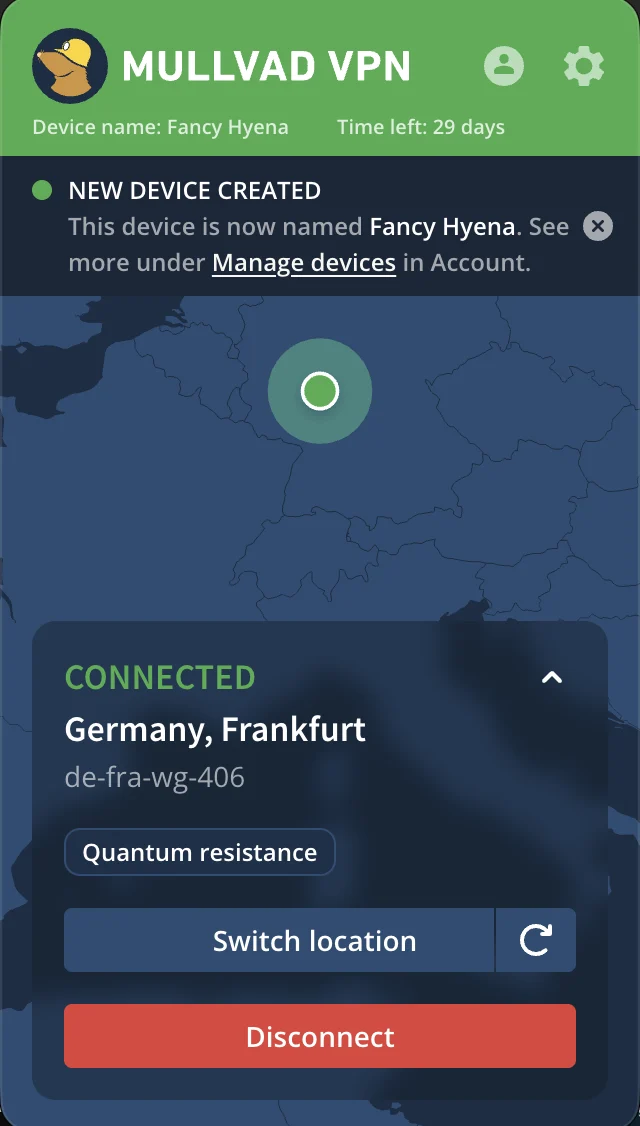
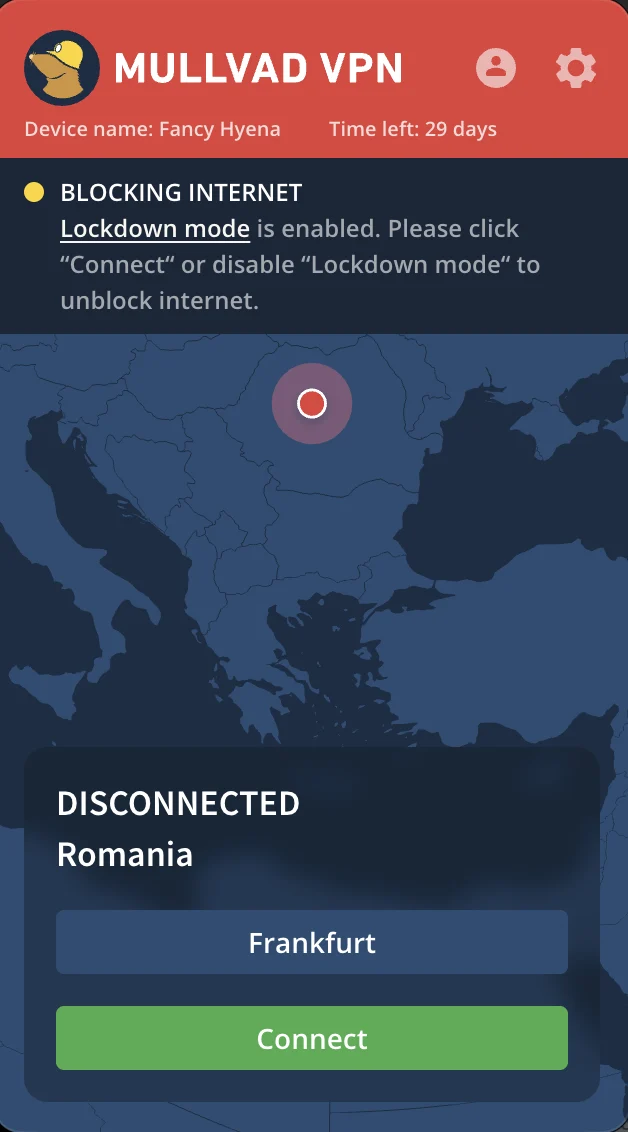
Signing up takes one click, because the app or website simply generates an account number. Write it down. It is your login, and Mullvad can’t send it to you, because it doesn’t know who you are. Each device gets a random name too. Mine became “Fancy Hyena”.
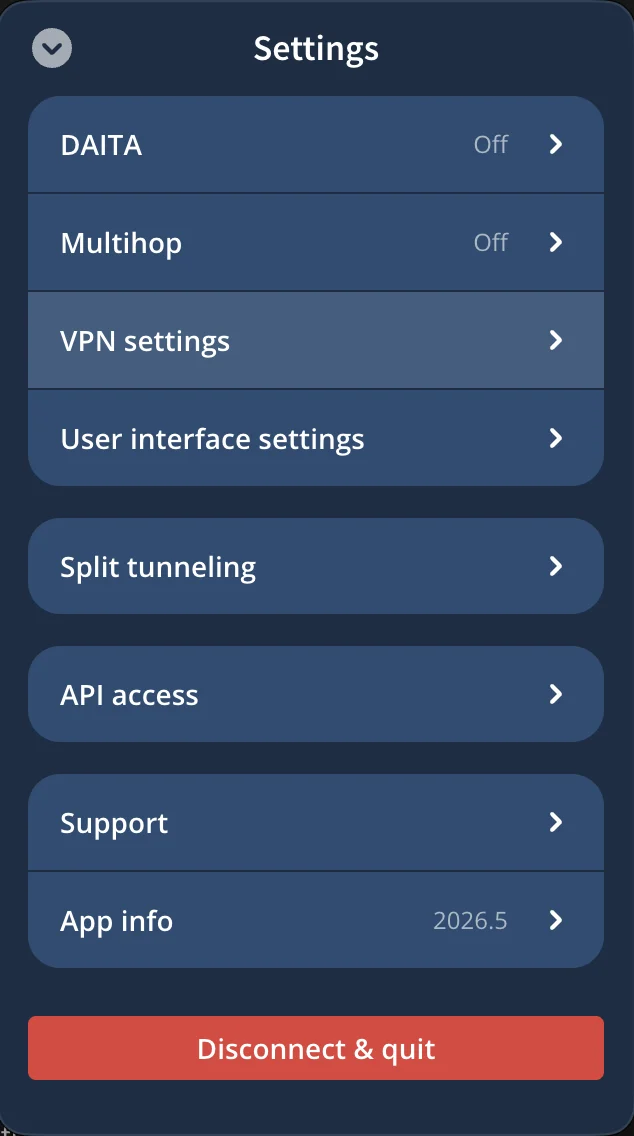
The features sit in Settings, and most of them are switches:
- Kill switch: always on, and you can’t turn it off. Lockdown mode goes further and blocks the internet even after you disconnect yourself.
- DAITA: dummy traffic that makes your traffic pattern harder to analyse; it costs some speed.
- Multihop: your traffic enters one server and leaves from another.
- Anti-censorship: Shadowsocks, QUIC, UDP-over-TCP or LWO, or Automatic.
- Split tunnelling: on Windows, macOS, Linux and Android, not on iOS.
- DNS content blockers: ads, trackers, malware and more.
- Quantum-resistant tunnels: on by default on every platform.
I tested Lockdown mode. With it on, I disconnected in the middle of a speed test: the upload stopped with an error, and the app showed “Blocking internet” until I connected again.
WireGuard has been the only protocol since 15 January 2026, when Mullvad dropped OpenVPN. For most people that changes nothing; if your router only speaks OpenVPN, it does.
Mullvad Browser, made with the Tor Project, is a separate free download.
Why 9 out of 10
Mullvad is as easy to use as ExpressVPN, just plainer to look at, and looks don’t cost points. Half a point goes for TVs: there’s no Apple TV app, and on Fire TV you install the Android app by hand. The other half is for routers, which you set up yourself, and only if they speak WireGuard.
 Support
7.0
Support is email only, at [email protected], which Mullvad runs on its own servers. There is no live chat.
Most answers are in the help centre, which is thorough and frank about what Mullvad can’t do, from Netflix to Russia. For a company that knows nothing about you, email is the logical channel, but when something breaks at night, you wait.
 Privacy
9.5
What Mullvad knows about you
Your account number, when your paid time runs out and, for each device, a WireGuard key and a tunnel address. That is the list in its no-logging policy, which also rules out logs of traffic, DNS requests, connection times, IP addresses and bandwidth. Even the five-device limit is counted in memory only.
How you pay decides what else exists. Cash leaves almost no trace. Card, PayPal and bank payments stay in Mullvad’s books as long as Swedish accounting law requires, and for cards Mullvad keeps the last four digits, not the number.
The 2023 police search
On 18 April 2023 at least six officers from Sweden’s national police came to Mullvad’s office with a search warrant, acting on a German request about a 2021 cyberattack. They left without anything, because there was no customer data to take. Since September 2023 every VPN server runs from RAM only.
Audits
Mullvad publishes its audit reports, the critical findings included, and its apps are open source on GitHub.
Fixing what auditors find is the point of audits, and Mullvad does. The gap is the servers: the last server audit is from June 2024, and the no-logs promise lives there.
My leak tests
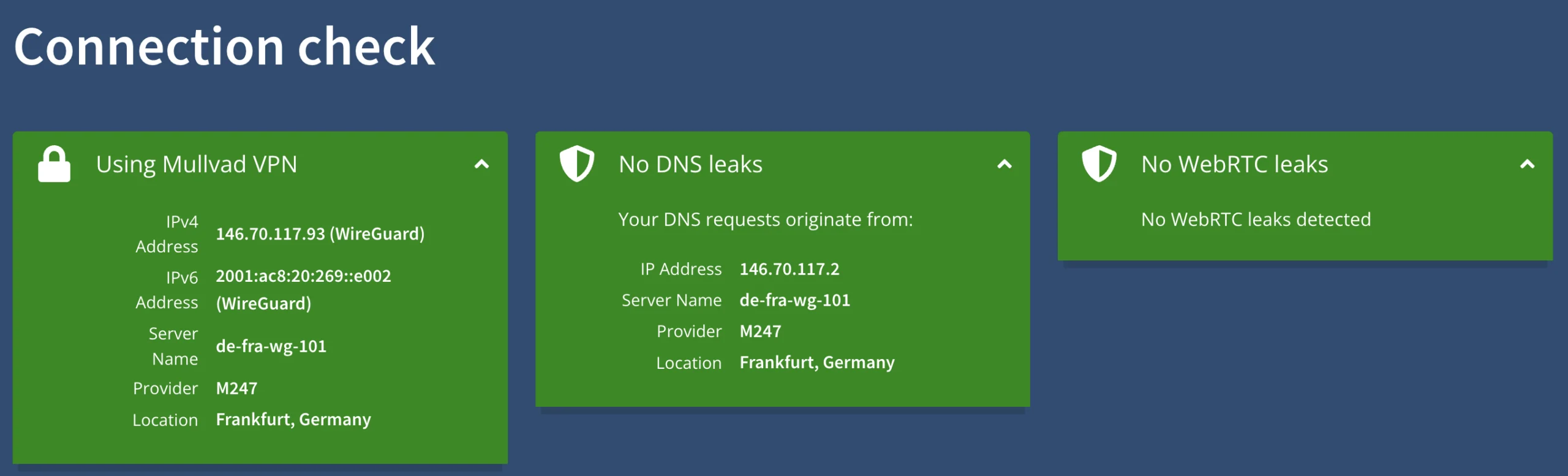
Connected to Frankfurt, I ran ipleak.net, the extended test on dnsleaktest.com and Mullvad’s own connection check. All three saw only the Mullvad server’s IPv4 and IPv6 addresses and Mullvad’s DNS server, with no WebRTC leak.
Android
Android is the weak spot, and it isn’t Mullvad’s fault. Mullvad has reported several ways Android lets some traffic bypass any VPN, and Google has declined to fix one found in May 2026. On a phone, Mullvad is as private as Android allows.
Sweden
Mullvad is a Swedish company, and Sweden appears on the “14 Eyes” lists of intelligence-sharing countries. What matters more is what Mullvad can be made to hand over. According to Mullvad’s legal page, Swedish telecoms law doesn’t count a VPN as a communications provider, so the data-retention rules for phone and internet companies don’t apply to it. A bill drafted in 2024 would extend those rules to messaging apps, not VPNs, and has been postponed with no new date. With nothing stored, there is little to hand over anyway.
Who owns Mullvad
Mullvad VPN AB and its parent Amagicom AB are fully owned by the two founders, Fredrik Strömberg and Daniel Berntsson, who started the service in 2009 and still run it. It lives on subscriptions: Mullvad says it never pays for reviews, has no affiliates and doesn’t pay influencers.
In July 2026 the Swedish newspaper Flamman revealed that Berntsson had personally given SEK 5 million to the Örebro Party, a new party running in Sweden’s national election; the gift made up 72% of the party’s 2025 income (The Register). Mullvad said the donation was private and that the company had no part in it.
Why 9.5 out of 10
Mullvad doesn’t know who you are, its servers run from memory, its apps are open source, and the Swedish police came for customer data in 2023 and left with nothing. Half a point goes because nobody has audited the servers, where the no-logs promise lives, since June 2024; Proton VPN’s was audited in May 2026. Android’s leaks affect every VPN, and a co-founder’s private donation doesn’t touch your data, so neither costs a point.
Mullvad VPN alternatives
Proton VPN comes closest on privacy: Swiss, open source and audited, with a free plan and a Stealth protocol for blocked networks. It asks for an email address and costs more after the first term.
For streaming, ExpressVPN and NordVPN work at it and say so; both are our affiliate partners.
In Russia, Amnezia VPN is built for the blocks Mullvad says it can’t beat.
FAQ
Is Mullvad VPN free?
No. It costs €5 a month, or €4.50 with crypto, and there is no free plan or trial. The 14-day refund covers card and PayPal payments, not cash or crypto. Mullvad Browser is free.
Does Mullvad keep logs?
It says it logs no traffic, DNS requests, connection times, IP addresses or bandwidth. It stores your account number, its expiry date and your devices’ WireGuard keys. A 2023 police search found no customer data, its servers run from RAM, and audits found no logging.
Is Mullvad VPN safe?
Yes. The apps are open source and audited, the servers run from RAM, and the kill switch can’t be turned off. On Android some traffic can slip past any VPN, Mullvad included, because of how Android works.
Does Mullvad work with Netflix?
Not in my test. On 23 November 2026 all ten random US servers I tried got Netflix’s proxy error. Mullvad doesn’t promise streaming, and its own advice is to let the Netflix app bypass the VPN with split tunnelling.
Does Mullvad still support OpenVPN?
No. Mullvad removed OpenVPN on 15 January 2026 and now uses WireGuard only, with quantum-resistant key exchange on by default.
Can I pay for Mullvad with cash?
Yes. You post the cash to Mullvad in Sweden, in one of nine currencies, with your account number. Cash payments can’t be refunded.
Conclusion
Most VPNs ask you to trust them with your identity and your traffic. Mullvad asks for €5 and has been checked by auditors and, once, by the police.
It is not the VPN for Netflix or for live chat at 3 a.m. It is the one for people who want their VPN to know as little about them as possible. Mullvad would rather not know your name. For a privacy company that should be normal; it is still rare.