Review
 Amnezia VPN Review

Score Breakdown:
Price from: $3.50/mo
Available on:


8.9
total score
Things To Like
Things Not To Like
Amnezia VPN Plans (November 2026)
Amnezia VPN is built for countries that block VPNs. In my tests it also made a good everyday VPN, faster than its own website promises and with Netflix working in every country I tried.
It is one of the few VPNs designed from the start to get past Russia’s censor, and Amnezia says it works in Turkey too.
In Turkey the regulator blocks the big VPN brands by name, and Amnezia is not one of them.
It comes in three forms. Amnezia Free is a free service that only opens blocked websites. Amnezia Premium is a regular paid VPN, $3.50 a month on the two-year plan. And the free, open-source AmneziaVPN app can set up a VPN on a server you rent yourself.
Its weak spots are uploads, which dropped to 17% of my line on one server, support without a live chat, a no-logs claim nobody has audited and four company names in its paperwork.
Updated 24 November 2026: my own speed, protocol, leak, Netflix and support tests with the Mac app, screenshots, current prices, locations and policies, and new scores with the reasons for each. The Russia and Turkey facts were checked on 13 November 2026 on Amnezia’s website, documentation and GitHub, in its published security audits and in independent reporting.
Does Amnezia VPN work in Russia and Turkey?
In Russia, mostly yes, and that is rarer than it sounds. Roskomnadzor, the Russian censor, has filtering equipment installed at every internet provider. It recognises ordinary VPN protocols such as WireGuard and OpenVPN by the shape of their traffic and cuts them off. By early 2026, only protocols that disguise themselves as something else still got through.
Most big VPN brands were built for privacy on open networks and added a disguise later. Amnezia was built the other way round. Its two main tools:
- AmneziaWG: WireGuard with the recognisable parts removed. Plain WireGuard sends handshakes of fixed sizes with fixed header values, which is exactly what a censor’s filter looks for. AmneziaWG adds junk packets, random header values and padding, and can make the start of a connection look like QUIC or DNS traffic. Version 3.1, released after the June 2026 blocks, also hides how the connection behaves over time. The encryption is the same as WireGuard’s.
- VLESS with Reality (from the Xray project): the connection copies the encrypted handshake of a real website, so it looks like a visit to that site. If the censor probes the server, it gets the real website back.
Self-hosting adds a third trick. A server you rent yourself has an address that is on nobody’s blocklist, at least until someone notices it.
It is not block-proof. Between 1 and 15 June 2026, Roskomnadzor blocked over 90% of Amnezia’s Russian servers, with DDoS attacks on top. Amnezia’s own postmortem calls it the largest attack in the project’s history. The active phase lasted about a month and a half, and Amnezia answered with AmneziaWG 3.1, new servers and extra subscription time for Premium users. When at least ten VPN providers were hit after the September 2026 Duma elections, Amnezia said it was not affected.
All of that comes from Amnezia and the press. We found no independent measurement of how reliably it connects in Russia, and my own tests were run from Romania. When I asked Amnezia’s support whether it works reliably in Russia, the answer, on the second try, was that it does and that most of its users are there (more under Support).
Mobile whitelists are a different problem. In many regions the mobile internet switches to a mode where only approved services open. In July 2026 only 30.5% of mobile sessions in Central Russia ran without restrictions, and in Moscow 51% went through the whitelist only (Kommersant, from Vigo data). A disguise doesn’t help when everything off the list is cut. Amnezia says its Premium “Greenland” location is meant for whitelist-only networks, but it doesn’t say how that works. Treat it as a promise until people on the ground confirm it.
Turkey blocks VPNs differently. It goes after brands, not protocols. In November 2023 the telecoms regulator BTK ordered 16 services blocked, among them Proton VPN, NordVPN, ExpressVPN and Surfshark. İFÖD, a Turkish free-expression group, has since counted 26 blocked services and 454 server addresses. In its tests the Proton VPN block worked by reading the site name in the encrypted connection, then slowing it and silently dropping it.
Amnezia is not on BTK’s list, and its traffic doesn’t carry the signatures those filters look for. Amnezia’s FAQ says Premium works in Turkey. That makes it a sensible pick there, but not one of a rare few: smaller VPNs that nobody has put on a list may work too.
During the throttling of social media in Istanbul in September 2025, Human Rights Watch called VPNs “not a reliable alternative in Türkiye” because most major providers had been blocked for years. That is the gap a smaller, disguised service fills, for as long as it stays off the list. A draft law from April 2026 would make VPN providers get a licence and set up a Turkish company, with fines of up to 30 million lira and throttling of up to 95% for those that don’t (Diken). As far as we could find, it had not passed by November 2026, and no Turkish law bans using a VPN.
Using a VPN is not an offence for individuals in Russia either, but advertising one is fined, and so is deliberately searching for banned “extremist” material, with or without a VPN. More in Are VPNs legal?
Free, Premium or your own server?
Amnezia Free costs nothing and needs no account, but it is not a full VPN. It only sends a list of blocked services through the tunnel (Instagram, Facebook, X and 200+ more, depending on your region), and everything else goes out directly with your real IP address. YouTube isn’t on the list, speed is capped at 8 Mbps and you can’t pick a location. It is for getting to blocked social media, not for privacy.
Amnezia Premium is the regular VPN: all your traffic, 65 locations in the app, up to 7 devices and, by Amnezia’s own figure, up to 200 Mbps. In my tests it ran at 420–530 Mbps. Prices and plans are under Pricing below.
The self-hosted option is what Amnezia started with. You rent a server from any hosting company, type its address and login into the app, and the app installs the VPN protocols there itself. You choose from AmneziaWG, XRay, OpenVPN over Cloak, Shadowsocks, WireGuard and IKEv2, and you can share access with family through a key. No VPN company sits in the middle. The flip side is that you are the admin, and the server’s address is tied to the hosting account you paid for with your own name.
Is Amnezia VPN safe?
The software has a decent record. The apps and server code are open source, and the security firm 7ASecurity has audited them three times. The latest audit, from December 2024 to January 2025, found two critical flaws, both fixed and confirmed on retest.
My leak test on the Mac came back clean: the test sites saw only Amnezia’s address, and no DNS server of my internet provider.
The service asks for more trust than the code. Amnezia says it keeps no activity logs, but nobody has audited that claim or the Premium servers, and there is no transparency report. The privacy policy lets it keep connection IP addresses from some locations, and four company names in at least three countries appear in its paperwork. Details are under Privacy below.
Summary
Amnezia is one of the few VPNs built for countries that block VPNs, and in Russia it is a real option where many big names struggle. It is open source, audited and cheap enough, with a free tier and a self-hosted app on top.
As an everyday VPN it surprised me. Every server I tried kept 63–79% of my download speed, more than twice the 200 Mbps Amnezia advertises, and Netflix played on the first try in all six countries I tried. Uploads were slow on two of the five locations. The minimal Mac app keeps everything one or two clicks away.
Its weak spots are trust and support: an unaudited no-logs claim, a policy that allows keeping IP addresses in some countries, a company structure spread across four names in at least three countries, and a support team that answered my question about Russia only on the second try.
 Pricing
9.0
Amnezia Premium has three plans, all with the same features. You pay up front on Amnezia’s website, by card (Visa, Mastercard, JCB) or in cryptocurrency, and you only need an email address.
Prices (as of 24 November 2026)
- 2 years: $84, or $3.50 a month
- 1 year: $54, or $4.50 a month
- 6 months: $32, or $5.34 a month
The prices were the same as on 13 November, with no Black Friday offer on the Premium page.
The AmneziaVPN app’s own plan screen still showed older, lower prices on 24 November: $80 for 2 years, $50 for a year and $30 for 6 months. Its buy button, though, opened the same checkout page as the website, and that charged the website prices above.
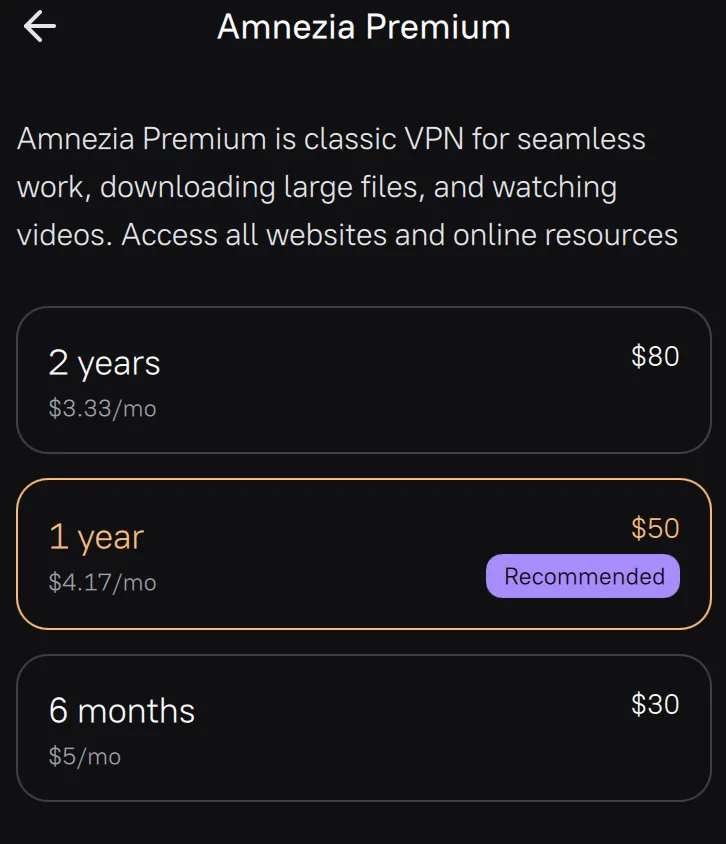
Plans bought on the website don’t renew automatically. Amnezia emails you three days before the end, and renewing through the website or support gets you 20% off. That is unusual in an industry where the second year usually costs more than the first.
Over four years, the 2-year plan plus one renewal at 20% off comes to $151.20, or $3.15 a month ($3.50 if you renew without the discount).
In the iPhone and Android apps you can also buy Premium through the App Store or Google Play. Those subscriptions renew automatically and don’t get the renewal discount.
Refunds: 14 days for website purchases, no questions asked, paid back the same way you paid, minus payment or network fees. App store purchases follow Apple’s or Google’s refund rules.
Switching offer: If you already pay for another VPN, for longer than a month, Amnezia sells 6 months of Premium at half price ($16) against a receipt or other proof, through its Telegram bot or a form.
Free options: Amnezia Free costs nothing, and the AmneziaVPN app is free if you run your own server (you pay the hosting company). Amnezia’s Telegram bot also has a button for a free 7-day Premium trial.
At $3.50 a month for two years, Premium costs about the same as Proton VPN’s VPN Plus. Over the long run, counting the first plan and renewals over at least three years, it works out cheaper than ExpressVPN, NordVPN, Surfshark or Proton VPN, and dearer than PIA or CyberGhost.
Why 9 out of 10
Over four years, Premium costs $3.15 a month with the renewal discount and $3.50 without it, both under the $4 a month at which I start taking points off. Half a point goes for the 7 devices, as with CyberGhost, since most big VPNs allow 10 or more. Another half goes for the 14-day refund window, as with Mullvad; the others give 30 days or more. Plans that don’t renew on their own are nice to have, but I don’t add points for them.
 Speed
9.5
I tested Amnezia Premium in the AmneziaVPN Mac app on the evening of 24 November 2026, with the same setup I used for ExpressVPN, NordVPN, Surfshark, PIA, CyberGhost, Proton VPN and Mullvad: a 2021 MacBook Pro (M1 Max) on 5 GHz Wi-Fi, and a home line sold as 850 Mbps down and 500 Mbps up. Each result is the median of three Speedtest.net runs. My speed without the VPN is the median of six runs, three before the VPN tests and three after them.
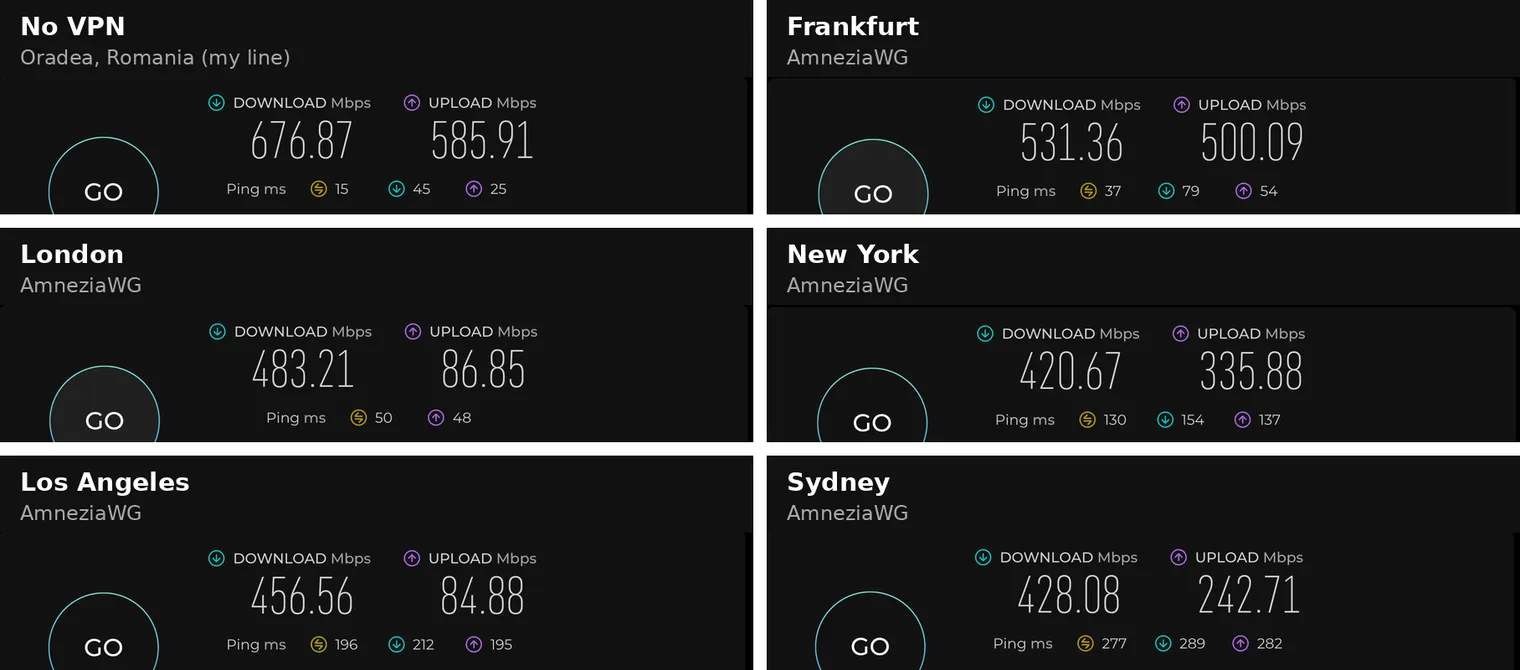
Amnezia still sells Premium as “up to 200 Mbps”, on its website, in its FAQ and in the app. Whatever cap that was, I didn’t run into it. Every location went more than twice as fast, from 421 Mbps in New York to 531 Mbps in Frankfurt, or 63–79% of my line.
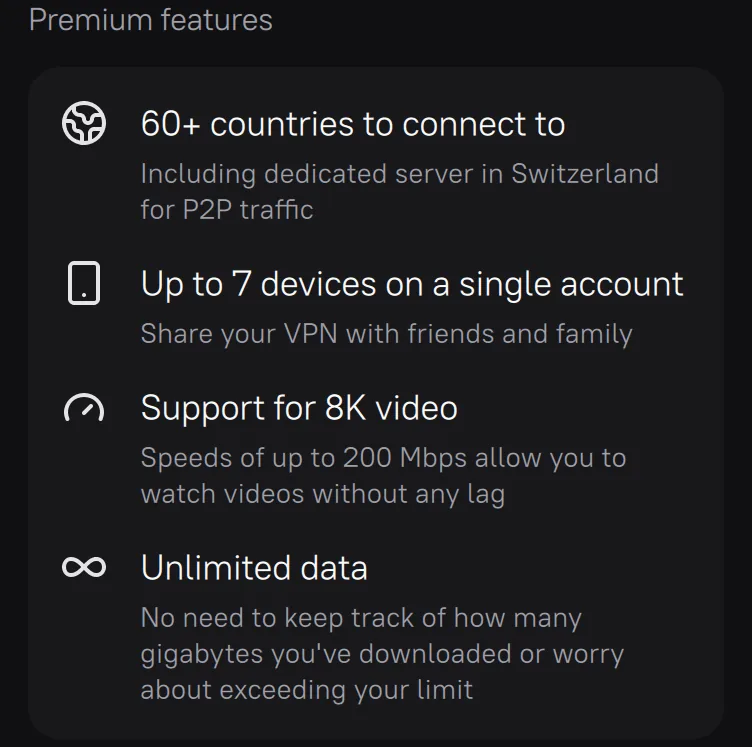
Distance cost surprisingly little. Sydney kept 64% of my download speed, about as much as New York, and its ping of 277 ms is in line with the other VPNs I tested. The nearest server, Frankfurt, kept 79%, less than the 85–105% most VPNs I’ve re-tested managed there.
Uploads were uneven. Frankfurt kept 88% of my upload speed and New York 66%, but Los Angeles dropped to 25% and London to 17%. Even 17% of my line is 88 Mbps, plenty for video calls, but backing up big files through London would take a while.
Protocols
The app has two protocols, AmneziaWG (the default) and VLESS, and you switch between them on the main screen, right under the location. In Frankfurt, VLESS kept 62% of my download speed and 68% of my upload speed, against 79% and 88% for AmneziaWG on the same server. Both held their connection through every run.

Amnezia’s advice is to stay on AmneziaWG and switch to VLESS when a network blocks it. My numbers give no reason to do otherwise.
Amnezia Free is capped at 8 Mbps, and on a self-hosted server, speed depends on the server you rent.
Why 9.5 out of 10
Downloads kept 63–79% of my line at every location, more than twice the 200 Mbps Amnezia advertises, with no weak server and a normal ping to Sydney. VLESS, the second protocol, also stayed well above half of my line. Half a point goes for uploads, which fell to 25% in Los Angeles and 17% in London; ExpressVPN, NordVPN, Surfshark and Proton VPN lost the same half point for slow uploads on some servers, and CyberGhost, slow everywhere, lost a full point. Downloads were lower than with most VPNs I’ve re-tested, but the nearest server kept 79%, so the half point Proton VPN lost for staying under 60% even nearby doesn’t apply.
 Locations
8.5
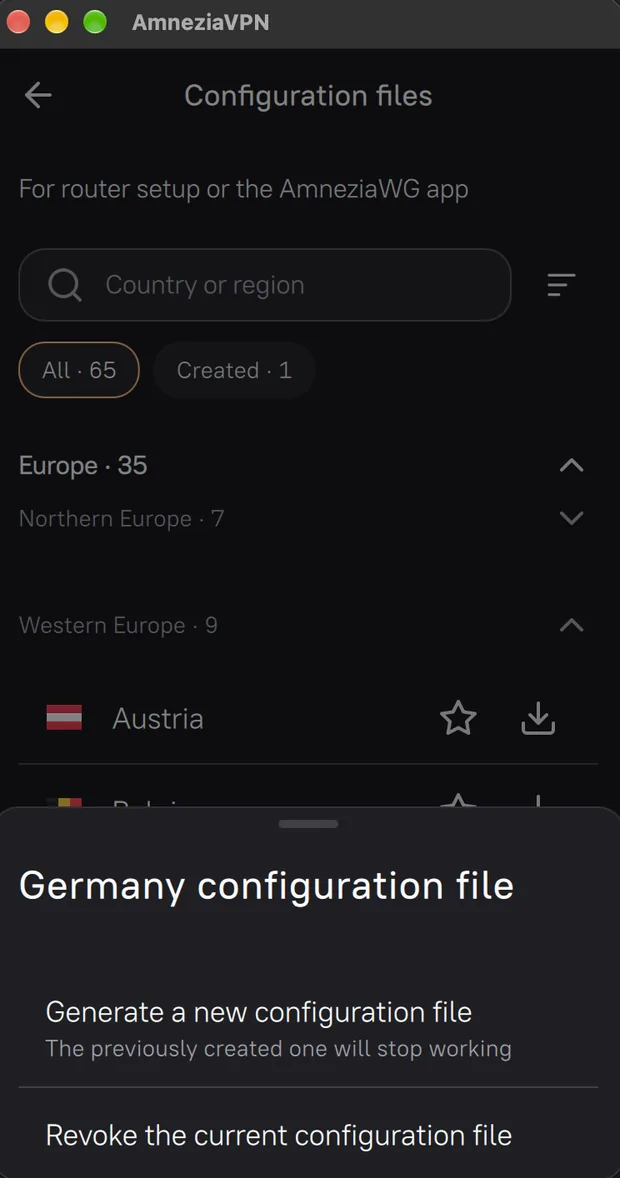
When I tested, the app listed 65 locations. Amnezia’s FAQ lists 61 in 60 countries (the US has two, New York and Los Angeles), and its website still says “50+”. The list includes Russia, Kazakhstan, Turkey and the “Greenland” location for whitelist-only mobile networks. Some may be missing from the app for a while when they are blocked.
Whether every location is where it says is less clear. Amnezia’s FAQ now says its servers are physically in the locations you choose, and suggests checking on IPinfo.io. Its homepage, though, still advertises “50+ countries for changing virtual location”, and Tom’s Guide found in spring 2026 that the US East and Canada servers were in Amsterdam.
Amnezia says Russian websites and apps should open on any of its locations except Switzerland.
Streaming
Netflix played on the first try in every country I tried: Germany, France, the UK, Canada, the US (New York) and Australia, all over AmneziaWG on ordinary locations, with no buffering. After five out of five I added a sixth country, because I hadn’t expected that. It worked too.
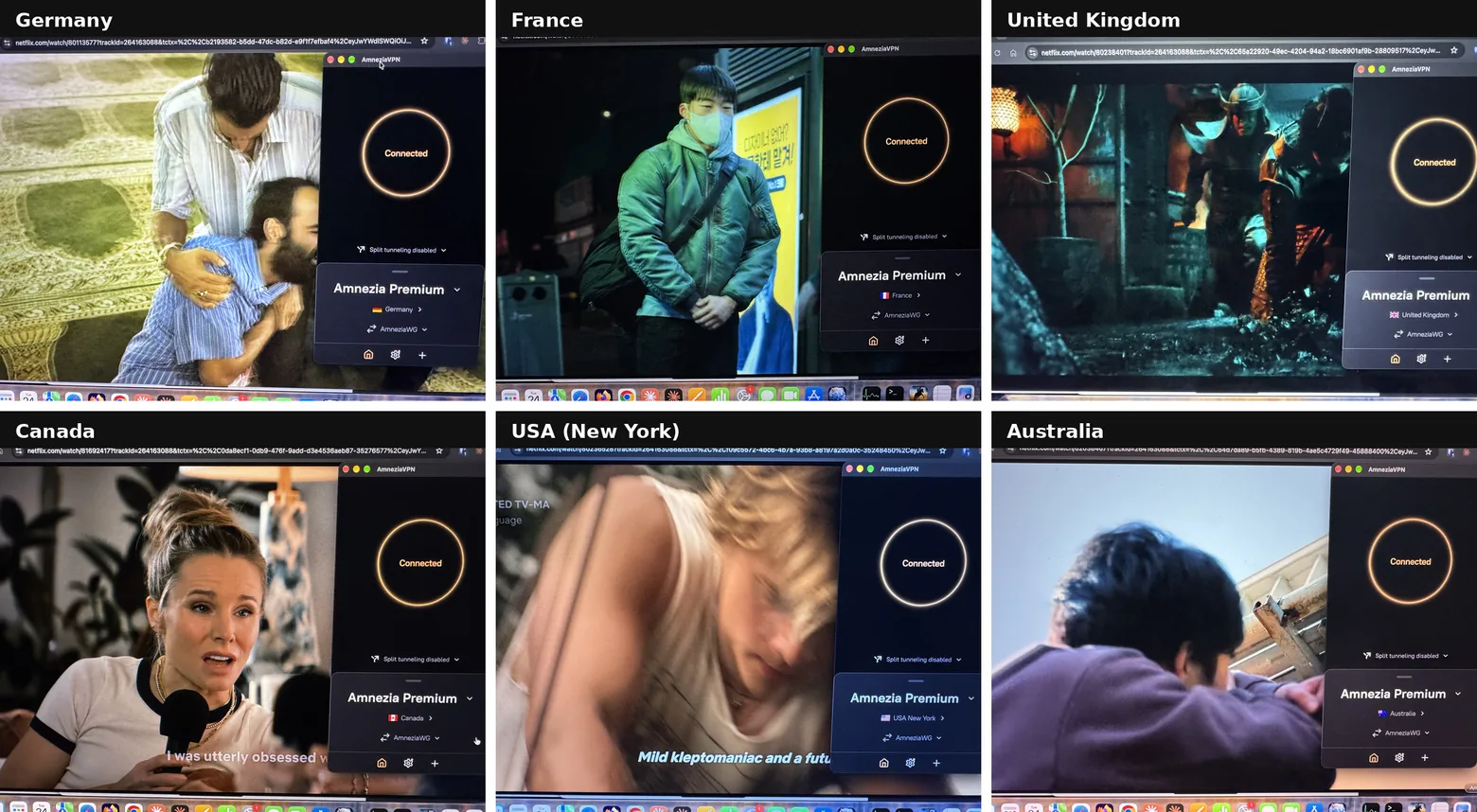
Other reviewers had mixed results earlier in 2026. TechRadar got US Netflix, BBC iPlayer and Australia’s 9Now working at the first try, while Tom’s Guide found BBC iPlayer detected the VPN even on a UK server. I tested Netflix only.
Torrenting
Allowed, but only on the Switzerland location.
Amnezia Free picks the location for you, and a self-hosted server sits wherever you rented it.
Why 8.5 out of 10
About 60 countries cost a point and a half, as Mullvad’s 50 did, since VPNs with 100 or more let you appear in far more places. Netflix played on the first try in all six countries I tried, so streaming costs nothing; without it, the score would also be 8.5. Tom’s Guide’s spring finding about servers in Amsterdam costs nothing either, because the scale counts the countries where you get an address, physical or virtual.
 Ease of Use
9.0
The AmneziaVPN app runs on Windows 10 (version 1809 or later) and 11, macOS 14 or later, Linux, Android 9 or later including Android TV, and iOS 16 or later. Amnezia lists no app for Apple TV or Fire TV. Premium and self-hosted servers also work on Keenetic and OpenWrt routers through AmneziaWG: you create a configuration file for a location in the app and load it into the router. The Android 7–8 version is unavailable for now, but the separate AmneziaWG app still runs there.
The Mac app
The Mac app is sleek and minimal, and cleaner than most VPN apps I’ve used. The main window is a big Connect button with the location and the protocol under it, plus three icons at the bottom: home, settings and add a connection. There are no side menus. I liked them in some of the other apps I’ve re-tested, but here I didn’t miss them, because everything I looked for was one or two clicks from the main window. It looks nothing like ExpressVPN’s or NordVPN’s apps, but I’d put its design on the same level.
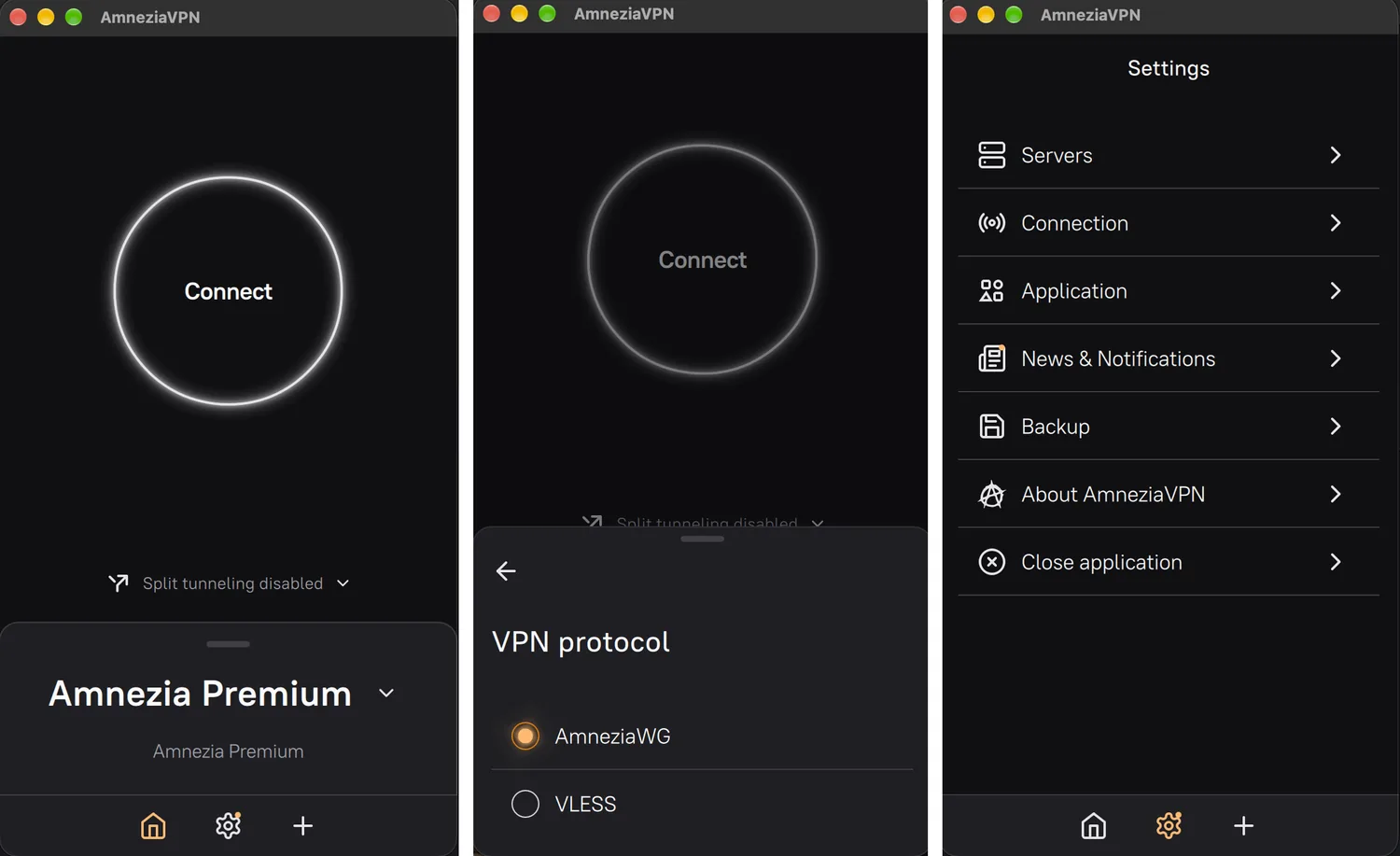
Free and Premium connect with one button. Self-hosting needs a rented server (VPS) and its login details. The app does the rest, but you still have to pick a host and keep the server paid.
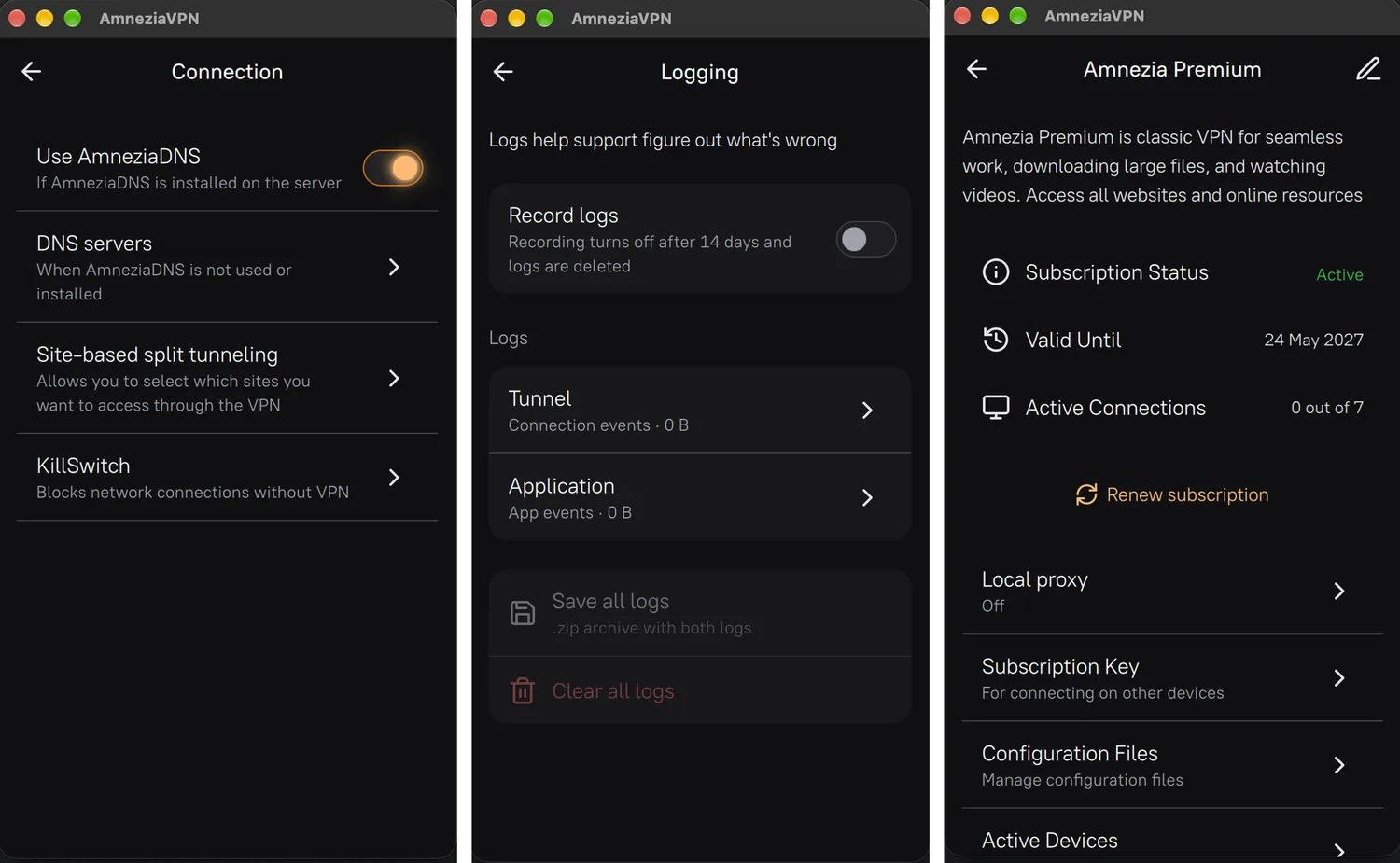
The kill switch and split tunnelling (by website in the Mac app) sit under Settings → Connection, next to the DNS settings. Logging is off by default. If you turn it on for support, it switches itself off after 14 days and the logs are deleted.
Getting the app in Russia
Apple removed AmneziaVPN from the Russian App Store on 31 October 2024 at Roskomnadzor’s request, and amnezia.org is blocked in Russia. Amnezia keeps a mirror of its site on Google Cloud Storage and its documentation explains how to install the iPhone app with an Apple account from another country. Premium users can use DefaultVPN instead, a simpler client that is still in the Russian App Store.
If you are travelling to Russia, install and set it up before you leave.
Why 9 out of 10
Apps for Windows, Mac, Linux, Android, Android TV and iPhone, and a Mac app where everything is one or two clicks away. Half a point goes for TVs, since there’s no app for Apple TV or Fire TV; Mullvad and CyberGhost lost the same. Another half goes for routers, where you load configuration files by hand, as with every VPN I’ve re-tested. Not deducted: the app’s removal from Russia’s App Store, which was Apple’s doing at Roskomnadzor’s request, and the lack of a VPN browser extension, as with Mullvad.
 Support
8.5
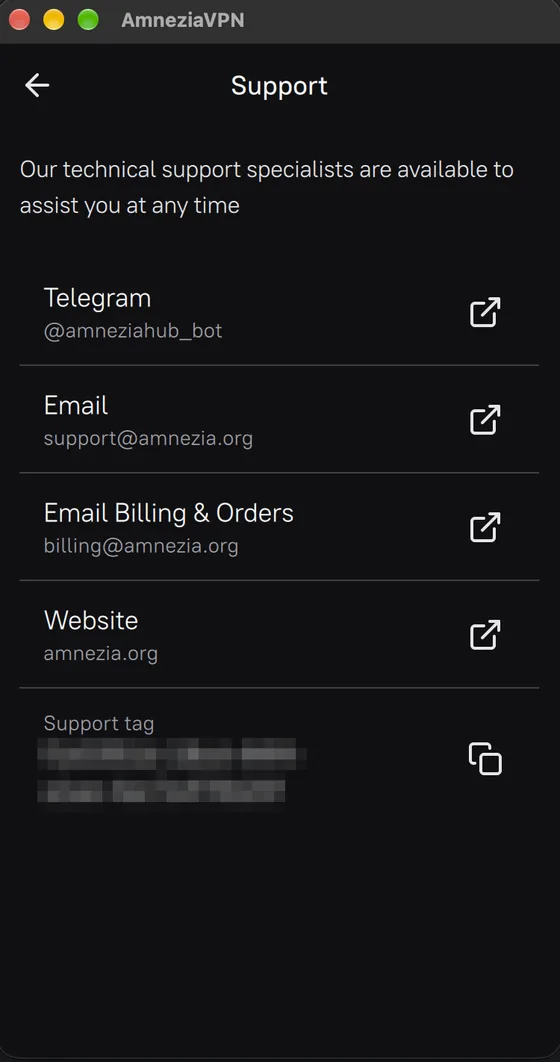
The app’s support page is two clicks from the main window. It lists a Telegram bot, email ([email protected]; [email protected] for payments and refunds) and the website. There is no live chat, in the app or on amnezia.org. Amnezia’s own comparison table describes its support as “24/7 via Telegram and email”.
My test
The Telegram bot greeted me in Russian, and typing /lang switched it to English. It isn’t a chatbot. You pick Support from a menu, write your question, and the bot opens a numbered request; the answer comes back in the same chat. On 24 November 2026 at 18:57 Bucharest time, I asked whether Amnezia works reliably in Russia.
A person answered 23 minutes later. That’s slower than the live chats of the big VPNs, where someone replied within minutes, but acceptable, and it puts the bot somewhere between a ticket system and a live chat. The answer, though, ignored my question. It offered me a 7-day trial key to test Premium before buying, and asked for my email address. I had already paid, told them so and asked again.
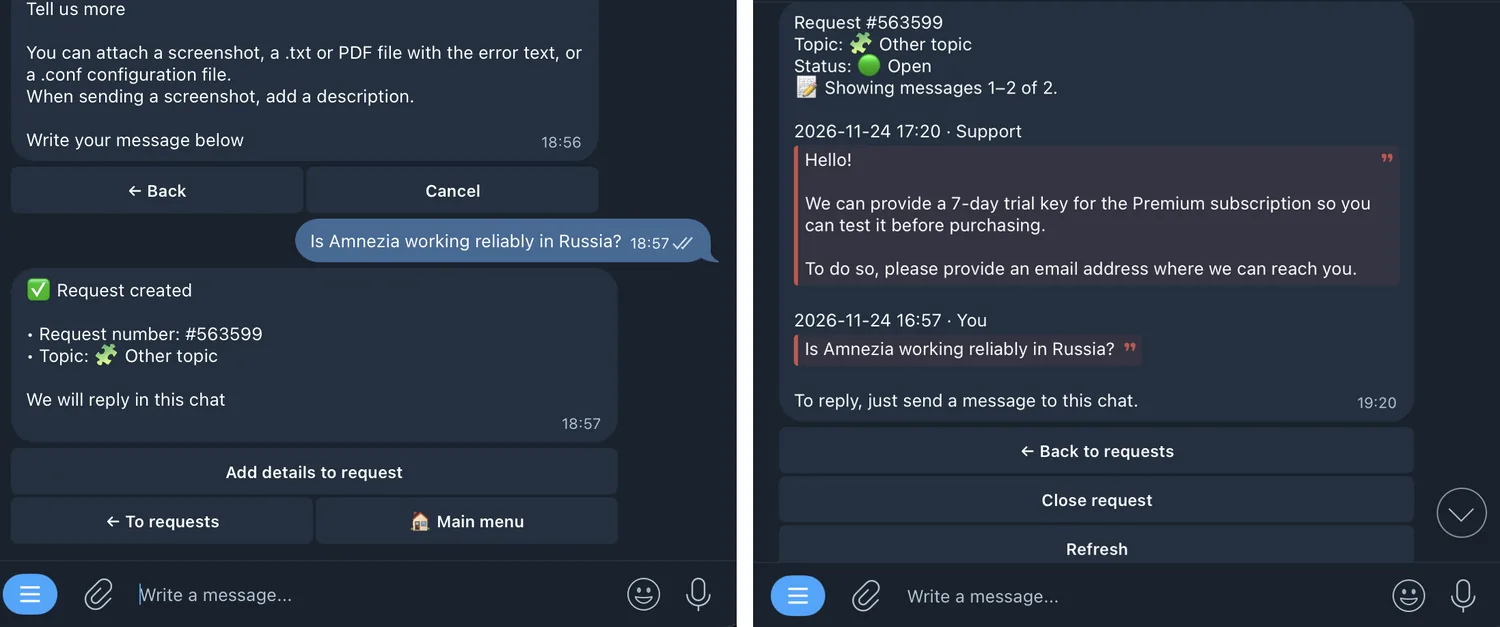
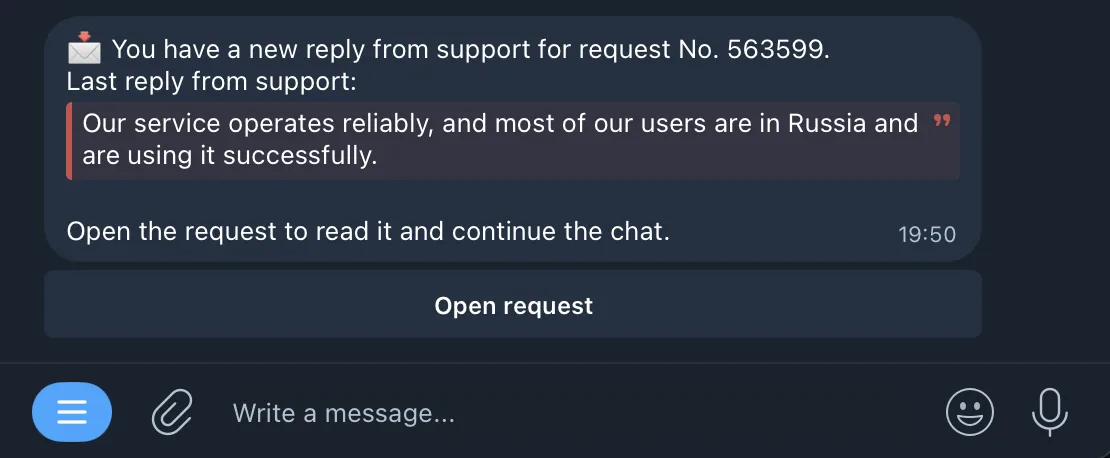
The second reply came 22 minutes later, and this time it was a plain yes: the service works reliably, and most of Amnezia’s users are in Russia and use it successfully. That’s more confident than NordVPN, Surfshark, PIA, CyberGhost and Proton VPN, which all told me they couldn’t guarantee it. It also leaves out June, when most of Amnezia’s Russian servers were blocked for weeks.
The documentation is detailed and practical, with troubleshooting pages for blocked connections, missing locations and app store problems. Since amnezia.org is blocked in Russia, many links come with a mirror.
Why 8.5 out of 10
Support is easy to reach from the app, and both replies came within 25 minutes, well under the two hours I allow before taking anything off. One point goes because there is no live chat: the Telegram bot works like a ticket system, even if a quick one, and the rest is email. Half a point goes because the first reply ignored my question and offered a paying customer a trial; I only got an answer after asking again. NordVPN lost the same half point for a canned reply that didn’t answer the question.
 Privacy
9.0
Who runs Amnezia
The idea came from Demhack, a 2020 hackathon run by RosKomSvoboda, a Russian digital-rights group, and the project then grew in the Privacy Accelerator programme. Who runs it today is harder to pin down. The website footer names Euphoriatech Limited in Nicosia, Cyprus. The privacy policy names ANARCHY LAB S.R.L. in Bucharest, Romania, as the data controller. On Google Play the developer is Amnezia Unipessoal Lda in Portugal, and on the App Store the seller is Privacy Technologies OU.
Spreading a business over several companies is legal and common. It still makes “who answers for my data?” harder to answer than it should be. The policy’s answer is the Romanian company, which says it only follows legal requests that are consistent with Romanian and EU law. The founder, Mazay Banzaev, speaks for Amnezia in the press under his own name.
What Amnezia logs
The policy, in force since 13 October 2026, rules out logs of browsing, visited sites, traffic destinations and content. For Free and Premium it collects the app version, the operating system and a device ID the app creates, plus your email when you pay and your Telegram ID if you use its bot. It processes the IP address you connect from. For connections “from locations where additional technical measures are required”, that IP address “may also be retained” and used against abuse. The policy doesn’t say which locations or for how long.
Amnezia’s About page says it does “not collect or store any data, including logs or analytics”. Its own privacy policy describes more than that. The policy is the document that counts.
Audits and code
The apps and server code are open source under the GPL-3.0 licence on GitHub. 7ASecurity has audited them three times, in 2022, 2024 and from December 2024 to January 2025. The last audit covered the whole system and found two critical flaws: imported OpenVPN files could run code with administrator rights, and any paying subscriber could reach the Premium service’s admin functions. Both were fixed and confirmed on retest.
The Premium page still says the audits found “no critical issues”. They did, and Amnezia fixed them, which is the better story anyway.
No audit has checked the no-logs claim or the Premium servers themselves, and there is no transparency report. Amnezia says its servers run from memory only (RAM).
My leak test
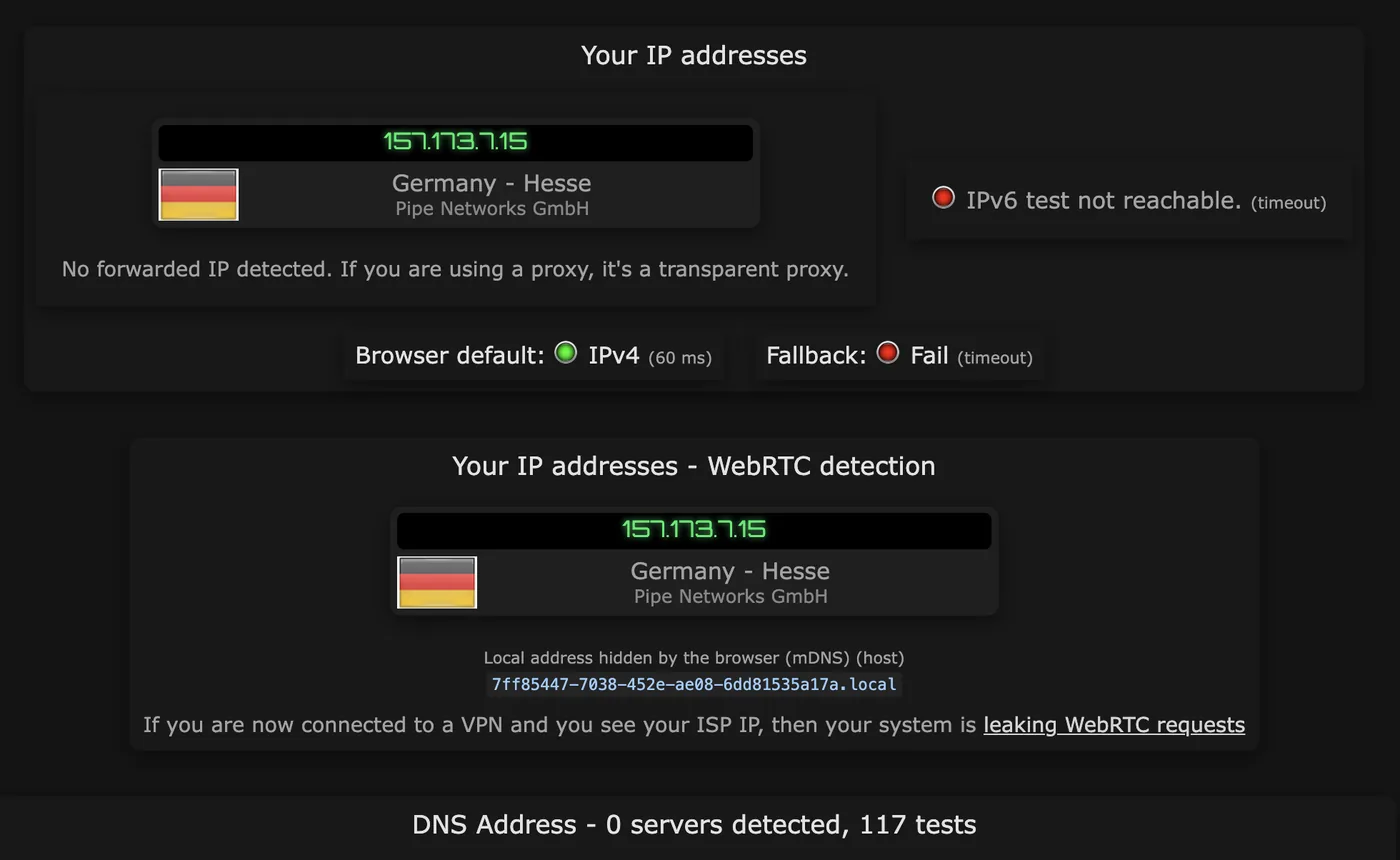
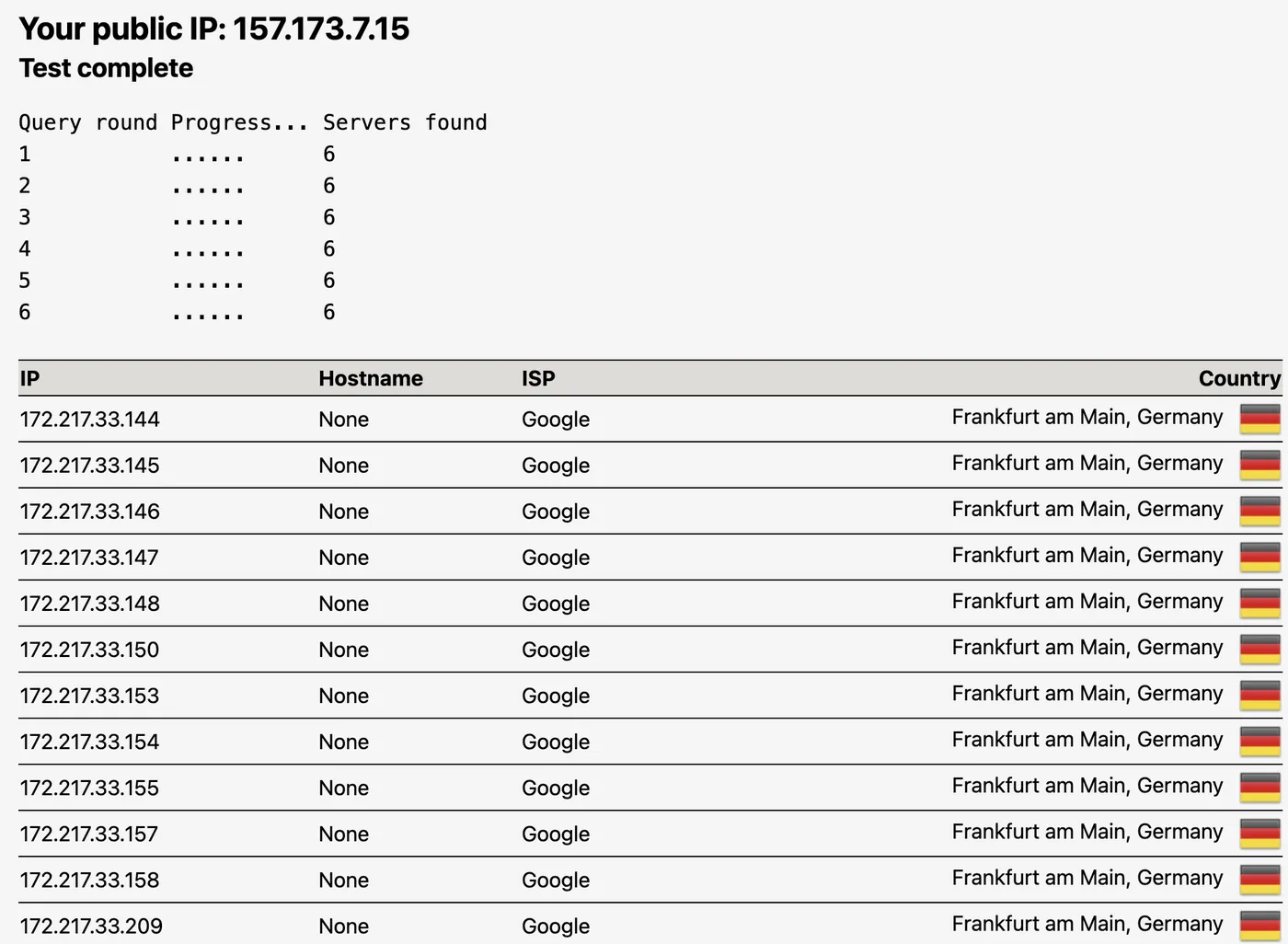
With AmneziaWG connected to Frankfurt, ipleak.net showed only Amnezia’s address, in the IPv4 and the WebRTC checks, and its IPv6 test couldn’t reach me at all. On dnsleaktest.com, the DNS servers that answered were Google’s public ones in Frankfurt, not my internet provider’s. That’s no leak, since Google sees the requests coming from Amnezia’s server, not from you. If you’d rather not use Google, the app lets you set other DNS servers under Settings → Connection.
Self-hosting
Your own server means no VPN company sees your traffic. The hosting company still knows who rented the server, and a server only you use makes your traffic easier to tie to you than a shared one. Self-hosting is for getting past censorship and keeping a VPN company out of the loop, not for anonymity.
Why 9 out of 10
On the technology, Amnezia does well: open-source apps and server code, three security audits by 7ASecurity, logging off by default in the app and a clean leak test on my Mac. Half a point goes because no audit has ever checked its no-logs claim or its servers; Mullvad lost the same for an audit more than two years old. Another half goes for the privacy policy, which lets Amnezia keep the IP address you connect from “from locations where additional technical measures are required”, without saying where or for how long, while its About page says it collects no data at all. Not deducted: the four company names, which are legal and come with a named data controller in Romania; the missing transparency report; and Google’s DNS servers.
Amnezia VPN alternatives
On our Russian-language pages we recommend Amnezia, with Proton VPN as the fallback if it doesn’t connect. Proton’s Stealth protocol wraps WireGuard in the encryption websites use, and it is on every plan, including the free one. Proton says Stealth works in Russia but that it can take several tries on some days. Amnezia’s founder has called Proton, NordVPN and ExpressVPN “effectively non-functional” there (both in TechRadar). Proton, a Swiss company with five public no-logs audits, is the stronger choice on privacy.
Windscribe added AmneziaWG to its apps in 2026, so you get Amnezia’s protocol with a different company behind it. Mullvad has its own anti-censorship settings and doesn’t even ask for an email (you get an account number), but it says Russia blocks most of its servers.
Our guide to VPN obfuscation compares how nine VPNs disguise their traffic.
FAQ
Is Amnezia VPN Russian?
It started at a 2020 hackathon run by a Russian digital-rights group, and Amnezia says Amnezia Free alone has more than a million active users in Russia. The companies named in its paperwork are registered in Romania, Cyprus and Portugal, with the Romanian one as the data controller. It runs physical servers in Russia and Kazakhstan, among others.
Is Amnezia VPN free?
Partly. The app is free, Amnezia Free is free (blocked sites only, up to 8 Mbps, no YouTube) and self-hosting is free apart from the server you rent. Premium costs $32 to $84 depending on the plan.
Is Amnezia Premium capped at 200 Mbps?
Amnezia says Premium reaches up to 200 Mbps. In my tests on 24 November 2026, every location I tried went past 400 Mbps, with Frankfurt at 531 Mbps.
Does Amnezia VPN work with Netflix?
In my tests, yes. Netflix played on the first try in Germany, France, the UK, Canada, the US and Australia in November 2026. Streaming services block VPN addresses from time to time, so that can change.
Does Amnezia VPN keep logs?
It says it keeps no activity logs, and its policy rules out browsing history and traffic content. It does collect a device ID, app version and OS, and it may keep your connection IP address in some locations. No audit has checked its no-logs claim.
Does Amnezia VPN work with mobile whitelists in Russia?
Ordinary disguises don’t, because only approved services open. Amnezia says its Premium “Greenland” location is made for whitelist-only networks but hasn’t explained how it works.
Is Amnezia better than Proton VPN in Russia?
Both say their service works there, and both have been blocked at times. Amnezia is built only for this, while Proton is the more trustworthy company on privacy. Having both installed before you need them is the safest bet.
Conclusion
If you live under a censor that blocks VPNs, Amnezia belongs on your shortlist, and in Russia near the top of it. It is open source, it was built for this fight, and when Roskomnadzor knocked it out in June it came back within weeks with a new protocol.
For everyone else it turned out better than I expected: fast downloads on every server, Netflix in every country I tried and a clean, minimal app where nothing is more than two clicks away. What holds it back is trust (an unaudited no-logs claim, an IP clause in its privacy policy, four company names) and support that, in my test, needed a second try to answer a simple question. Install it before you need it, and keep a second option on the phone. Censors don’t send a warning first.